News
The desire to know the future


- /home/u249204778/domains/spectator.com.gh/public_html/wp-content/plugins/mvp-social-buttons/mvp-social-buttons.php on line 27
https://spectator.com.gh/wp-content/uploads/2022/02/Future-Pixx.jpg&description=The desire to know the future', 'pinterestShare', 'width=750,height=350'); return false;" title="Pin This Post">
- Share
- Tweet /home/u249204778/domains/spectator.com.gh/public_html/wp-content/plugins/mvp-social-buttons/mvp-social-buttons.php on line 72
https://spectator.com.gh/wp-content/uploads/2022/02/Future-Pixx.jpg&description=The desire to know the future', 'pinterestShare', 'width=750,height=350'); return false;" title="Pin This Post">
One of the most common complaints of mankind is that we know so little about the future. To most of us the future is closed, except as it may be predicted in general terms by the experience of the past, and except as it has been broadly outlined in scripture. But so anxious are some to pry into the secrets of specific things to come in their own lives, that they will go to great lengths to consult almost anyone within reach who professes powers beyond the perception of ordinary men. Before Saul ever consulted the Witch of Endor, and perhaps until the last scene of time shall have been enacted, men have tried and will continue to try to wrest from the great unknown, some inkling of what is yet to transpire.

Accordingly, the soothsayer, the fortune teller, the clairvoyant, the crystal-gazer, the reader of the tea-cup, the diviner of cards, have all sold information they do not know; or, if they have such information the source of it will not bear scrutiny. It is true that the scriptures testify: “Surely the Lord God will do nothing but he revealeth his secret unto his servants the prophets.” (Amos 3:7) and it is also true that down through the centuries divinely appointed prophets of the living God have been privileged by the Almighty to foresee events that were yet to transpire, but these prophetic utterances have been proclaimed and recorded by men of God for the knowledge and comfort and warning of all the children of our Father, and have not been sold for silver, nor bartered for gold.
It is natural that men should desire to know something of what lies before them, but if it were good that each of us should have specific fore-knowledge of events to come in our lives, the wisdom of an all knowing Creator would have made such prescience possible, without our resorting to dark places among those who, for a price, conjure up specters and mumble incantations.
In some respects, and to some extent the future may and should be known, For example, science helps us to forecast something as to the future of weather conditions, which is of much value to all of us. To know something concerning the future of private wants and needs, helps the manufacturer and the merchant to avoid some of the hazards of chance, and to this end we have our business forecasts.
The broad lines of the future, so far as the plan and purpose of life are concerned, as well as specific forthcoming events, have often been foretold by the prophets, when the purposes of God were served thereby. But the desire to know the future may become an inordinate desire—so much so that there are some who feel they cannot rest unless they can know the unknowable and see the unseeable, and who, to this end, place their confidence in those who profess, for a price, to tell what irrevocable events the fates have decreed, as revealed in the stars, the tea leaves, in the cutting of the cards, in the crystal, or by some other occult means.
In this twenty-first century we have sometimes given ourselves to believe that we have left witchcraft and mummery and superstition behind, and then we cling to much of it. In the wisdom of God it has not been given to us to pry the lid off the future at our indiscriminate discretion. It has been so ordered that in many things we shall live by faith, and meet the events of life as they come. If the stars were fixed and the pattern of our lives were fixed with them; if the future were already set in its mold, then the next logical conclusion would be that it doesn’t matter how we live or what we do with our livesthe result would be the same anyway. But such philosophy is false and untenable.
If a man cannot be happy and live well with such knowledge as God has chosen to reveal concerning things to come, it would be left to conclude that, among other things, such a man lacks understanding, and also faith, which is a fundamental element in an acceptable life.
By Samuel Enos Eghan


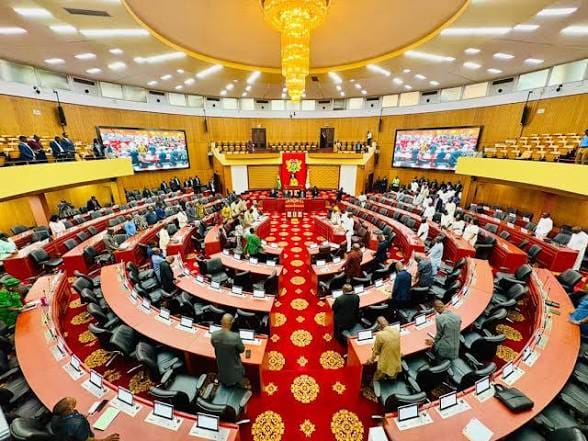
Parliament has clarified public commentary on social media regarding a notice on its notice board that read “No Vacancy for National Service Personnel 2026/2027. Kindly go for reposting.”
In a statement, signed by the Director of Media Relations, David Sebastian Damoah, Parliament said the notice has been misconstrued and was not a policy statement, a freeze on national service placements, or a change in its support for the National Service Scheme.
According to Parliament, the notice was a routine administrative message to prospective personnel who reported to the House, informing them that it has received more personnel than it can accommodate for the 2026/2027 service year and that they should seek reposting to other institutions.
It said it remains committed to the National Service Scheme and values the contribution of service personnel to its work, and regrets any confusion or inconvenience the wording may have caused.
By Edem Mensah-Tsotorme

Ghanaian public advocate Hopeson Yaovi Adorye has been elected to the Board of Directors of the World Taxpayers Association (WTA).
The election took place on Sunday, October 5, 2026, during the Association’s conference in Kraków, Poland.
His election marks a significant addition to his international leadership portfolio and provides a platform for Ghanaian and African perspectives to contribute to global discussions on taxpayer rights, responsible taxation, transparency and prudent management of public resources.
Reacting to his election, Mr. Adorye expressed appreciation to the leadership and members of the WTA for the confidence reposed in him.
“I am deeply honoured by this confidence and conscious of the responsibility that comes with it. Taxpayers are at the heart of every economy, and they deserve fairness, transparency, accountability and value for the taxes they pay. I look forward to working with colleagues from across the world to strengthen the voice of taxpayers and promote responsible fiscal governance,” he said.
According to him, taxation should not be viewed solely as a mechanism for raising government revenue, but also as an important component of the social contract between citizens and the state.
Mr. Adorye said governments have a responsibility to ensure taxes are collected fairly and public resources are utilised efficiently to deliver quality infrastructure, healthcare, education, security and other essential services.
His election also creates an opportunity to bring African experiences into international conversations on taxation and public expenditure.
Mr. Adorye, who is Executive Director of Taxpayers League Ghana, has previously served as Global Board Chairman of the International Youth Network for UN Security Council Resolution 2250, an NGO associated with the United Nations Economic and Social Council (ECOSOC).
He is expected to use his new role to champion fiscal accountability, taxpayer education, good governance and stronger citizen participation in public financial management.