Features
Taking a cue from a country where modesty and simplicity are its hallmark in governance

Modesty, is a God-given principle that helps a person or an institution to keep safely on the convenient path as the person or the body makes strides in the presence of the Almighty God. Modesty in actual sense, thought and behaviour, will help prepare mankind to make a sacred temple covenant. Similarly, simplicity in its true meaning, connotes uncomplicated, simple and elaborate method that can be understood, apply or done easily for the purposes of progress and development.
Being modest and simple begin with how one sees himself or herself and the place in the world. By being aware of your own strengths and weaknesses, you can avoid pitfalls of arrogance and start life more modestly. Just try to see yourself the way others see you by asking your closest friends how to perceive you. In effect, modesty and virtue, are qualities that are universally recognised as essential for the proper development and success of individuals and nations. It is important to impact in the youth these values so that they grow up into responsible and productive members of their communities and the nation in general.
POSITIVE ATTRIBUTES OF MODESTY AND SIMPLICITY
Some of the attributes of modesty include simplicity in the way of doing things, living within ones means not spending more than what comes in, be content with what you have and thinking about the long- term rather the short-term. It is said that a person is modest when he or she is considerate and does not boast or brag, so it is to developing nations across the world. The watchword is “Cutting your coat according to your cloth”.
I have decided to take my readers to the realms of theory just to prepare their minds to appreciate the importance of modesty and simplicity in our everyday lives and how they reflect on governance in countries that are well developed so that those of us in the developing world can learn and apply them for our own good and progress.
VIDEO ON SWEDEN AND THEIR WAY OF LIFE
Just recently, a cousin of mine domiciled in the United States of America who has been feeding me with educative materials including video clips across the world to educate, inform and entertain me of happenings across the globe, sent me one of his interesting videos about Sweden which since time immemorial, has adopted modesty and simplicity as their way of life which are working perfectly for them as a nation.
The video is about how this Scandinavian nation with thousands of coastal inland and inland lakes, with vast boreal forest and glaciated mountains, are running their august parliament as well as effective governance in a more matured, modest and simple way that have inured to their progress and advancement. Even though this country with a total population of a little over 10.35 million as of 2020 is fairly rich and industrious, it has been able to put in place certain mechanisms to cut down cost of public spending in order to rake in more funds to meet its developmental goals and that is working perfectly and effectively for them.
SHORT HISTORY ABOUT SWEDEN
To get a true picture of Sweden since I have never been to that country in my lifetime, I have done a little research about that country just to educate and carry my readers some of whom are just like me along to have a feel of that country. As I stated earlier, Sweden is a Scandinavian nation with its eastern capital located in Stockholm which is built on 14 islands. It has more than 50 bridges as well as medieval old town, Gamla Stan, royal palaces and museums. Although the country is relatively wealthy, 16.2 per cent of its people are at risk of falling into the poverty bracket. Even though English is one of the most commonly spoken languages in the world, it will be of interest to know that while about 80 per cent of the people understand English perfectly, they hardly speak the language, except their mother tongue, Swedes.
The vast majority of enterprises are privately owned. We are told that the country’s economic success is due to stable economic and political institutions which allow the people to focus on producing wealth. Swedish society is based on equality and individualism and the people are proud of their nation and its accomplishments which they termed Lagom, which means “Not too much, not too little…just right” a word often used and heard in Sweden. The country has a profound respect for integrity.
MODESTY AND SIMPLICITY IN SWEDISH PARLIAMENT
Having given the geographical location of Sweden, I will now go back to the video clip to show how modest and simple their parliament is being run to cut cost. The five minutes’ video titled, “The country where Members of Parliament don’t get free coffee, talks about drastic reduction of the way of life of the MPs as far as their living conditions are concerned. It talks about the whole parliament having three cars which are used for official work. Besides, MPs are expected to use public transportation during sitting hours. We are being told in that video that until 1957, the MPs were not being paid for their jobs and could not raise their own salaries. Apartments are provided to MPs from outside Stockholm which is one room apartment. Visitors are not allowed to stay overnight and if any of the MPs wants to bring a visitor to his or her apartment to stay overnight, the MP must pay for it. Any trip abroad by MPs must cost a maximum of 85 per cent of his or her salary. If an MP rents a car, he or she must choose the shortest possible route. Swedish MPs have no secretaries or assistants and they have to plan their own schedules.
THE JUDICIARY AND POLITICIANS IN SWEDEN
Parliamentarians who have missed more than 60 per cent of their voting occasions must repay from their salaries. There are no lifetime pensions for former MPs. In the case of judiciary, the criminal justice system is well organised and judges have no right to official cars. There is no immunity from criminal prosecution of politicians. Regional politicians do not receive salaries because their work is considered public good as such is unpaid. Public Service in Sweden is neither prestigious nor lucrative. The video ended by explaining that all these rules and many others, are designed to make Sweden a functioning democracy.
AFRICANS MUST LEARN FROM SWEDISH EXPERIENCE
Seriously, what we need to ask ourselves as Africans is that, is it not relevant to adopt some of these rules in our institutions of governance to cut down wastage, cost and conserve foreign exchange and other meagre resources to advance economic progress on our continent? If a nation like Sweden which is fairly rich in resources and capital, is operating modestly and simple, why can’t we in Africa learn from their experience? Africa is suffering because our leaders are selfish in character and do not think about the interests of their peoples. The limited resources at their disposal are being plundered to satisfy their personal interests and that of their closest associates while their citizens continue to live in abject poverty and misery.
OUR OFFICE HOLDERS MUST SHOW LEADERSHIP BY EXAMPLE
Over here in Ghana, as we continue to battle with the current economic crises which have brought untold hardships to the people, there are quite a number of institutions of governance which are feeding fat on the people. Our institutions of governance are not being considerate with the citizens and continue to impose all kinds of taxes and levies to worsen the plight of Ghanaians while those in positions of authority continue to enjoy.
The Swedish example must inspire us including other African countries to adopt measures to cut down cost and protect the public purse.
Contact email/WhatsApp of author:
0277753946/0248933366
By Charles Neequaye


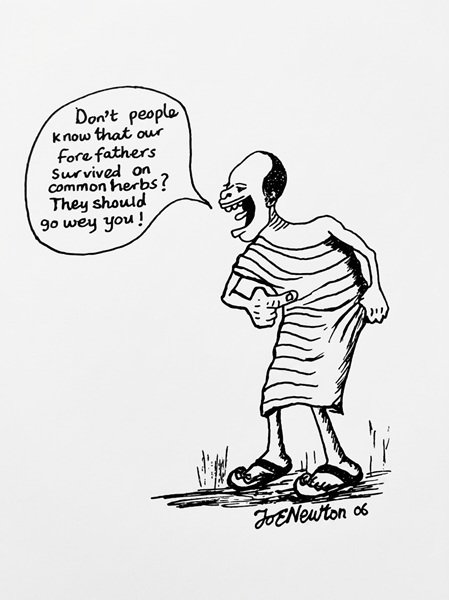
THE typical itinerant salesman in Sikaman is a herbalist. He is normally a slim macho with the capacity to perambulate the expanse of area covering the triangle of Accra-Tema-Ashiaman. In short, he can walk a total of 60 miles a day, marketing a product that cures every disease, including poverty. 
The door-to-door herbal pharmacist advertises his product by word of mouth. He has nothing to do with the Food and Drugs Board (FDB). After all, his concoctions do not feature on FM stations.
Those herbalists who cannot walk to propagate the herbal gospel, liaise with drivers of mass transportation and their mates. They are, therefore, given the chance to sell their products on Benz buses that ply the routes.
Normally, the herbalist starts his sales message with a prayer and Bible study. He asks the passengers to bow down their heads in supplication to God the father, the son, the Holy Spirit.
When a herbalist asks the passengers to close their eyes and bow their heads, Moslems on board naturally feel offended. They feel that the herbalist has no right to assume that every passenger is a Christian. They think such an assumption is an affront to Islam.
So a Moslem on board will raise the hand for a point of order. He’ll remind the herbalist that it would be in his own interest to mind his language.
“Be careful the way you address people in a public place. Not every person here is a Christian,” he’d state assertively.
Of course, the herbalist will promptly ignore him, but would all the same “watch” his tongue. Who knows whether or not the Moslem brother is inspired by Quoranic zeal to defend the tenets of Islam to the hilt?
When he starts saying, “Wallahi!” and “Inshallah!” it could be the beginning of proclaiming Islam as supreme, a point which must be driven home with talibanic precision.
So the herbalist must tread carefully lest he steps on fire.
The herbalist could even add a measure of mirth to it all, by announcing that Christians on board today have very interesting company on the journey, but that should not detract from the business of the day.
The Moslem brother will weigh the words carefully and offer a wry smile.
He must be careful the occasion does not degenerate into the use of semantics and proverbial oration to deride his conviction that public utterances must be mindful of religious sensibilities. He has made his point very clear and expects that it is taken in good faith in the interest of a peaceful journey.
The herbalist will now open the New Testament and preach salvation, stating clearly that salvation can come only through Jesus Christ and NOBODY else.
The Moslem brother will now start twitching his moustache. The visible and almost revolutionary reflexes of his upper lip can be an indication that sentiments have begun superseding reason, and the outcome could well be tragic now shift uneasily in his seat.
The time has come for him to also express his right to the religion of his fore-bears. He’ll put his hand into his pocket and rise to his feet. The time has indeed come!
This article was first published on Saturday, September 9, 2006
When the cause of a particular problem like sickness, disease, sudden illness, a social issue etc. are not known, it stands to reason that resolving it becomes a huge challenge.
Citizens would understand the government when public announcements are made to the effect that government is trying to find a solution to the issue, even though it is taking a while for it to be resolved because citizens are rational beings.
On the other hand, if the solution to a particular issue is known to everybody but the government for whatever reason, is dragging its feet in resolving it, citizens become frustrated and begin to lose trust in their leaders.
One such issue is the heavy traffic along a section of the Kasoa – Odokor road. A short stretch of bad road between the traffic light at the Weija Government Hospital and the entrance to the entrance of the overhead that leads to the N1, is the cause of the problem but nothing is being done about it, day after day, week after week, month after month. Thus is clearly unacceptable.
Another issue that requires urgent attention is the lack of pavements along a lot of streets in parts of the various Municipal Assemblies. Exercise is a prerequisite for long life and healthy living and for those of us who it has become a way of life, this issue of people putting up structures right to the edge of the drains beside the roads, are making life difficult for us.
We are compelled to walk along the roads, putting our lives at serious risk. Pedestrians should never be compelled to compete with vehicles on our streets and roads. Roads and streets are made for vehicles and pavements are made for pedestrians. That is the norm. Any attempt to normalise a situation where pedestrians are mingling with vehicles is insanity.
It is the road regulations that makes it so and therefore district or municipal assemblies are to take responsibility and ensure that spaces for pavements are not encroached upon. Citizens have rights that must be protected by their leaders and making pavements available to pedestrians, is one of them.
When we hear of teachers having sex with students, it appears it is something recent. It is not a new phenomenon. It has been there since Adam. Perhaps this issue is getting much attention due to the proliferation of social media. It was an open secret in times past when Teachers were in relationships with female students and some married them immediately after completion of school.
Some teachers were also known to be having unholy interactions with female pupils but due to the times that these acts occurred, human rights issues and the awareness around it, allowed such unscrupulous teachers to get away with their crimes.
Now we are in a different era and so a Headmaster is now in hot waters. He is alleged to have raped about 19 female students and as usual, some officials tried to cover it up and are also in hot waters and their actions or inactions in the matter are under investigation.
Why the man has been allowed to roam freely without being arrested is simply mind boggling. It appears that the law applies differently, depending on who you are. This issue came to public attention sometime in August this year, yet the police had not arrested or invited this man for question regarding the rape allegation.
It has come out that he is a Constituency Secretary of the ruling party and the question in the public domain is that, is it because he is a political figure that is why he is still walking around without questioning? I believe in the rule of law so let us hold our breadth and let the proper thing be done.
The police must however be seen to be active in this matter. God bless.
SKIP THE QUEUE, TAP THE NEWS
You can now read the Ghanaian Times and The Spectator newspapers from the comfort of your device via TimesNewsPlus.
Join our WhatsApp Channel: https://whatsapp.com/channel/0029VbBElzjInlqHhl1aTU27