News
Religious institutions urged to engage sign language interpreters

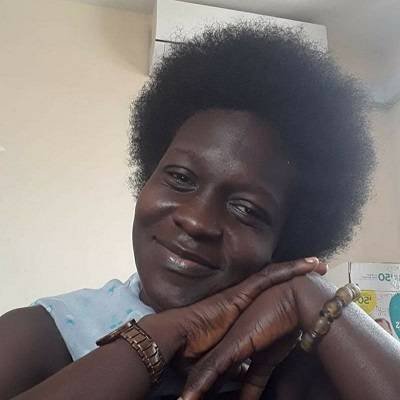
Ms Nukunu Akushika Deku, an Advocate for Persons who are Deaf
An advocate for the deaf, Ms. Nukunu Akushika Deku, has asked religious institutions to engage the services of sign language interpreters to make their meetings friendly for the hearing-impaired in society.
In an interview with The Specta¬tor on Tuesday, Ms. Deku, pointed out that the deaf have not been fairly treated in this regard and said it was about time every religious institution saw the need for inter¬preters to facilitate communication between the hearing community and the deaf.
The absence of the sign language interpret¬ers in the churches, mosques and religious institutions has for decades, restricted the deaf from joining their events, a situation Ms Deku found as discrimi¬natory.
“Clearly, this de¬feats the purpose for the establishment of these institutions whose messages are supposed to be propagated to all manner of persons, re¬gardless of their physical challenges,” she said.
The deaf, she said, “just like other physically chal¬lenged persons, suffer various forms of discrimination and injustice and to think that the church or the mosque and others which should be places for them to find solace have not addressed these concerns; it leaves much to be desired.”
She recalled as a child how she followed her grandmother to church and there was no sign language interpretation, making her uncom¬fortable because she could not hear to benefit in any way.
Ms. Deku said her grandmother explained that she did not want her to go to churches with interpreters for the deaf because she hoped to hear with time.
She said her ability to follow church proceedings was a huge relief to her and so she could appreciate the inconvenience religious institu¬tions which do not have sign lan¬guage interpreters were taking their members through.
She said if the churches and mosques assisted deaf persons to un¬derstand their sermon and activities, it would encourage more of them to patronise their activities and begin to enjoy that sense of belonging.
Ms. Deku said the current state of affairs made deaf persons feel excluded because every activity obviously was not planned with them in mind.
She questioned how they were supposed to understand readings, teachings, songs and announcements if there were no sign language inter¬pretation.
She said it was about time reli¬gious institutions prioritised the deaf like all other persons by train¬ing sign language interpreters to bridge the gap between the hearing and non-hearing.
She said when the deaf were offered the platform, they would be efficient to enhance growth wherev¬er they find themselves.
She bemoaned the development where decisions or major policies about them can be taken without consulting them and appealed to religious institutions to take the initiative to embrace the deaf com¬munity.
From Dzifa Tetteh Tay, Adjei Kojo


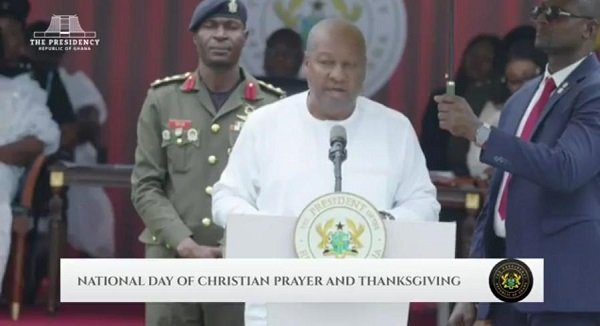
President John Dramani Mahama has called on Ghanaians to remain united, grateful and prayerful despite the recent floods that claimed lives and destroyed property in parts of Accra.
Speaking at the National Day of Prayer and Thanksgiving held at the forecourt of the State House in Accra, the President noted that the nation had gathered not because all its challenges had been solved, but to reflect, give thanks to God and renew its commitment to the country’s development.
He explained that throughout Ghana’s history, the nation had consistently turned to God during both difficult and successful times, describing faith as one of the country’s strongest pillars.
“We gather not as members of different political parties, ethnic groups or religions, but as one people under God,” President Mahama stated.
He encouraged Ghanaians to approach the occasion with grateful hearts, stressing that every blessing the country enjoys comes from God.
Reflecting on the recent floods that devastated parts of Accra, President Mahama acknowledged the pain of families who lost loved ones and property during the disaster.
Despite the tragedy, he urged citizens to draw strength from Scripture, quoting First Epistle to the Thessalonians Chapter 5, Verse 18, which encourages believers to give thanks in all circumstances.
The National Day of Prayer and Thanksgiving brought together religious leaders, members of Parliament, the Judiciary, senior government officials, members of the diplomatic corps, security service chiefs, traditional leaders and other dignitaries to pray for the nation and reflect on its progress and challenges.
By: Jacob Aggrey
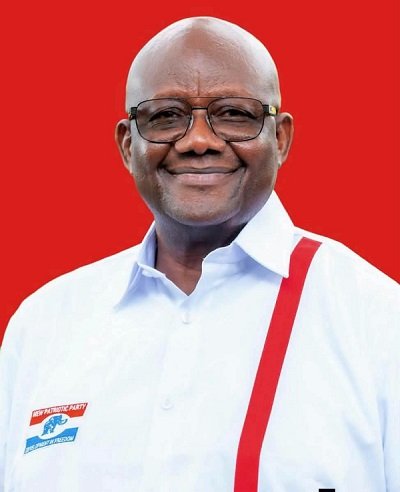
Renowned Ghanaian businessman and an indigene of the Upper East Region, Awentami Paul Afoko, has called for the construction of an international airport in the Upper East Region, arguing that it is critical to unlocking the region’s agricultural and export potential.
Addressing stakeholders at the Regional Development Framework validation forum in Bolgatanga, Mr. Afoko said the Upper East Region possesses enormous economic opportunities that can be harnessed through strategic investment in agriculture, infrastructure,, and trade.
“As an entrepreneur, I have learnt that governments do not create businesses; entrepreneurs do. Government’s responsibility is to create the environment within which businesses can thrive,” he said.
He highlighted irrigation projects and commercial farming as key drivers of economic transformation, urging greater investment in year-round production of vegetables, fruits, and flowers for international markets.
“The challenge is not finding buyers. The challenge is producing at sufficient scale throughout the year,” he stated.
Mr. Afoko also called for investment in warehouses, cold-chain facilities, packaging centres and standardized production systems to improve the competitiveness of local products, including shea butter, basket weaving, and textiles.
“We must organise ourselves to produce standardised products and invest in warehouses, cold chains, and packaging so that we become year-round suppliers,” he said.
He stressed that an international airport would significantly boost exports from the region.
“We need an airport urgently so that flowers from the Upper East can reach Europe before Kenyan flowers do. Burkina Faso produces strawberries, and we can do the same,” he remarked.
According to Mr. Afoko, the region’s strategic location also presents opportunities to expand cross-border trade with neighbouring countries through stronger economic diplomacy.
“There is the need for an international airport in the region to enable us to seize export opportunities. Our strategic location also presents enormous opportunities to strengthen border trade,” he added.
He called on the government, diplomats, and development partners to work together to position the Upper East Region as a major agricultural and export hub in West Africa.
By: Jacob Aggrey