News
Prof. Isaac Wiafe calls for human-centred AI to drive Ghana’s development

- /home/u249204778/domains/spectator.com.gh/public_html/wp-content/plugins/mvp-social-buttons/mvp-social-buttons.php on line 27
https://spectator.com.gh/wp-content/uploads/2026/07/WhatsApp-Image-2026-07-06-at-13.17.25.jpeg&description=Prof. Isaac Wiafe calls for human-centred AI to drive Ghana’s development', 'pinterestShare', 'width=750,height=350'); return false;" title="Pin This Post">
- Share
- Tweet /home/u249204778/domains/spectator.com.gh/public_html/wp-content/plugins/mvp-social-buttons/mvp-social-buttons.php on line 72
https://spectator.com.gh/wp-content/uploads/2026/07/WhatsApp-Image-2026-07-06-at-13.17.25.jpeg&description=Prof. Isaac Wiafe calls for human-centred AI to drive Ghana’s development', 'pinterestShare', 'width=750,height=350'); return false;" title="Pin This Post">
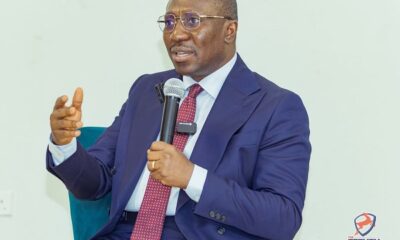
Professor Isaac Wiafe of the Department of Computer Science at the University of Ghana has called for Ghana to adopt a human-centred approach to artificial intelligence (AI), arguing that the technology will only be relevant if it addresses the country’s real development challenges.
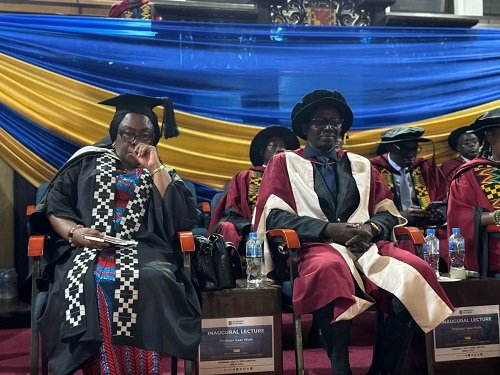
He made the call while delivering his inaugural lecture at the University of Ghana’s Great Hall on Thursday under the theme, “Why AI is Irrelevant to Ghana: Reclaiming Our Future through Human-Centred Transformation.”
According to Prof. Wiafe, AI has become one of the most influential technologies in the world and is widely promoted as a solution to problems in healthcare, education, agriculture, governance, transportation and economic development.
However, he argued that in its current form, AI offers limited value to Ghana because many of the technologies are designed using foreign priorities, datasets and assumptions that do not reflect Ghana’s social, cultural and economic realities.
The computer scientist said the issue was not whether Ghana should adopt AI, but whether the country could develop AI systems that understand local languages, reflect Ghanaian culture and solve the everyday problems facing its people.
Prof. Wiafe explained that awareness of AI alone does not lead to development, stressing that technology only becomes useful when it changes decisions, influences behaviour and improves people’s lives.
He noted that while Ghana’s informal sector employs between 70 and 80 per cent of the country’s workforce, it contributes only about 27 per cent of the Gross Domestic Product (GDP), suggesting that most workers are not benefiting from AI-driven productivity.
Using recent flooding in Accra as an example, he said Ghana has accumulated enough data over the years to predict floods but has often failed to act on the available information.
According to him, recent floods exposed weaknesses in emergency response, drainage management, planning and disaster preparedness.
He explained that AI could accurately forecast floods and identify high-risk areas, but such predictions would have little impact if institutions failed to enforce regulations and citizens ignored warnings.
Prof. Wiafe stressed that technology alone cannot transform society, saying meaningful development depends on responsible decision-making, implementation, enforcement and behavioural change.
He introduced the concept of “contextual intelligence,” explaining that AI systems must understand Ghana’s languages, culture, institutions and social realities before they can effectively serve the country.
The professor warned that the global competition in AI is no longer centred on natural resources but on the ability to develop intelligent systems that shape knowledge, education and decision-making.
He cautioned that if Ghana continued relying mainly on foreign AI platforms, the country would not only be importing software but also foreign intelligence.
According to him, Ghana’s greatest risk is not failing to adopt AI but depending heavily on technologies developed elsewhere without building the capacity to create its own.
Prof. Wiafe further revealed that his research uncovered racial and cultural biases in some AI systems, where image-generation tools frequently associated intelligence, beauty and scholarship with white people while portraying Black people negatively.
He urged users to question AI-generated responses instead of accepting them as completely objective.
The professor proposed several measures to make AI more relevant to Ghana, including building a national data infrastructure, investing in local language datasets, training AI experts and developing efficient AI systems designed for Ghana’s unique needs.
He appealed to parents to encourage the use of Ghanaian languages at home, saying local languages must remain active if AI systems are to understand and preserve them.
Prof. Wiafe called on universities, research institutions and policymakers to work together to build AI solutions that improve agriculture, healthcare, education, business and services for persons with disabilities.
He disclosed that researchers at the University of Ghana had already developed AI tools, including speech technologies for Ghanaian languages, health chatbots and digital platforms designed to support persons with disabilities.
The professor warned that delays in approving new academic programmes could leave Ghana behind in rapidly changing fields such as AI and called for more responsive accreditation processes.
He concluded that AI would only become relevant to Ghana when it improves the daily lives of ordinary citizens, strengthens local institutions and supports inclusive national development.
Prof. Wiafe argued in the abstract of his inaugural lecture that Ghana should shift from an AI-first approach to a human-first approach to digital transformation.
He said such a shift would prioritise local needs, indigenous knowledge, cultural preservation and community empowerment rather than simply adopting foreign technologies.
According to him, Ghana’s immediate priorities should include improving digital infrastructure, expanding affordable internet access, strengthening digital literacy and developing technologies that address everyday social and economic challenges.
He warned that the current global AI ecosystem risks creating a new form of digital dependence, weakening local innovation and increasing inequalities if countries like Ghana remain consumers rather than creators of AI technologies.
The Vice-Chancellor of the University of Ghana, Professor Nana Aba Appiah Amfo, described the lecture as thought-provoking and said it challenged participants to rethink the purpose of AI and its role in national development.
She said one of the key lessons from the lecture was that technology must always serve humanity and improve people’s lives rather than simply becoming more advanced.
Prof. Amfo stressed that Africa must play a greater role in developing AI systems that reflect its languages, cultures and development priorities instead of relying entirely on technologies created elsewhere.
She commended Prof. Wiafe for his contributions to AI research and innovation, describing his work as practical, bold and important to Ghana’s digital future.
By: Jacob Aggrey





Residents of Brodi, a farming community in the Tain District of the Bono Region, have been left in shock and mourning following the alleged murder of a 45-year-old woman by her husband, who later died by suicide.
According to information gathered by the Ghana News Agency (GNA), the suspect, popularly known as Kwabena Jack, believed to be in his 50s, allegedly attacked and killed his wife, Abena Donkor, while the couple were working on their farm on Monday, August 11, 2026.
Mr Kingsley Obah, Assembly Member for the Brodi Electoral Area, confirmed the incident to the GNA.
He explained that after news of the woman’s death spread through the community, residents launched a search for the suspect. His lifeless body was later discovered in a nearby bush on Tuesday, August 12, 2026.
Police have since conveyed both bodies to the Tain District Government Hospital, where they have been deposited for preservation and autopsy.
Investigations into the incident are ongoing. -GNA
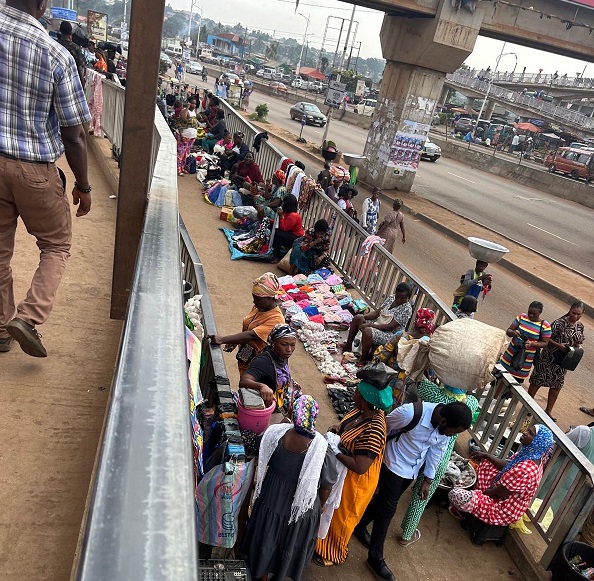
Hawkers and roaming preachers have taken over the five-metre high Madina REDCO footbridge and adjoining streets, making it increasingly difficult for pedestrians to use the facility intended to promote safe road crossing.
The traders have virtually turned sections of the footbridge into a marketplace, displaying their wares on the floor using jute sacks, plastic sheets and metal trays, while others have occupied both sides of the walkway with their merchandise.
Foodstuffs such as okro, garden eggs, pepper, onions, dried fish, smoked fish, grains, spices and other groceries are openly sold on the footbridge and along the roadside, forcing pedestrians to weave through the crowded path.
Clothing and fashion accessories including slippers, brassieres, panties, socks, bags and other household items are also displayed for sale, leaving only limited space for commuters to use.
The situation is worsened by the presence of itinerant preachers who position themselves on the footbridge with public address systems to evangelise, drawing crowds to further obstruct pedestrian movement.
Head porters are also seen crossing the highway through the median while carrying heavy loads instead of using the footbridge, exposing themselves to the danger of being knocked down by speeding vehicles.
Also, portions of the footbridge are showing signs of deterioration. Several metal railings are rusted, bent and loosely secured with pieces of wire, raising concerns about the safety of users, especially children, the elderly and persons with disabilities.
Sections of the concrete surface are worn and chipped, while makeshift wooden supports attached to parts of the structure suggest temporary repairs.
After a visit by The Spectator last week, it emerged that many commuters preferred crossing the busy Madina Highway instead of using the footbridge because of the congestion created by the trading and preaching activities.
For years, successive attempts by the police, the military and the La Nkwantanang Madina Municipal Assembly to address congestion around the REDCO and Zongo Junction enclave have yielded little success, with the area becoming notorious for roadside trading, indiscriminate parking and pedestrians refusing to use the footbridge.
A pedestrian, who gave her name only as Maame Yaa, described the situation as worrying, saying the footbridge, which was constructed to protect lives, had gradually lost its purpose because of the growing encroachment by traders and preachers.
According to her, many pedestrians were discouraged from using the facility because navigating through the crowded walkway had become difficult and uncomfortable.
She appealed to the La Nkwantanang Madina Municipal Assembly and other relevant authorities to intensify enforcement to prevent unauthorised trading and other activities on the footbridge and ensure it served its intended purpose of promoting pedestrian safety.
However, during the visit, personnel of the Ghana National Fire Service (GNFS) were seen carrying out a decongestion exercise to remove hawkers from sections of the roadside around the footbridge as part of efforts to improve public safety and ease the movement of both pedestrians and motorists.
The exercise forms part of a pilot project initiated by the Municipal Fire Commander for Madina, Division Officer II (DO II) Abdul Salia, who assumed command of the Madina Municipal Fire Station three months ago.
Speaking in an interview with The Spectator, DO II Abdulai Salia, who is also a long time resident of the community, said the month long project began on July 1 and ended on July 31, with 30 firefighters deployed daily to regulate traffic, clear hawkers from the streets and footbridge, and create access for emergency vehicles.
Continued on page 12
By Esinam Jemima Kuatsinu