Features
My humble opinion on election 2020 amid COVID-19


December 7, 2020, is a very important date in the governance processes in our country called Ghana. It is very important because it is the date for the election of members of the Legislature and the President and for that matter the Executive arm of government, in any election year.
The constitution makes that date sacrosanct and until what is enshrined in the constitution is changed, nothing can be done about it and, therefore, come rain or shine; elections must be conducted on December 7, 2020.
This, therefore, places an onerous responsibility on the Electoral Commission (EC), the government, civil society and all other stakeholders including the electorate.
Since the conduct of elections on December 7, this year is given, all stakeholders are faced with a serious challenge, in that we are not in normal times.
The COVID-19 has created an environment which makes the smooth running of the electoral process very problematic. In normal times, electoral processes have generated a lot of tension and there have been occasions where disturbances have occurred at registration centres.
Delays have resulted which had in the past created unnecessary tension in the country with political parties having a go at each other and at the EC.
Going into the elections some political parties are of the view that the decision of the EC to compile a new voters’ register is not necessary and that the EC must, therefore, quash that idea.
The ruling government on the other hand is of the view that the electoral register as currently constituted, is not credible since there is credible evidence that the cleaning ordered by the Supreme Court has not been effectively done.
Given this scenario, the only way out is for the EC which is the arbiter, to take its own decision and so it has decided to compile a new voters’ register and all stakeholders must support it(EC).
However, if we go along with the decision of the EC, a concern raised by those opposed to the compilation of a new voters’ register is brought into sharp focus.
Given the mode of infection of the COVID-19 virus, the issue of increase in the infection rate due to more people being brought together at the registration centres cannot be overlooked.
In the same vein, given our past experience of how passionate people are on the day of election, the possibility of a huge number of people being infected cannot be glossed over.
This brings us in a quandary as a nation and the phrase of the renown poet Shakespeare, in the book ‘Hamlet’ “to be or not to be, that is the question” aptly fits our current situation.
The devastation of economies and the havoc COVID-19 has wreaked on individual lives across the world is nothing to be toyed with. The consequences that further infection can wreak on the nation give cause for concern and so if that likelihood exists, then there is the need to look at various options to prevent its occurrence.
What must be noted is that any attempt to change the date of the election would require a change in the constitution to enable the EC to act accordingly without flouting any laws.
The first option available to the EC is to postpone the elections so that the concerns of those opposed to the compilation of a new voters’ register based on the view that there is the likelihood of the spread of COVID-19 can be addressed.
In order to be able to do this, the constitution has to be amended to give the EC the power and the lawful authority to execute same. When the elections are postponed, there must be amendment of other provisions to prevent a vacuum being created because under the current constitution, the term of the president expires after midnight of January 6, 2021.
Postponing the election, therefore, would have to be looked at in terms of the feasibility of amending the constitution within the next five months to prevent a constitutional crisis.
Former President Kuffour started a discussion on the term of office of presidents being revised upwards to at least five years instead of the current four years.
Currently, that idea is gaining momentum and there have been talks about amending the term of office of the president and maybe this COVID-19 and the challenges of the compilation of a new register, provides us with an opportunity to amend the constitution to facilitate the implementation of this idea. This would definitely help in reducing expenditure on elections which also affects the inflation rate especially during an election year which ultimately affects the quality of life of the larger populace.
The EC has an opportunity to make a strong case to Parliament and the Judiciary as well as the Executive that it needs time to conduct COVID-19 risk free elections and ask for a stakeholders’ discussion on the issues involved in such a decision.
Another issue raised by those who are advocating abolition of the idea of a compilation of a new register is cost that would be incurred compared with the use of the current register.
The use of the current voters’ register would definitely reduce the expenditure on elections but the EC would still have to conduct limited registration. The limited registration would involve people queuing to go through registration process and the risk of infection would be present although at a reduced level.
The thing is that one life lost through COVID-19 is one too many and, therefore, if there is the risk of infection in the conduct of registration, then we must as well postpone it altogether.
Those who are claiming that it is unnecessary for a compilation of a new voters’ register and that only limited registration is required, has a point, but they should realise that it would also provide a risk of infection although on a limited scale compared with a mass compilation.
Whether limited or mass, the risk of infection on Election Day, is still awaiting us and it is time we all examined the issue and took a decision that would be beneficial to all of us. The only time the risk of infection would be absent is when a vaccine for the disease is found.
I hope that those who are using the argument of the risk of COVID-19 infection would agree to the amendment of the constitution to extend the term of office for the president since it is envisaged that the earliest time a vaccine could be obtained is towards the end of 2021.
In order to resolve the disagreements among the political parties regarding the credibility of the voters’ register, the only way out is for a collaboration between the EC and the NIA so that the Commission can compile its register by selecting those who are 18 and above and are Ghanaians and are of sound mind. There would be no more arguments about the register and the cost of compilation would be minimal not to mention the absence of political tension.
Given the time left between now and the elections, this collaboration would have to be done in future and so all of us either support the EC to carry out a compilation of a new register or postpone the elections by amending the constitution.
Laud Kissi-Mensah


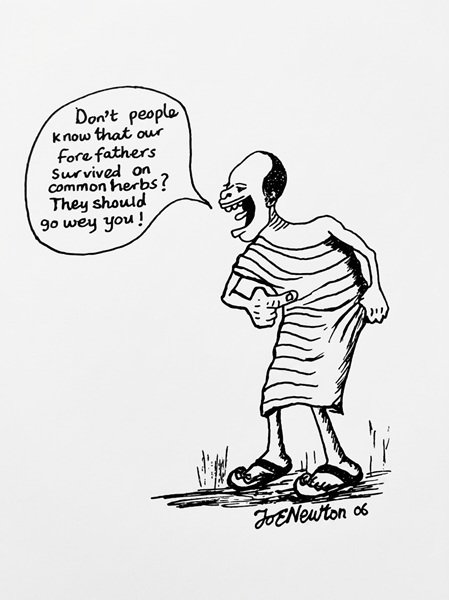
THE typical itinerant salesman in Sikaman is a herbalist. He is normally a slim macho with the capacity to perambulate the expanse of area covering the triangle of Accra-Tema-Ashiaman. In short, he can walk a total of 60 miles a day, marketing a product that cures every disease, including poverty. 
The door-to-door herbal pharmacist advertises his product by word of mouth. He has nothing to do with the Food and Drugs Board (FDB). After all, his concoctions do not feature on FM stations.
Those herbalists who cannot walk to propagate the herbal gospel, liaise with drivers of mass transportation and their mates. They are, therefore, given the chance to sell their products on Benz buses that ply the routes.
Normally, the herbalist starts his sales message with a prayer and Bible study. He asks the passengers to bow down their heads in supplication to God the father, the son, the Holy Spirit.
When a herbalist asks the passengers to close their eyes and bow their heads, Moslems on board naturally feel offended. They feel that the herbalist has no right to assume that every passenger is a Christian. They think such an assumption is an affront to Islam.
So a Moslem on board will raise the hand for a point of order. He’ll remind the herbalist that it would be in his own interest to mind his language.
“Be careful the way you address people in a public place. Not every person here is a Christian,” he’d state assertively.
Of course, the herbalist will promptly ignore him, but would all the same “watch” his tongue. Who knows whether or not the Moslem brother is inspired by Quoranic zeal to defend the tenets of Islam to the hilt?
When he starts saying, “Wallahi!” and “Inshallah!” it could be the beginning of proclaiming Islam as supreme, a point which must be driven home with talibanic precision.
So the herbalist must tread carefully lest he steps on fire.
The herbalist could even add a measure of mirth to it all, by announcing that Christians on board today have very interesting company on the journey, but that should not detract from the business of the day.
The Moslem brother will weigh the words carefully and offer a wry smile.
He must be careful the occasion does not degenerate into the use of semantics and proverbial oration to deride his conviction that public utterances must be mindful of religious sensibilities. He has made his point very clear and expects that it is taken in good faith in the interest of a peaceful journey.
The herbalist will now open the New Testament and preach salvation, stating clearly that salvation can come only through Jesus Christ and NOBODY else.
The Moslem brother will now start twitching his moustache. The visible and almost revolutionary reflexes of his upper lip can be an indication that sentiments have begun superseding reason, and the outcome could well be tragic now shift uneasily in his seat.
The time has come for him to also express his right to the religion of his fore-bears. He’ll put his hand into his pocket and rise to his feet. The time has indeed come!
This article was first published on Saturday, September 9, 2006
When the cause of a particular problem like sickness, disease, sudden illness, a social issue etc. are not known, it stands to reason that resolving it becomes a huge challenge.
Citizens would understand the government when public announcements are made to the effect that government is trying to find a solution to the issue, even though it is taking a while for it to be resolved because citizens are rational beings.
On the other hand, if the solution to a particular issue is known to everybody but the government for whatever reason, is dragging its feet in resolving it, citizens become frustrated and begin to lose trust in their leaders.
One such issue is the heavy traffic along a section of the Kasoa – Odokor road. A short stretch of bad road between the traffic light at the Weija Government Hospital and the entrance to the entrance of the overhead that leads to the N1, is the cause of the problem but nothing is being done about it, day after day, week after week, month after month. Thus is clearly unacceptable.
Another issue that requires urgent attention is the lack of pavements along a lot of streets in parts of the various Municipal Assemblies. Exercise is a prerequisite for long life and healthy living and for those of us who it has become a way of life, this issue of people putting up structures right to the edge of the drains beside the roads, are making life difficult for us.
We are compelled to walk along the roads, putting our lives at serious risk. Pedestrians should never be compelled to compete with vehicles on our streets and roads. Roads and streets are made for vehicles and pavements are made for pedestrians. That is the norm. Any attempt to normalise a situation where pedestrians are mingling with vehicles is insanity.
It is the road regulations that makes it so and therefore district or municipal assemblies are to take responsibility and ensure that spaces for pavements are not encroached upon. Citizens have rights that must be protected by their leaders and making pavements available to pedestrians, is one of them.
When we hear of teachers having sex with students, it appears it is something recent. It is not a new phenomenon. It has been there since Adam. Perhaps this issue is getting much attention due to the proliferation of social media. It was an open secret in times past when Teachers were in relationships with female students and some married them immediately after completion of school.
Some teachers were also known to be having unholy interactions with female pupils but due to the times that these acts occurred, human rights issues and the awareness around it, allowed such unscrupulous teachers to get away with their crimes.
Now we are in a different era and so a Headmaster is now in hot waters. He is alleged to have raped about 19 female students and as usual, some officials tried to cover it up and are also in hot waters and their actions or inactions in the matter are under investigation.
Why the man has been allowed to roam freely without being arrested is simply mind boggling. It appears that the law applies differently, depending on who you are. This issue came to public attention sometime in August this year, yet the police had not arrested or invited this man for question regarding the rape allegation.
It has come out that he is a Constituency Secretary of the ruling party and the question in the public domain is that, is it because he is a political figure that is why he is still walking around without questioning? I believe in the rule of law so let us hold our breadth and let the proper thing be done.
The police must however be seen to be active in this matter. God bless.
SKIP THE QUEUE, TAP THE NEWS
You can now read the Ghanaian Times and The Spectator newspapers from the comfort of your device via TimesNewsPlus.
Join our WhatsApp Channel: https://whatsapp.com/channel/0029VbBElzjInlqHhl1aTU27