Hot!
Missing Titanic sub search in critical phase amid fears over oxygen levels


The huge search for a missing submersible vessel near the wreck of the Titanic has entered a critical stage, as fears mount over the oxygen levels that may be on board.
If the sub is still functional and intact, it may only have low levels of oxygen left based on earlier estimates.
It went missing in a remote area of the North Atlantic on Sunday with a four-day oxygen supply for its crew of five.
And on Thursday many questions remained over how it could be recovered.
The minivan-sized submersible, which was owned and operated by the private company OceanGate Expeditions, is yet to be located. If it is found, it will need to be reached by complex rescue equipment and then brought to the surface in an operation that would likely take hours.
That would need to happen before the oxygen supply runs out and without damaging its structure or endangering those on board.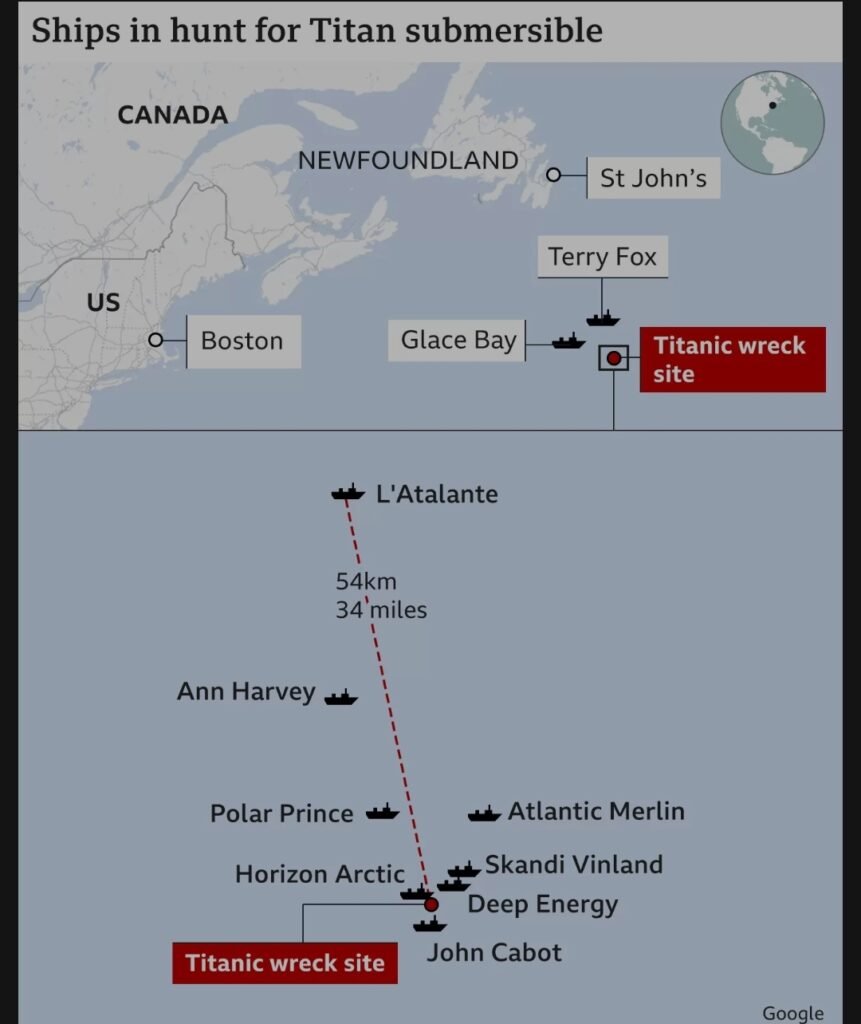
The condition of the vessel and its crew of five is unknown, but the US Coast Guard said the operation remains a rescue mission. “This is a search-and-rescue mission, 100%,” Captain Jamie Frederick told reporters on Wednesday.
There appeared to be a glimmer of hope after officials said undersea noises had been detected by Canadian search planes on Tuesday and Wednesday.
But it is still unclear what these were, and officials said they may not have come from the submersible. Remote-controlled underwater search vehicles (ROVs) were deployed to the area where the sounds were detected but are yet to find anything.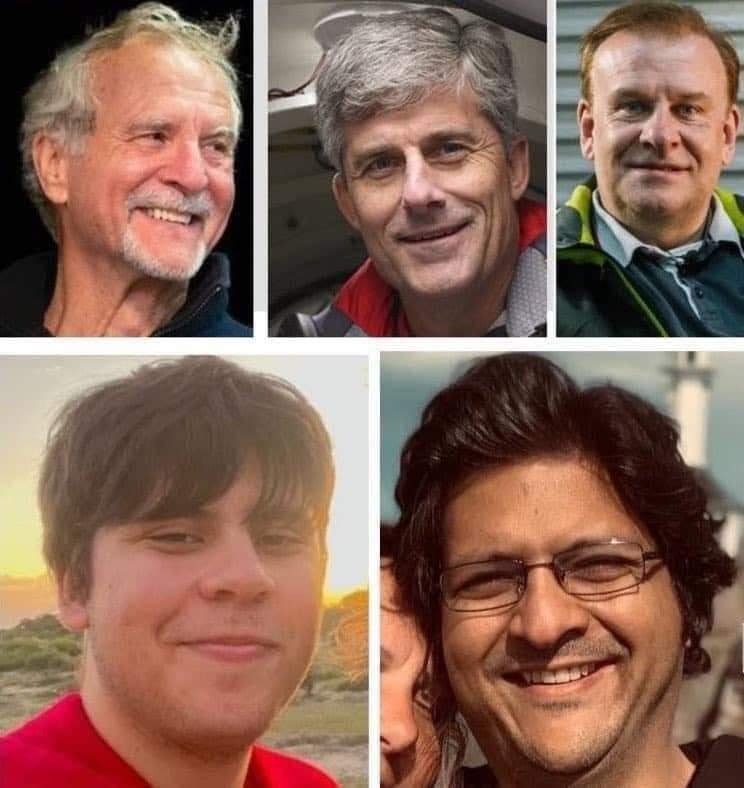
One of the ROVs, deployed from the Canadian vessel Horizon Arctic, reached the ocean floor early Thursday morning. Several more were expected to arrive at the site later in the day, along with more multi-national support.
A French research ship, the Atalante, also arrived in the area on Thursday morning and deployed its own ROV, the US Coast Guard said. That robot is capable of researching depths below the Titanic wreck, which lies about 12,500 ft (3,810m) below the surface, and has experience of surveying the Titanic.
The overall area of sea being scoured is about 26,000 sq km (10,000 sq miles), twice the size of the US state of Connecticut. The area is prone to stormy conditions and poor visibility which makes search operations more challenging, experts say.
On board the 21-foot vessel is British businessman Hamish Harding, British-Pakistani businessman Shahzada Dawood and his son Suleman, former French navy diver Paul-Henry Nargeolet and the CEO of OceanGate – which operates the submersible – Stockton Rush.
“One of the factors that makes it hard to predict how much oxygen is left is that we do not know the rate of the consumption of oxygen per occupant on the sub,” Rear Admiral John Mauger from the US Coast Guard told the BBC.
Dr Ken LeDez, a hyperbaric medicine expert at Memorial University in St John’s, Newfoundland, told the BBC it was possible the crew could survive even as oxygen supplies dwindle, depending on the crew’s fitness and the conditions in the submersible.
While it is impossible to know the exact conditions inside, Dr LeDez said the crew will likely be facing increasing levels of carbon dioxide and could also be dealing with cold temperatures, along with the declining levels of oxygen.
A combination of these factors could lead to hypothermia and a loss of consciousness, he said. But these conditions aren’t necessarily deadly and their metabolisms slowing down because of the cold could help them survive longer, he added.
“They’re very smart… very accomplished people in there,” he said. “If anybody can survive” in it, “it’s these individuals.”
source :BBC



Photos from the High-Level Event on Reparatory Justice for the trafficking of enslaved Africans and the racialised chattel enslavement of African people, convened at the United Nations Headquarters, New York.
Delivering a powerful address, President John Dramani Mahama underscored the moral urgency of confronting historical injustices and advancing a global commitment to reparatory justice.
“The entire transatlantic slave trade was designed to deny African people their humanity,” the President stated.
Highlighting the significance of ongoing international efforts, he added:“This resolution allows us, as a global community, to collectively bear witness to the plight of the 18 million men, women, and children whose homes, communities, names, families, hopes, dreams, futures, and lives were stolen from them over the course of four centuries.”
In reaffirming the enduring truth of justice, President Mahama noted:
“Just because everybody is doing something doesn’t make it right. Slavery is wrong now, and it was wrong then. For as long as Africans have been trafficked and enslaved, there have been abolitionists who have spoken up against it.”
He further called for a deeper reflection on identity and dignity:
“We must also remember to reclaim our own humanity… when we absorb too much of the language of violence and erasure, our minds become enslaved.”

A member of the New Patriotic Party (NPP), Beatrice Siaw, has expressed mixed views about Ghana’s current leadership, saying she admires President John Dramani Mahama but is not fully satisfied with how the country is being governed.
Speaking in an interview on Metro TV on Tuesday, she said although she belongs to the NPP, she finds it difficult to criticise the President personally.
“I admire President Mahama, so it’s hard to speak against him. But I do love my party. I am impressed with the President, not necessarily impressed with how things are going” she said.
She acknowledged that the NDC has made efforts in managing the economy and improving some key indicators. She noted that the party appears determined to prove critics wrong after previously being voted out of office.
“They are trying to do a lot of things that Ghanaians thought they couldn’t do when they were in power,” she said.
However, she was quick to add that these efforts may not necessarily translate into electoral success in the next election cycle.
When asked whether the NDC’s performance could pose a strong challenge in 2028, she said she does not believe so, although she admitted there have been some improvements in certain areas.
“In some aspects, yes,” she said when asked if she had been impressed by the government’s performance.
By: Jacob Aggrey