Features
KIA: An aberration of the highest order (Part 1)

When a man fathers a child, he names it after himself. In African culture, even when the father or grandfather dies, their progeny are named after them to preserve their revered ancestry. Their descendants are not named after strangers. There could be an exception to the rule if a stranger were acclaimed by members of the naming family as having benefited the family in a way deemed worthy of immortalising.
Then, the stranger’s name could be adopted into that family’s heritage. Otherwise, it is an aberration to name somebody’s baby after another person who is not the father, more so if that stranger had some character defects. It is an abominable paradox. It is a misnomer.
Talking of naming reminds me of another scenario in Ghana, where it is common practice to name foreigners as “Nkosuorhene,” that is, “Development chief” because of their contribution to the upliftment of a particular community. These “strangers” are invited from their countries of origin and enstooled with regalia, traditional name, and all, and paraded through the streets to outdoor them.
Sometimes, in the euphoria of celebrating these foreign helpers, tradition is even broken. For instance, these “chiefs” may be carried in a palanquin which is meant for only the overlord of the beneficiary community. But who cares? They deserve all the encomiums.
Not so with the case of Osagyefo Dr. Kwame Nkrumah, the man who led the struggle for Ghana’s independence and helped the country to shake off the heavy yoke of colonialism. The Akans have a proverb that says: “W’annyi me ay3 a, enns3e me din,” which loosely translates to: “If you would not praise me,(for all I have done), do not malign me.”For all Nkrumah did for Ghana in record time, they gave him a bad name and hanged him. The Western world with whom he dared to compete in terms of industrialisation, branded him a communist and encouraged his own countrymen like Lt. General Emmanuel Kwasi Kotoka to depose him from office.
What was his crime? Apart from being charged with practising communism, Nkrumah’s stature was growing at breakneck speed among freedom fighters all over the world who saw him as their go-to person as they looked for inspiration to break free from the yoke of colonialist subordination.
Besides, his “dangerous” rhetoric about the selfish ambitions of the Western powers, his continuous bashing of them, his name-calling such as exploiters, imperialists, and neo-colonialists, did not sit well with them. Furthermore, his concrete efforts to unite all of Africa to enable the continent to present a united front against the intention of the Western powers to call the shots and keep Africa in perpetual subjugation, were too threatening to ignore.
Amidst the tension, Nkrumah published a book: Neo-Colonialism: The Last Stage of Imperialism, shunned economic policies prescribed by the IMF in May 1965, and proceeded with his own mission to develop Ghana the way he thought best for the country. That means he refused to collaborate with the West in his development plan because he did not see them as helpers but exploiters. His stout stance caused diplomatic relations with the West to deteriorate further.
To the Western powers led by the US, Nkrumah was becoming too much of a pain in the neck. Consequently, they planned to eliminate him and found ready accomplices in Kotoka, who was a Lt. Colonel at the time and his gang. Other co-conspirators were Major Akwasi Amankwaa Afrifa, Lt. General Ankrah from the army, and from the police, Mr. J.W.K. Harlley, the Inpector General of Police and Mr. A.K. Deku, his deputy.
Irrefutable evidence abounds implicating Kotoka and his henchmen in cahoots with clandestine saboteurs like America’s CIA and M16, their British equivalent, to undermine Ghana’s rapid move towards industrial growth and prosperity. And what were they promised? Listen to what Robert W. Komer, one of the operatives on the ground told President Lyndon B. Johnson after the coup succeeded:
“Nkrumah was doing more to undermine our interests than any other black African. In reaction to his strongly pro-Communist leanings, the new military regime is almost pathetically pro-Western. The point of this memo is that we ought to follow through skillfully and consolidate such successes. A few thousand tons of surplus wheat or rice, given now when the new regimes are quite uncertain as to their future relations with us, could have a psychological significance out of all proportion to the cost of the gesture. I am not arguing for lavish gifts to these regimes—indeed, giving them a little only whets their appetites, and enables us to use the prospect of more as leverage.”What a shame!
In collaboration with those clandestine organisations, they staged the first military coup d’etat that led to a domino effect precipitating ripples across Africa. For one thing, as a trailblazer, when Ghana sneezes, the rest of Africa catches cold. Even though Togo organised the first coup in sub-Saharan Africa in 1962, followed by Nigeria in 1966, Ghana’s participation made it more “attractive” for others to join the bandwagon.
Between 1962 and 1967, there were 15 coups in Africa. Even now, see what is happening in Mali, Niger, Burkina Faso, Guinea, and Chad. The military in these countries have all overthrown democratically elected governments, some twice or more.
That brings me back to what I was saying earlier about the proper way to name babies. The current name of Ghana’s premier airport: Kotoka International Airport, (KIA) is strange, misplaced, and improper. The simple reason is that the airport is one of the maiden projects of Dr. Nkrumah following the attainment of independence and, therefore, it is his baby. For that matter, its current name is unacceptable, inappropriate, and utterly amiss.
Remember what I said from the outset, that babies are not named after people with character defects, and Kotoka’s record is there for all to see. His name is that of a traitor who conspired with foreign powers to halt Ghana’s quick march towards greatness. Why then should Ghana’s premier airport be named after Kotoka for all his sabotage? If you did not understand what it meant to add insult to injury, this is a typical example.
Originally, the airport was a military landing strip used by the British Royal Air Force during the Second World War. After the war, the facility was handed over to the British civilian authorities. On March 21, 1952, Dr. Nkrumah became Prime Minister of the Gold Coast before the country’s name was changed to Ghana. He hit the road running because he realised that the British were only interested in exploiting Ghana’s rich mineral resources with no commitment to the prosperity of the country. Even the airport was left just as it was – a military base.
To ensure a rapid transformation of the country, President Nkrumah drew a master plan spearheaded by massive infrastructural development. Among his plan was a redevelopment project to restructure the military base into an international airport with a commensurate terminal building. He launched the project in 1956 and got it completed in 1958. The airport which initially had a capacity of 500,000 passengers per year, was originally named Accra International Airport.
With incredible ingenuity and leadership, Nkrumah proceeded with other aspects of his enormous development agenda, embarking on projects whose magnitude, variety and pace were unmatched elsewhere in Africa. Within a short time, he completed projects such as the Tema township and industrial area, Tema Harbour, Tema Oil Refinery, Tema Motorway to link the port city with Accra, the Akosombo Hydro-Electric Dam, and the expansion of the old Takoradi harbour for the exportation of Ghana’s raw materials such as cocoa, timber, coffee, and rubber among others. What about the Ghana Atomic Energy Programme at Kwabenya, Accra? All these were geared towards the rapid industrialisation and transformation of the country.
But alas! That was not to be. The trajectory of progress took a downward spiral. Ghana, Africa’s rising star, was shot from the sky and made to tumble down to earth. On February 24, 1966, while Dr. Nkrumah was away to Hanoi, the capital of North Vietnam on a peace mission to seek an end to Vietnam’s war with the US, Kotoka and his cohorts staged Ghana’s first coup, a bloody one for that matter, and ousted the President from office.
For Kotoka and his gang to sell their conscience to an organisation working against Ghana’s progress is pure treason. Apart from the treasonable nature of the offence, Kotoka’s putsch dragged Ghana towards a downward spiral from which we have never recovered.
Yet, his name is imprinted boldly on an edifice as important as Ghana’s main international airport, the gateway to the land people from the diaspora are trooping in to see, partly because of the name and fame Kwame Nkrumah gave to Ghana. This is adding insult to injury. It is an abomination. It is a shame!
Next week, we shall discuss how the airport’s name was changed. We shall talk about the legacy of Kotoka also.
Contact:teepeejubilee@yahoo.co.uk
By Tony Prempeh

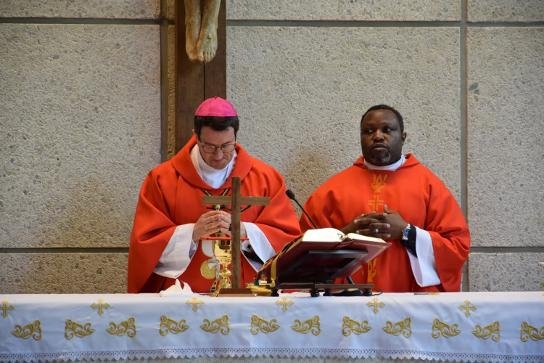
On Sunday, October 11, 2026, it was the turn of Ghanaian Catholics in Finland to lead the singing in the church service of the African Catholic Chaplaincy in Finland (ACCF).
It was indeed a spirit-filled feeling for worshippers present. And for the Ghanaian migrants, the occasion also brought back to them memories of church services in their home country, Ghana.
The ACCF has a roster for each country/community to sing from time to time. Next Sunday will be the turn of the Nigerian community. Other communities that usually sing are the Kenyan/Tanzanian community, the Cameroonian, the Ugandan, group, etc.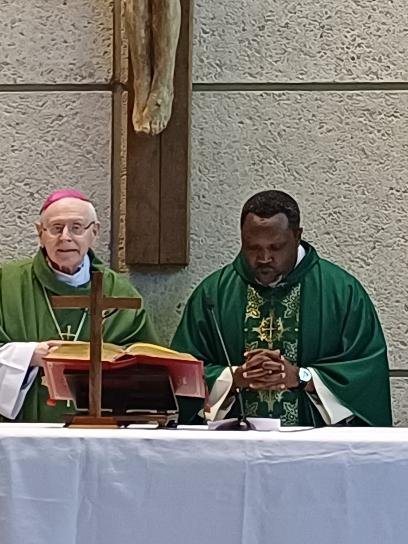
A powerful religious experience
The mass services of the Chaplaincy usually give a powerful religious experience and a display of cultural diversity, especially in occasions such as when the Bishop of Helsinki, Bishop Raimo Goyarrola, celebrated mass with the Chaplaincy on Pentecost Day, May 24, 2026.
There was a similar time of spiritual joy last month (September 27, 2026) when Emeritus Bishop Teemu Sippo, former Bishop of Helsinki, visited the Chaplaincy. Bishop Teemu was the main celebrant, assisted by the Chaplain, Reverend Father Thomas Otieno.
Last Sunday, Reverend Father Bernard Sor, a Ghanaian Catholic priest based in Austria, was the main celebrant in the mass service where he performed a rite of baptism. Fr Bernard had celebrated mass a few months ago when he visited his sister and her husband in Helsinki. 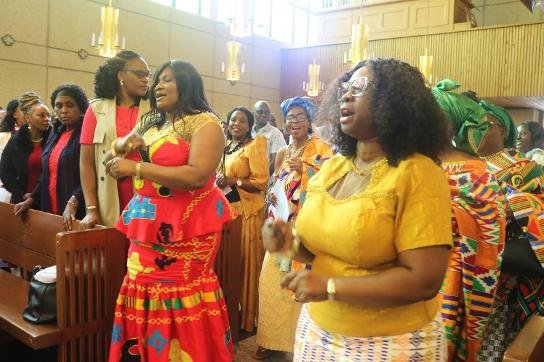
All these well-attended religious occasions indeed leave lasting memories. The homilies (peaching) by the priests usually emphasize religious tenets such as the importance of loving and serving God in truth, existing in peace with our fellow humans to promote unity in diversity, etc.
Unity in diversity and a colourful display of cultures
The African Chaplaincy church services usually produce impressive displays of diverse cultures from different parts of Africa and elsewhere. The events are often spiced by rich cultural displays of dances and colourful attires which are a delight to watch.
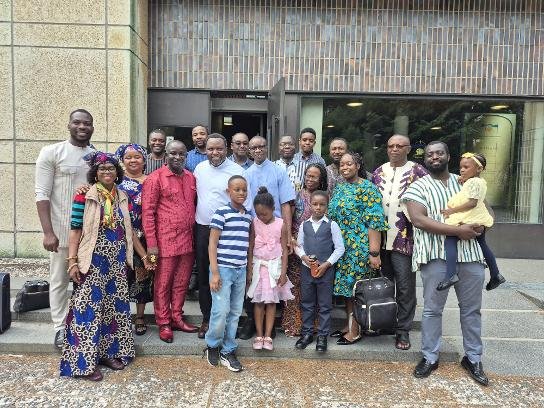
On special occasions, members of the Ghanaian Catholic community, in their gay and colourful kente attire and with adowa dance and music, usually lead the procession into the church. Other communities such as the Cameroonian, Nigerian, Kenyan and Tanzanian as well as Sudanese/South Sudanese groups also put up well-choreographed performances from their cultures.
The African Catholic Chaplaincy in Finland
The African Chaplaincy was founded on June 4, 2017, which was a Pentecost Sunday, in a Pontifical High Mass celebrated by Monsignor Emeritus Sippo S.C.I., the then Bishop of Helsinki, at the St. Mary’s Catholic Parish Church in Helsinki.
The Chaplaincy was created by Bishop Teemu in collaboration with the Diocesan body when they detected a great flocking of African immigrants to Finland, the majority of whom were Catholics. This was to give the immigrants a possibility to integrate into the Finnish society by worshiping as Catholics and in their African cultural identity.
The responsibility of the Chaplaincy was given by Bishop Teemu to Father Dr Leonard Wobilla Shwei, who is thus the first Chaplain and ably led the Chaplaincy. He was succeeded a few years ago by Father Thomas Otieno, who continues to move the Chaplaincy forward. Thank you!
GHANA MATTERS column appears fortnightly. Written in simple, layman’s terms, it concentrates on matters about Ghana and beyond. It focuses on everyday life issues relating to the social, cultural, economic, religious, political, health, sports, youth, gender, etc. It strives to remind us all that Ghana comes first. The column also takes a candid look at the meanings and repercussions of our actions, especially those things we take for granted or even ignore. There are key Ghanaian values we should uphold rather than disregard with impunity. We should not overlook the obvious. We need to search for the hidden or deeply embedded values and try to project them.
With Dr Perpetual Crentsil
SKIP THE QUEUE, TAP THE NEWS

You can now read the Ghanaian Times and The Spectator newspapers from the comfort of your device via TimesNewsPlus.
Join our WhatsApp Channel: https://whatsapp.com/channel/0029VbBElzjInlqHhl1aTU27
She did not find out he was cheating. She found out he was drowning.
It was two weeks after their beautiful wedding. The jollof was still in the fridge. A loan officer called her number-not his-and politely asked, “Madam, please tell your husband to pay his overdue loan. We have been calling him.”
That was how she discovered her new husband had entered their marriage with a hidden debt of over GH¢ 40,000. No cheating. No other woman. Just a financial secret.
And that is how many Ghanaian marriages begin to die. Not with a shout, but with a secret alert on a phone.
We prepare for the wedding. We do not prepare for the wallet.
What is money honesty?
Let me define it simply. Money honesty is not that you both earn the same. It is that you both know the same. It is the ability to sit down and say without fear:
“This is how much I earn.”
“This is how much I owe.”
“This is how I was raised to see money.”
“This is what scares me about money.”
Financial transparency is not about control. It is about clarity. You cannot build trust on top of secrets.
Many couples tell me, “Counsellor, we love each other, love will handle money.” I always answer, “Love is the car, but money honesty is the fuel. Love without honesty cannot move.”
How To Buy Your Marriage Insurance Today – My 5-Step Protocol
If you are engaged, newly married, or even 20 years in marriage, you can still fix this. At Counsellor Prince & Associates Consult—CPAC, this is what I give couples:
Step 1: The 90-Minute Money Naked Session.
No phones, no blame. Each partner writes down on paper: Monthly income, monthly debts, monthly family obligations, savings, and your biggest money fear. Then you exchange papers. Read it. Don’t react for 24 hours. Just absorb.
Step 2: Create OUR Money, YOUR Money, My Money.
You need three pots. OUR money for rent, food, school fees, utilities, properties, and the like— joint contribution. YOUR money and MY money—a small agreed allowance no one questions. This stops the feeling of being controlled.
Step 3: The No-Secret Debt Rule.
Agree from today: No new loan, no new hire purchase, no new family financial commitment above GHS 500 without telling each other first. Not permission, but information.
Step 4: Talk About Your Money Personality.
Are you a Spender or a Saver? Are you Risky or Safe? Most Ghanaian marriages are a Spender married to a Saver. Neither is wrong. But if you don’t understand your partner’s personality, you will call his saving “stinginess” and her spending “wastefulness.”
Step 5: Do a Monthly 30-Minute Money Date
Not an argument date. Light, with tea. “How did we do this month? What worried you? What should we plan for next month?” Couples who do this divorce far less.
My Final Word
Before you say “I Do” at the altar, have pre-marital counselling and also have the money talk on the sofa.
Ask your partner:
“If I lost my job today, how long can we survive?”
“What debt are you bringing into this marriage?”
“How much do you send to your family monthly and will that continue?”
If he or she gets angry that you asked, don’t get married yet. A person who is angry about accountability will be abusive about money.
Marriage insurance is not bought at Star Assurance or Enterprise. It is bought in honest conversations when no one is watching.
The wedding costs one day. The marriage costs a lifetime. Don’t enter a lifetime contract and covenant with hidden costs.
You can still insure your marriage today.
Source:
Counselor Prince Offei, CPAC’s founder, is a leading Mental Health Professional, Marriage Counsellor, Author, ADR Expert/Arbitrator, and Spectator Newspaper Columnist. He writes on relationships, marriage, parenting, special needs support, and their connection to mental health. For therapy, counselling, or enquiries, contact Counselor Prince & Associates Consult (CPAC) in Accra on 0559850604 / 0551428486.
SKIP THE QUEUE, TAP THE NEWS
You can now read the Ghanaian Times and The Spectator newspapers from the comfort of your device via TimesNewsPlus.
Join our WhatsApp Channel: https://whatsapp.com/channel/0029VbBElzjInlqHhl1aTU27