Health Essentials
Independence comes with responsibility

- /home/u249204778/domains/spectator.com.gh/public_html/wp-content/plugins/mvp-social-buttons/mvp-social-buttons.php on line 27
https://spectator.com.gh/wp-content/uploads/2021/03/Our-roads-are-now-battlefields.jpg&description=Independence comes with responsibility', 'pinterestShare', 'width=750,height=350'); return false;" title="Pin This Post">
- Share
- Tweet /home/u249204778/domains/spectator.com.gh/public_html/wp-content/plugins/mvp-social-buttons/mvp-social-buttons.php on line 72
https://spectator.com.gh/wp-content/uploads/2021/03/Our-roads-are-now-battlefields.jpg&description=Independence comes with responsibility', 'pinterestShare', 'width=750,height=350'); return false;" title="Pin This Post">
Sixty-four years of life in a human is quite an achievement especially when you find yourself in a part of the world where you are LUCKY to be born in a hospital, electricity and water are available during your birth and you have a pliable road connecting you to a hospital with a doctor and a nurse.
In those 64 years you would have had bitter exchanges with mosquitoes and you may even have flirted with typhoid and cholera. You will even consider yourself fortunate if you have access to medication whenever you fall ill and count yourself among the privileged few if the medicine you use is affordable.
In many instances God cures us so the healthcare professionals can take the credit. If you have managed to live this long in the midst of herbal concoctions that can cure virtually every disease and whose representatives artfully ply their trade on buses, bus stations and even in the open without fear then I congratulate you on being alive and healthy.
For obvious reasons many of these “pushers” have disappeared or don’t appear to have answer to COVID. Hmmm just when we needed their magic the most.
Sixty-four years on the other hand in the life of a country may not be that long but it is long enough to provide its citizens with the basic necessities of life; food, shelter, clothing, education, health, electricity and water among others.
64 years for a country is also long enough for leaders and citizens to lovingly neglect their conscience to the extent that a country that may have started fairly well will be found on its knees or maybe even have its face in the mud.
Who is willing to sacrifice for mother Ghana where George Orwell’s Animal Farm seems to be enacted on a daily basis? INDEPENDENCE comes with responsibility and sacrifice and as Ghanaians we have to come to the realization that the places that we admire so much were once like ours or even worse; we need to sacrifice, take pride in our own, treat everyone fairly and ALL of us have to put in our very best to save our motherland.
These past few days I have been thinking about being responsible as individuals.
Acting responsibly will go a long way to bring order, make us more efficient in all aspects, reduce corruption and make us healthy and wealthy as a nation, and then a few things caught my attention;
Throwing Safety to the dogs
It appears we just do not care about human life. From throwing people in jail without trial to creating death traps with the semblance of hospitals. Road construction is a major area of concern. Walking or driving in town during the day is dangerous but attempting to do the same at night is simply suicidal.
Last weekend as I walked along a pavement, I was totally shocked to find open drains, planks with nails jutting out, slabs not properly fixed and all these had no warning signs. How careless can we get?
In the situation above warning signs should have been all over the place and should have started over 50 metres from the construction site. I am sure someone is in charge of the work going on there and even those directly working on the site can be a little bit responsible. This is the norm rather than an isolated case.
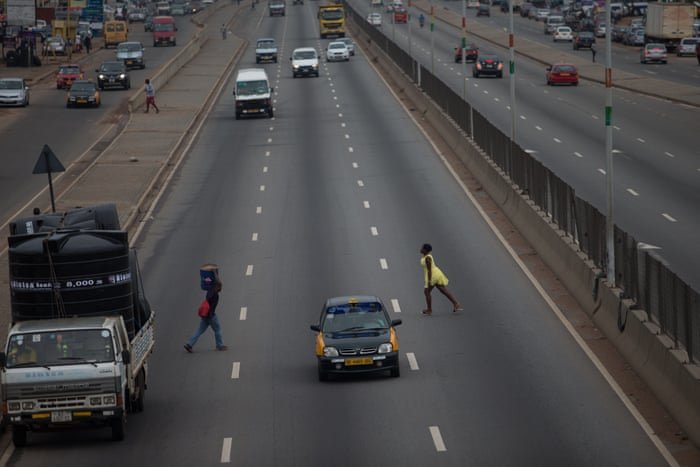
Turning our roads into battlefields
If you are like me and many other Ghanaians you must be fed-up with the “important” people who instead of setting out early for an appointment like the rest of us do, would rather cut it close to the time and resort to blaring their horns, flashing their headlights and quite often may even be escorted by a peace officer. Really aren’t the rest of us who are painfully trudging along while we see the minutes tick away equally important and don’t we often have to work so money can be generated to construct more roads and purchase more cars that will push us off the roads?
Then you have to contend with commercial bus drivers who believe they are masters of the steering wheel and they also can’t afford to waste 30 seconds for their turn.
Can you imagine how annoying it is to see motor and bicycle riders jump the red-light with impunity and deliver unprintable words in your direction when you dare to complain?
Nobody seems to care when an ambulance with a critically ill person tries to make its way through traffic. Maybe people are tired of giving way only to find out the ambulance is carrying a corpse or is on its way to the market.
It’s almost a fight on the road; morning, afternoon and evening. You are drained by the time you arrive at work and I daresay your best bet is to take it easy and smile in the midst of all the confusion.
Abusing our children in unimaginable ways
The time has come when at the very least all teachers and healthcare professionals should be on the lookout when they come into contact with a child. Our children are suffering not only from sexual abuse but physical as well as verbal ones. Let us look out for tell-tale signs; an extra quiet child, unexplained marks on a child, a child who appears to be scared for no reason.
The boy-child is equally at risk when it comes to sexual abuse. We often make it appear only the females should be protected but there have been stories of ordeals that the male-child goes through. The boy-child in Ghana is slowly becoming an endangered species even when it comes to education. It is time to learn from the experience of the African-American male.
Fix our healthcare system else we perish together
Nature has a way of warning us years ahead. So COVID-19 made us aware that there can be a time when all borders may be closed and no matter how connected or wealthy you may be you cannot have access to healthcare except what you have grown at home; let us do the needful.
In our current state we can’t even start handpicking any sector or area, we must go for a complete overhaul of every part of our dear country. Fortunately there will be no march past, no speeches and no fanfare this year. Hopefully we will spend all the time reflecting on what we can do for mother Ghana and not the usual what can Ghana do for me or what can I steal from Ghana. Enough is enough.
On Independence Day, I salute all Ghanaians and may we all remember that just us OUR HEALTH IS OUR RESPONSIBILITY, INDEPENDENCE ALSO COMES WITH RESPONSIBILITY.
AS ALWAYS LAUGH OFTEN, ENSURE HYGIENE, WALK AND PRAY EVERYDAY AND REMEMBER IT’S A PRICELESS GIFT TO KNOW YOUR NUMBERS (blood sugar, blood pressure, blood cholesterol, BMI)
Dr. Kojo Cobba Essel
Health Essentials Ltd/ St Andrews Clinic
Dr. Essel is a medical doctor, holds an MBA and is ISSA certified in exercise therapy, fitness nutrition and corrective exercise.
Thought for the week – “Our Independence is meaningless unless we take responsibility for everything we do and we all have a common goal of working tirelessly to ensure the prosperity of our nation.”



These last few months of 2026, I am embarking on a new journey. Over the past several months I have tried out some aspects of my “new way of life” but not in the manner I am doing now and I am sure you are doing same too. Draft your own points based on what is important to you and let us begin the journey together. It is never too late.
Many of the things I am working on now are guided by years of interaction with different people, what may be my purpose in my opinion, great family and friends and the type of wisdom that comes only with years.
- Self-Care
Quite often we try to take care of everything and everyone without ensuring we are appropriately “charged”. There is nothing to give out if you are empty. Self-care is NOT a luxury and it has taken me years to appreciate this;
- I will add a new hobby I have been toying with.
- Surrounding myself with like-minded people who energise me, make me laugh and be the best version of myself. Building Social capital pays.
- I am spending quality time with God daily
- Spending time in nature is key and I ensure that I take much needed breaks
- Spending a few minutes a day to meditate, exercise and spoil myself sometimes
- I will have some hours each day that will be blocked out as “no phone time”
- Keeping a Goal Diary
Many people have described ways of putting down your goals and seeing them happen. My coach taught me the power of VISUALISATION but over the years I went off that golden path. It’s time to get back. This is what I am doing now;
- In a diary I am writing everything I want to be or do as long as I have breath. No pressure.
- I am writing in the present tense; “I am spending an amazing week in a 7-Star resort with the people I love the most”
- I will look at this list everyday
- Start a Gratitude Bank
I listened to this recently and though it was not referred to as a Gratitude Bank, I believe that is exactly what it is
- I picked a diary to write in but others choose a transparent container to drop in written points. Choose what you are comfortable with.
- At the end of each week I will write something(s) I am grateful for and put in the container.
- Whenever I feel “ungrateful” I will read through them to remind myself how blessed I am and surely I will be holding the “evidence”
- On December 31, I will go through the list irrespective of my mood.
- Practice. Practice. Practice
This is exactly as it is – whatever you have written out in your diary to do from self-care through your goals etc. prioritise or focus on a few at a time. As you practice e.g. meditating, exercising, eating right and the many great things you want to do, these will all GROW. Whatever you practice GROWS.
- Make the world a better place
I believe that we can make a difference in our corner no matter the challenges.
- That smile will change someone’s life
- An act of kindness is contagious and the giver, receiver and all those observing benefit immensely. Let us spread kindness.
- The Blood Bank on my mind for this year and beyond.
What are you focusing on, what are you practicing?
Do share your list with me via email.
AS ALWAYS LAUGH OFTEN, ENSURE HYGIENE, WALK AND PRAY EVERYDAY AND REMEMBER IT’S A PRICELESS GIFT TO KNOW YOUR NUMBERS (blood sugar, blood pressure, blood cholesterol, BMI)
Dr. Kojo Cobba Essel
Health Essentials Ltd/ Medics Clinic
(dressel@healthessentialsgh.com)
*Dr. Essel is a Medical Doctor with a keen interest in Lifestyle Medicine, He holds an MBA and is an ISSA Specialist in Exercise Therapy, Fitness Nutrition and Corrective Exercise. He is the author of the award-winning book, ‘Unravelling The Essentials of Health & Wealth.’
Thought for the week –“Never change your originality for the sake of others because no one can play your role better than you. So be yourself. You are the best.” – Unknown
References:
- Unravelling the Essentials of Health & Wealth; Dr. Kojo Cobba Essel

When it comes to cancer risk factors; ALL RISK FACTORS ARE NOT CREATED EQUAL. Someone may have several risk factors but remain perfectly fine while another may have only one or none yet end up with breast cancer or other cancers.
We cannot say with certainty that we can do all it takes to prevent cancer BUT we can do a lot to reduce our risk.
TEN (10) TIPS TO CANCER RISK REDUCTION
- Weight Control – being overweight or obese increases risk to SEVERAL cancers.
- Smoking – cigarette smoking predisposes one to several cancers including lung cancer. Other forms of air pollutants serve as risks too.
- Alcohol – limit intake or avoid. It has the power to expose one to several cancers as well especially when we can’t apply brakes to how much we consume.
- Healthy Eating
- Limit intake of processed food and sugar
- Limit intake of red meat
- Fruits and vegetables should be a mainstay of our diet.
- An antioxidant rich food like cocoa should be part of our food. The purer the cocoa, the better
- Fibre in your food is crucial.
- Exercise – on its own reduces risk for breast and colon cancers directly and many others through weight control.
- Also increases immunity.
- Cancer Screening – be regular so cancers can be detected early and managed aggressively.
- Vaccinations – take vaccines where needed e.g. Hep B vaccine or vaccine against HPV (human papilloma virus accounts for the majority of cervical cancers)
- Know your Family History
- Anyone in your family with a cancer? Necessary to be on your guard but also remember that you may be the first person in your family with a particular cancer.
- Start your family early and breast feed for as long as possible to reduce risk of breast cancer.
- Check exposure to Ultraviolet Light and other forms of radiation. Protect your skin.
- Practice SAFE SEX
- HPV infection leading to cervical cancer is commoner when one is exposed to sex early, directly or indirectly has multiple partners but NOT everyone follows this rule. As in many situations, outliers do exist.
- Conditions such as HIV/AIDS may suppress your immune system if not managed appropriately.
Do add two (2) others of your choice and send to me via email. Together we can protect ourselves.
Will treating H. Pylori infections be a game changer too?
ALWAYS remember that CANCER PREVENTION HAS NO QUICK FIX – we need to follow these points over and over.
AS ALWAYS LAUGH OFTEN, ENSURE HYGIENE, WALK AND PRAY EVERYDAY AND REMEMBER IT’S A PRICELESS GIFT TO KNOW YOUR NUMBERS (blood sugar, blood pressure, blood cholesterol, BMI)
Dr. Kojo Cobba Essel
Health Essentials Ltd/ Medics Clinic
(dressel@healthessentialsgh.com)
*Dr. Essel is a Medical Doctor with a keen interest in Lifestyle Medicine, He holds an MBA and is an ISSA Specialist in Exercise Therapy, Fitness Nutrition and Corrective Exercise. He is the author of the award-winning book, ‘Unravelling The Essentials of Health & Wealth.’
Thought for the week – “WHERE YOU LIVE SHOULD NOT DETERMINE IF YOU LIVE.”- WHO
By Dr. Kojo Cobba Essel