News
Godfred Abayateye, expert in ‘human waste’ disposal

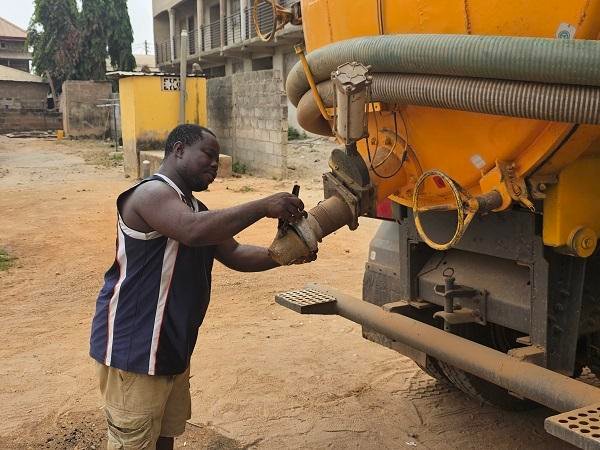
Godfred Abayateye inspecting a truck after collecting human waste to ensure there is no spillage
One of the common questions people ask when they meet a new person is his profession.
Usually, when people have ‘prestigious’ jobs, they are quick to respond. They are usually the first to mention their professions in a conversation and then ask others about theirs.
For Godfred Abayateye, a toilet waste truck driver whose job basically entails collecting and disposing of human excreta, one could have imagined the discomfort with such a question. But, interestingly, he is not embarrassed at all about the job he does.
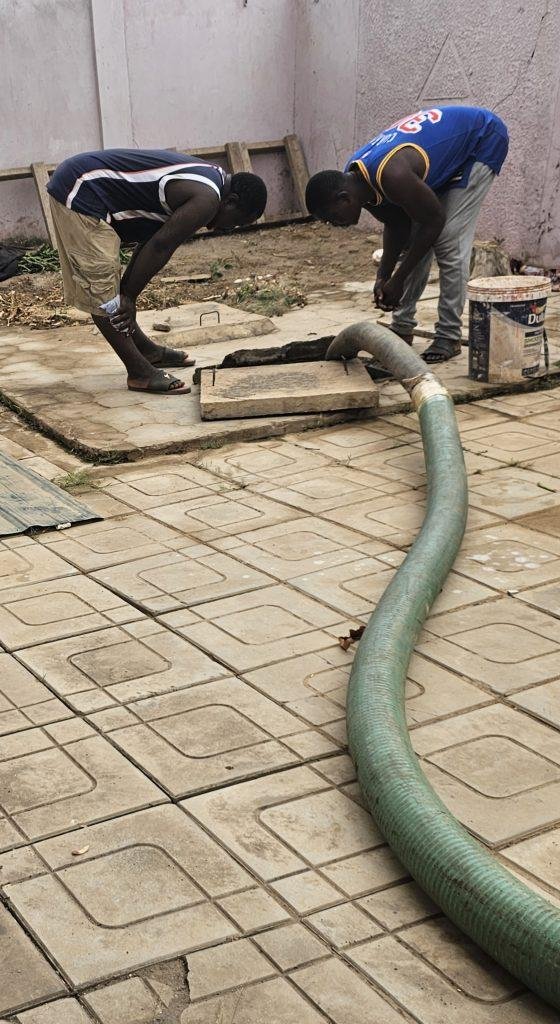
He said, the fact that his wife was very proud of him and appreciated him for his ability to shoulder their responsibilities as a husband and father that serves as a major source of motivation for him.
In an interview with The Spectator last week about his life and job, the resident of Ashaiman disclosed that he had been in the business of going to homes and premises of businesses to collect their waste for 12 years.
“There are no regrets for being someone who collects and disposes human waste of hundreds of people on daily basis.”
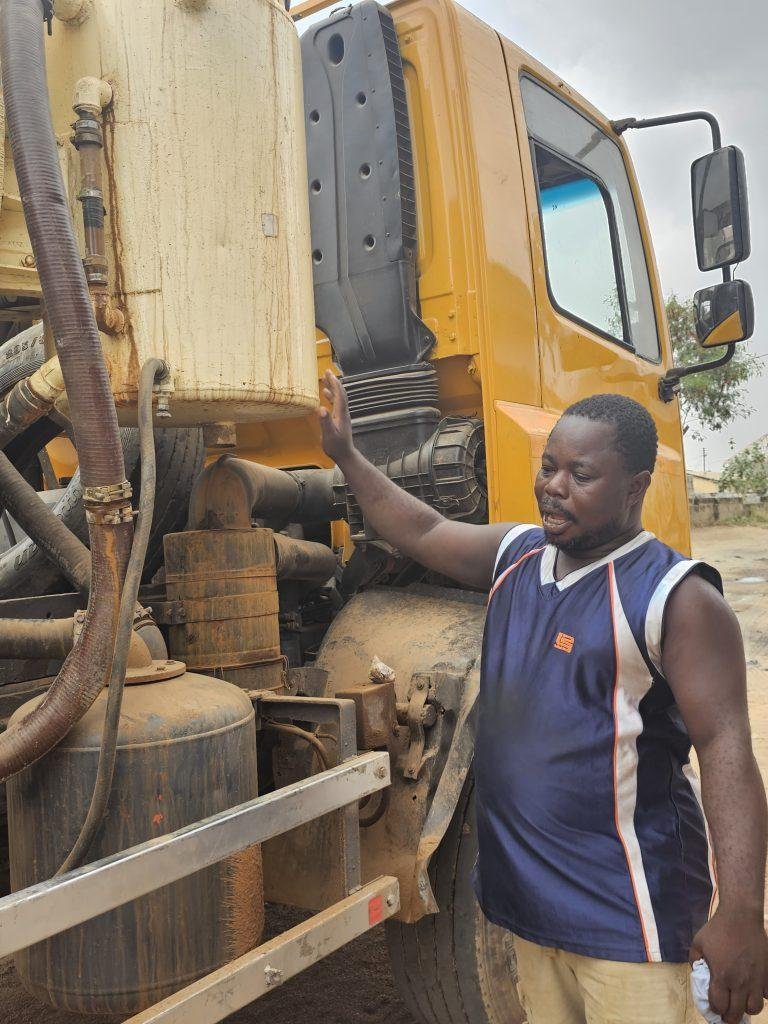
He said on a good day, he was able to serve four clients but when business goes slow, he struggles to get a single client. “In all honesty, I think it’s a good job which I’ll would recommend to anyone willing to join.”
Mr Abayateye who is in his 40s said he was in the business not just to make money but also keep the public clean.
He said although people disrespected them and liked to treat them without dignity, he was not perturbed.
He mentioned instances where clients even avoided talking to them when they went to their homes to offer their services because in their minds, the “toilet man” is not clean.
The father of four said some of their clients looked at them with contempt and would not even allow them to use their buckets to fetch water to help the process.
“These are the people who fails to appreciate that without us, their health can be compromised.”
In his view, persons in the waste business helped to curb open defecation, prevents diarrhoea and other health issues.
He said he was always happy to wake up to a new day of going round to take waste from people’s homes because he was able to give his children education and pay his bills to give his family a decent life.
He shared a joke about how some road users tried to avoid them on the road for fear of the collected waste spilling on them, the road or on their cars.
He said he tried ensuring that all the parts of the vehicle which could be used as a point of entry was well secured to prevent any air pollution or inconvenience to the public but reduce the danger to its barest minimum.
Mr Abayateye appealed to the government to prioritise sites for disposal of such waste to make the job more attractive and also keep the environment safe.
He also appealed on authorities to grant a subsidy on the cost of toilet waste trucks to attract more people into the profession to reduce the unemployment rate.
From Dzifa Tetteh Tay, Ashaiman



The spokesperson for Okuapehene, Ohenenana B.S. Opoku, has dismissed social media reports that there is insecurity in Okuapemam and for that matter an indefinite ban has been placed on the celebration of this year’s annual Odwira Festival.
Ohenenana Opoku, who is also a member of the Odwira Festival Planning Committee, said Odwira would be celebrated and all the necessary arrangements have been made for a peaceful celebration.
According to him, there is no merit in all the allegations on the media space because there has not been any chieftaincy dispute in any of the divisional heads in the area.
“There is absolute peace in Okuapeman, therefore, all Okuapeman citizens living in Ghana and abroad should come home to celebrate the Odwira Festival.”
In a press briefing at the Okuapeman Palace in Akropong on Friday, Ohenenana Opoku described the allegations as false, stating that all the divisional chiefs have been gazetted and recognised in Ghana’s Chieftaincy records.
He said Okuapemam has been celebrating Odwira Festival for the past five years under the leadership of Oseadeeyo Kwasi Akuffo III without any dispute.
He emphasised that Okuapeman constitutes 17 major towns with their own chiefs under Okuapemanhene and that nobody has the right to ban or stop any chief from celebrating it.
Ohenenana Opoku appealed to the people of Ghana to come and enjoy the Akuapem Odwira Festival which is one of the best cultures in Ghana.
In view of that, the Yagbonwura, Bii-Kunuto Jewu Saole, has accepted to grace the festival as the special guest of honour.
By Linda Abrefi Wadie
Join our WhatsApp Channel now!
https://whatsapp.com/channel/0029VbBElzjInlqHhl1aTU27
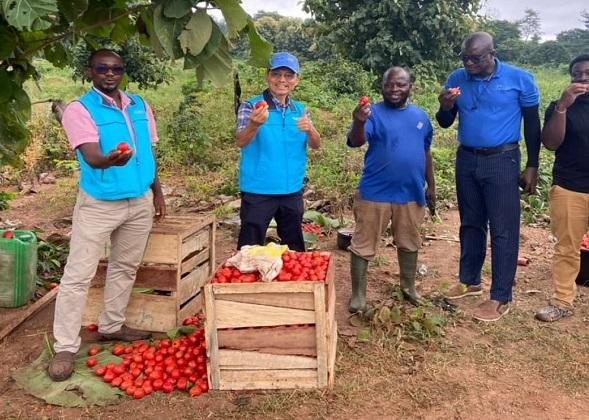
Childdren and pregnant women in Ghana are unknowingly being exposed to toxic levels of lead in everyday products, a new study by UNICEF and the Food and Drugs Authority (FDA) has revealed.
The nationwide study, which covered all 16 regions, found dangerous levels of lead contamination in items such as cosmetics, food, and household products, posing significant threat to public health, particularly to children and women of childbearing age.
A statement on the report copied to The Spectator in Accra on Monday explained that several commonly used items contained alarmingly high concentrations of lead.
Lead, a heavy metal used in batteries, paints, ceramics, and other industrial materials, is highly toxic even in small quantities.
Experts warn that it can cause irreversible brain damage, developmental delays, learning difficulties, and behavioural problems in children.
The study stressed that there were no safe levels of lead in the human body.
Traditional eyeliners known locally as kaji kaji or kholi, which many mothers use to brighten their children’s eyes, had contamination levels tens of thousands exceeding permissible limits.
White baked clay, called shire, ayilor, or farinkasa and commonly consumed by pregnant women to ease nausea, also tested positive for lead contamination in about 25 per cent of samples, with the highest rates recorded in the North East and Greater Accra regions.
Ground turmeric, a staple spice used across Ghana, was found to be contaminated in 42 per cent of samples, with particularly high levels in the Greater Accra (84 per cent), Central (75 per cent), and Bono (60 per cent) regions.
Similarly, locally prepared corn-based cereal (Tom Brown) showed lead contamination in 4.4 per cent of samples, mostly from the Eastern Region.
Old plumbing systems and certain cookware were also identified as possible sources of exposure, as lead can leak into drinking water or food during cooking.
The health impacts are severe. Lead exposure can cause anaemia, stunted growth, hearing loss, seizures, and pregnancy complications such as low birth weight and miscarriage.
UNICEF has, therefore, called for immediate national action to address the crisis, calling for public awareness campaigns, stricter enforcement of product safety standards, and routine screening for lead exposure, especially among vulnerable groups.
UNICEF reaffirmed its commitment to supporting the Government of Ghana and relevant partners to eliminate lead exposure and safeguard the health of every woman and child.
By Esinam Jemima Kuatsinu
Join our WhatsApp Channel now!
https://whatsapp.com/channel/0029VbBElzjInlqHhl1aTU27