News
Ghana’s industrial gold output sees 6% increment in 2019

Industrial gold output from Ghana, Africa’s top producer of the precious metal, increased six per cent in 2019 from the previous year while small-scale gold production dropped 20 per cent, the Chamber of Mines said in its annual general meeting held last Friday.
Industrial mines produced 2.989 million ounces of gold in 2019, up from 2.808 million ounces in 2018, according to the annual report of the Chamber, Ghana’s main mining industry association.
The drop in production from the small-scale gold sector – to 1.588 million ounces from 1.984 million ounces in 2018 – could be partly attributable to a clampdown on illegal mining, Chamber of Mines President Eric Asubonteng told a virtual AGM.
The mining sector was the second-biggest contributor to government revenue in 2019.
Its fiscal contribution increased by 70 per cent to 4.02 billion Ghanaian cedis ($701.6 million), from 2.36 billion cedis ($411.9 million) in 2018.
Gold mining companies active in Ghana include Newmont, Gold Fields, Kinross, and AngloGold Ashanti, whose redeveloped Obuasi mine started producing in December.
Among bulk metals, manganese output increased by 18 per cent and bauxite by 10 per cent.
Diamond production dropped by 41 per cent from 57,531 carats in 2018 to 33,789 carats in 2019.
Ghana was the second-most popular destination for mining exploration investment in Africa in 2019.
While neighbouring Burkina Faso drew $132 million, Ghana saw $98.6 million invested in exploration, according to the report. Mali came third in Africa, attracting $91.9 million.
Chamber of Mines President Asubonteng said the COVID-19 pandemic was causing significant uncertainty and could trigger a reversal of investment flows into Ghana.
“We don’t know what lies ahead,” he added.


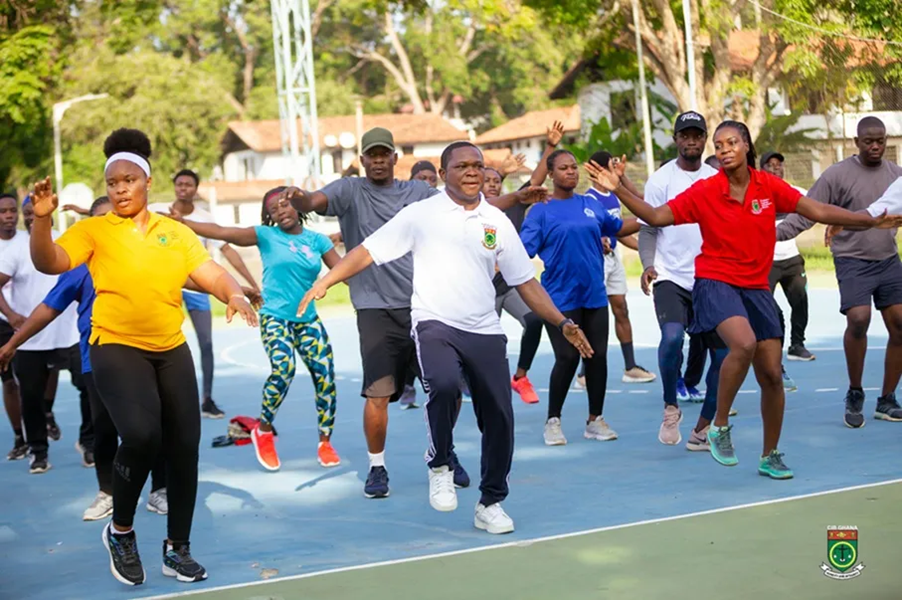
The Ghana Health Service (GHS) has urged Ghanaians to make regular physical activity part of their daily routines to improve blood glucose control and reduce the risk of developing Type 2 diabetes.
It said regular exercise helped the body use insulin more effectively, thereby improving blood sugar regulation and contributing to better overall health.
The call forms part of the Service’s 30-day diabetes awareness campaign ahead of this year’s World Diabetes Day, which is observed on November 14.
The GHS encouraged people to engage in simple physical activities such as walking, dancing, cycling and gardening.
It noted that staying physically active did not necessarily require expensive gym memberships, as everyday activities, including household chores, could contribute to maintaining an active lifestyle.
The Service advised adults to aim for at least 150 minutes of moderate-intensity physical activity each week, stressing the importance of starting with manageable activities and gradually building consistency.
It further encouraged people living with diabetes to combine regular physical activity with prescribed treatment and a healthy diet to help manage the condition.
The awareness campaign, being undertaken ahead of World Diabetes Day, is aimed at promoting healthy lifestyle choices and encouraging early action to prevent and manage diabetes.
This year’s World Diabetes Day is being observed under the theme “early action on diabetes,” with November 14 set aside to raise awareness of the condition and the importance of prevention, early detection and proper management.
By Esinam Jemima Kuatsinu
SKIP THE QUEUE, TAP THE NEWS
You can now read the Ghanaian Times and The Spectator newspapers from the comfort of your device via TimesNewsPlus.
Join our WhatsApp Channel: https://whatsapp.com/channel/0029VbBElzjInlqHhl1aTU27
We take certain things for granted but it should not be so, especially if you can read, write and understand what is said on TV and Radio in English. Usually at 7:00 pm, I watch the news on one of the popular media channels and it was no big deal until a few days ago.
As I listened to a radio presenter on a popular Fm station, the important role my parents played in my life, as far as education is concerned, suddenly dawned on me. The usual style at the start of the programme, is to play a very funny interaction between a man who identifies himself as Barry …and a Ghanaian man called Akwasi.
This Barry guy apparently was talking to Akwasi by phone and he was speaking in English and Akwasi asked him to speak English, meanwhile Akwasi did not understand the English language, so he quickly asked the Barry guy to change to Twi, when he realised that the intonation was not the normal Ghanaian one.
I really had a good laugh and that was when I realised that my parents had indeed helped me by giving me access to education.
Imagine going to enter a place and they have written push on the door frame and because you cannot read, you decide to assume that you need to pull the door towards you and the embarrassment you will go through, pulling with all your might and especially at places with glass doors at the main entrance, everybody watching you and you struggling with the door for quite a few seconds before deciding to push.
It is in moments like that, that you either start blessing your parents or otherwise, depending on whether they sent you to school or not. There are things we consider as little that we take for granted but in reality, it is a big deal if you are not educated.
I recently had to go to an office located in the Ridge Hospital area and it was located on one of the floors of a story building. The protocol requires that visitors to the place log their details in a book provided for that purpose.
You write the date, your name etc., the usual. Imagine for a moment that you are Akosua Seiwaa, an uneducated person, who is going to see someone in one of the offices in the building and you are required to fill the log book with your details. It suddenly generates a stressful situation for you.
The FM programme really set me thinking about how grateful we ought to be to our parents or guardians who gave us access to education such that we have the confidence to go boldly to all kinds of places without stress.
Just imagine going to a hospital and given a whole bunch of medication. As is usually the case, the pharmacist mentions your name and immediately starts telling you the number of times and the various dosage you are to take them.
He or she then goes to the next person and chances are you are likely to forget some of the instructions. If you are uneducated, how are you going to identify the right dosages and any other special instructions you need. There is a saying that ‘If you can read this, thank a teacher.’ I think it should rather be, ‘If you can read this, thank your parents.’
There was another recording of a hilarious conversation on the show between two ladies one of whom was uneducated and did not understand “It’s been a while”. Apparently a church member met her and she said to her it’s been a while and did not know how to respond till a young girl she was walking with explained to her in Twi “Ose ohuu wo aky3”.
She was bitterly complaining to the friend that had it not been the young girl, she would have been greatly embarrassed with this “it’s been a while, it’s been a while” that the church member said to her. Do not laugh alone. Share. God bless.