Hot!
Eschew corruption – Nana Addo tells judges

- /home/u249204778/domains/spectator.com.gh/public_html/wp-content/plugins/mvp-social-buttons/mvp-social-buttons.php on line 27
https://spectator.com.gh/wp-content/uploads/2022/07/7-696x432-1.jpeg&description=Eschew corruption – Nana Addo tells judges', 'pinterestShare', 'width=750,height=350'); return false;" title="Pin This Post">
- Share
- Tweet /home/u249204778/domains/spectator.com.gh/public_html/wp-content/plugins/mvp-social-buttons/mvp-social-buttons.php on line 72
https://spectator.com.gh/wp-content/uploads/2022/07/7-696x432-1.jpeg&description=Eschew corruption – Nana Addo tells judges', 'pinterestShare', 'width=750,height=350'); return false;" title="Pin This Post">
President Nana Addo Dankwa Akufo-Addo has said sixty (60) district courts, sixty (60) bungalows for judges, and three (3) new high courts for three (3) of the six (6) newly created regions will be commissioned before the start of the legal year in October.
According to President Akufo-Addo, the government has taken note of the inadequate numbers of courts in various parts of the country, resulting in citizens travelling long distances to gain access to courts, and has decided to remedy this situation.
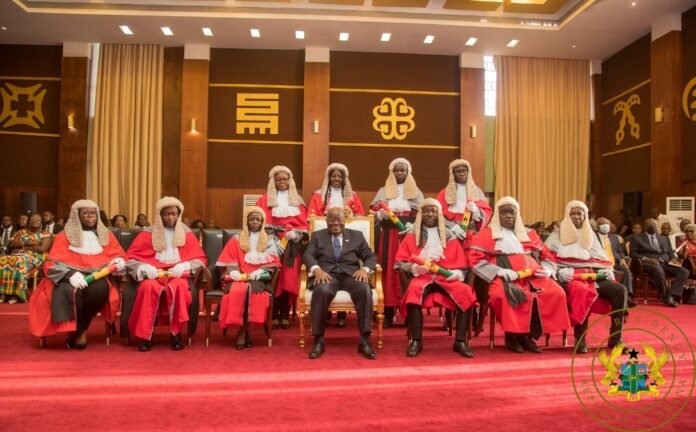
Speaking at the swearing-in of ten (10) new High Court Judges, on Monday, July 18, 2022, at Jubilee House, the President stated that Government, through the Administrator of the District Assembly Common Fund, is constructing one hundred (100) new courts and bungalows for Judges in all sixteen (16) Regions of the country.
They are broken down in the various Regions as follows – twenty (20) courts and twenty (20) bungalows in Ashanti; twelve (12) courts and twelve (12) bungalows in Eastern; eight (8) courts and eight (8) bungalows in Greater Accra; eight (8) courts and eight (8) bungalows in Volta; eight (8) courts and eight (8) bungalows in Ahafo; seven (7) courts and seven (7) bungalows in Western; and five (5) courts and five (5) bungalows in Bono East.
The rest are five (5) courts and five (5) bungalows in North East; four (4) courts and four (4) bungalows in Oti; four (4) courts and four (4) bungalows in Western North; four (4) courts and four (4) bungalows in Central; four (4) courts and four (4) bungalows in Bono; three (3) courts and three (3) bungalows in Northern; three (3) courts and three (3) bungalows in Savannah; three (3) courts and three (3) bungalows in Upper East; and two (2) courts and two (2) bungalows in Upper West.
“Sixty percent (60%) of these courts and bungalows have been completed, and will be commissioned before the start of the legal year in October. The remaining forty percent (40%) will be duly completed and commissioned by the end of the first quarter of 2023,” President Akufo-Addo said.
He continued: “Six new Regional High Courts are also being constructed in the newly created regions, i.e., Ahafo, Bono East, North East, Oti, Savannah and Western North. Three of the Courts, that is those in Ahafo, Bono East and Oti Regions, will be completed and ready for commissioning, again, before October. The other three, that is those in North East, Savannah and Western North, which are at eighty percent (80%) completion, will be ready for commissioning by the end of the first quarter of 2023.”
It will also be recalled in April last year, the President cut the sod for commencement of work on a new, modern Court of Appeal complex in Kumasi, together with twenty (20) townhouses and a guesthouse to serve as permanent residences for Court of Appeal Judges based in Kumasi, who will be mandated to handle appeals from the northern part of the country.
President Akufo-Addo noted that “they will be completed and commissioned in September”, adding that “two hundred and ten (210) vehicles were, earlier this year, distributed to all judges in the Supreme Court, Court of Appeal, High Courts and Lower Courts.”
These, the President reiterated, are all initiatives being undertaken by Government to strengthen the capacity of the Judiciary.
High Court Judges
Swearing the new High Court Judges in, upon the advice of the Judicial Council, given in accordance with the provisions of article 144 clause 3 of the Constitution, he indicated that they are eminently fit and qualified for the position of Justices of the High Court, and have the impartiality of mind and independence of spirit necessary to hold this high office.
They are Her Honour Mercy Adei Kotei, Mrs. Cynthia Martinson, Dr. Bridget Kafui Antonio-Apedzi, Ms. Nabeela Naeema Wahab, His Honour Ebenezer Osei-Darko, His Honour Bernard Bentil, His Honour Alexander Graham, George Kwame Gyan-Kontoh, Richard Apietu and Eric Ansah Ankomah.
With the High Court described as a superior court of record, with original, general jurisdiction as a tribunal of first instance, President Akufo-Addo told the new Judges to exhibit honesty, integrity and a sound knowledge of the law.
“A corrupt or incompetent judge is a danger to the public interest and judicial administration. The situation, where judges proffer judgements on the basis of decisions from lower courts and cite them as law, is not acceptable, and even less so, when judges cite no authority at all for their rulings, and give orders without reasons,” he added.
The President continued: “You must be learned, know your case law and ensure your decisions and judgements are properly motivated. The principle of stare decisis, the ancient common law doctrine of precedent, has been, and continues to be the time-honoured foundation for the coherent development of the law, and should not be lightly discarded.”
Source: www.pulse.com.gh


The University of Ghana Medical Centre (UGMC) has disputed claims made on social media by comedian Michael Blackson concerning the treatment given to his late mother, saying a review found that the allegations did not accurately reflect what happened during her stay at the hospital.
In a statement issued in Accra on August 5, 2026, the management of UGMC expressed condolences to Mr. Blackson and his family over the death of his 83-year-old mother, who died at the facility on July 16, 2026.
The hospital said it had taken the concerns raised by Mr. Blackson seriously and conducted a thorough review in line with its clinical and administrative procedures.
According to the statement, the facts presented by Mr. Blackson on social media contained “numerous inaccuracies” and did not accurately reflect the medical care provided to his mother.
UGMC explained that she was referred to the facility from another hospital and received treatment there from May 27 to July 16, 2026, a period of about eight weeks.
The hospital stated that it would not release details of her diagnosis, treatment, medical records or other aspects of her care because it had a duty to protect patient confidentiality, even after death.
It said the decision was intended to respect the dignity of the deceased and the privacy of her family.
UGMC further stated that all clinical decisions at the facility are made by qualified healthcare professionals based on medical judgment, established standards of care and the best interests of the patient.
The statement added that such decisions are made in consultation with authorised family representatives where necessary and that billing and financial procedures are governed by institutional policies and are separate from clinical decision-making.
The hospital noted that it values feedback from patients and their families and considers both positive and negative comments important for improving the quality of care.
Mr. Blackson had earlier used social media to criticise the care his mother received at UGMC, prompting the hospital’s response.
By: Jacob Aggrey
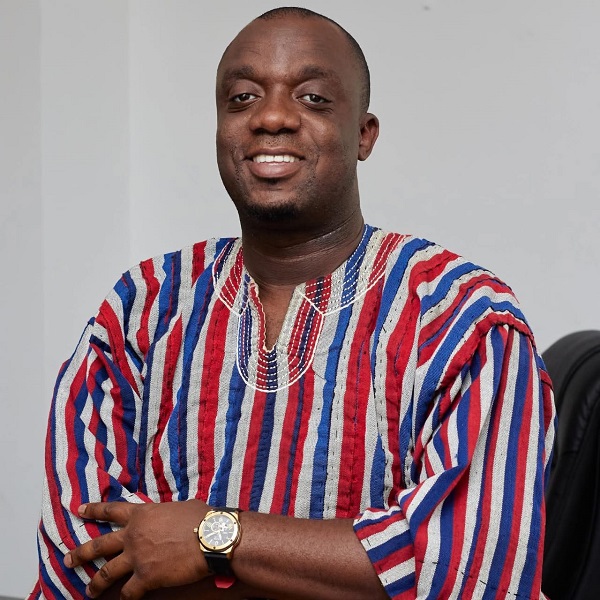
The New Patriotic Party (NPP) has directed all aspirants campaigning in the Greater Accra Region to suspend their campaign activities on August 5 and 6 and instead mobilise supporters for the party’s planned “Democracy Under Attack” demonstration.
The directive was issued by the party’s National Steering Committee in a statement signed by the NPP General Secretary, Justin Kodua Frimpong, on Tuesday.
According to the statement, the decision forms part of efforts to ensure a strong turnout for the demonstration, which is scheduled for Thursday, August 6, 2026.
The party said the protest would begin at 5:00 a.m., with participants expected to gather at the Supreme Court in Accra.
It further directed Regional, Constituency and Polling Station Executives in Greater Accra to work closely to mobilise members and supporters for the event.
“The National Steering Committee is calling on all aspirants currently campaigning across the Greater Accra Region to temporarily suspend their campaign activities on the 5th and 6th of August and join in mobilising support for the upcoming demonstration,” the statement noted.
The NPP appealed to party members and supporters to remain peaceful, disciplined and orderly throughout the protest.
The demonstration forms part of the party’s response to concerns it has raised over issues relating to Ghana’s democratic governance and the justice system.
The NPP leadership expressed confidence that party members would cooperate fully to ensure a successful and peaceful event.
By: Jacob Aggrey