Editorial
Congratulation! King Charles III of Great Britain

- /home/u249204778/domains/spectator.com.gh/public_html/wp-content/plugins/mvp-social-buttons/mvp-social-buttons.php on line 27
https://spectator.com.gh/wp-content/uploads/2023/05/King-Charles-III-and-Queen-Camilla-wave-the-crowd-after-the-ceremony.jpg&description=Congratulation! King Charles III of Great Britain', 'pinterestShare', 'width=750,height=350'); return false;" title="Pin This Post">
- Share
- Tweet /home/u249204778/domains/spectator.com.gh/public_html/wp-content/plugins/mvp-social-buttons/mvp-social-buttons.php on line 72
https://spectator.com.gh/wp-content/uploads/2023/05/King-Charles-III-and-Queen-Camilla-wave-the-crowd-after-the-ceremony.jpg&description=Congratulation! King Charles III of Great Britain', 'pinterestShare', 'width=750,height=350'); return false;" title="Pin This Post">
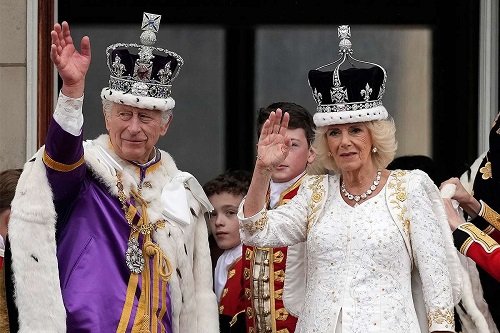
King Charles III and Queen Camilla wave the crowd after the ceremony
Dear Editor,
The old order changeth yielding place to new. Lest one old custom should corrupt the world. God fulfils Himself in many ways. I have lived my life and that which I have done, may God Himslef make pure…But thou, if thou should not see my face again, pray for my soul” — King Arthur of Great Britain, ancient time.
It is much considered that Prince Charles’ coronation which took place on Saturday, 6th May, 2023, at Burkingham Palace, England, attracted numerous world leaders. Prominent among them were delegations from the Former British colonies of which Ghana’s President, His Excellency Nana Addo Dankwa Akufo Addo, The Asantehene, King Osei Tutu II, and others were there to grace the ceremony.
By courtesy of CITI TV, viewers were able to witness the grandeous dimension of the ceremony which was not only solemn, but also with an air of mixed feelings of sadness and joyous moments.
Sadness, because Her Royal Majesty Queen Elizabeth II, of blessed memory, who had immensely endeared herself to the world was no more to be accorded Britain’s National Anthem of “God Save the Queen”, but whilst in her deep eternal peaceful rest, had her son, as required by British culture and norms to be accordingly crowned King Charles III of Great Britain in her succession.
May I at this moment ask readers to join me heartily say congratulations to His Majesty King Charles III and to hereby join all the British people in singing the chorus of the new British National Anthem, “God Save the King….”
It is our earnest prayer that the new King be equally granted longer life whilst on the throne and be of great blessing not only to the people of Great Britain but the world at large.
It is also believed that Britain as well as the world will have to accord unflinching support to the New King just as he in turn will have to be fair and firm in the discharge of the onerous responsibility that lies ahead of him to ensure lasting world peace, stability and order.
Considering the wide range in age difference between King Charles III and his immediate predecessor, Queen Elizabeth II in the ascension to the sacred British Throne, let us all with one accord wish King Charles III success on the throne in the years ahead.
J.K Tetteh-Kpojie,
P.O.Box 10, Somanya, E/R.
0557672086


Dear Editor,
Before we start blaming the government, the authorities and how bad our roads are, perhaps we should first ask ourselves what role we played in making our roads unsafe.
Road safety is often discussed as though it is solely the responsibility of the government and law enforcement agencies, neglecting our roles we play to make the roads unsafe.
While authorities have an important role to play, the behaviour of individual road users remains equally important.
A driver who speed, overtakes recklessly, uses phone while driving or drives when tired is making a decision that could affect many lives.
A motorcyclist who ignored traffic light and also refuse to wear a helmet, passengers who encourage the driver to speed and the pedestrians who crosses a busy road carelessly can also contribute to danger.
We must therefore develop a strong culture of personal responsibilities on our roads.
Drivers should obey speed limit, avoid distractions and ensure their vehicles are road worthy, passengers should also not encourage reckless driving simply because they want to arrive at their destination quickly whiles pedestrians must also exercise greater caution when crossing roads.
At the same time authorities must continue to improve road infrastructures, enforce traffic regulations consistently and educate the public about responsible road use.
Road safety cannot succeed through enforcement alone; it requires change in attitude. If each road user understand that another person’s life may depend on their decision, our road can become safer.
Let us not wait for another crash before we remember the value of life. Thank you for the space.
From Akwasi Aaron
Accra.
Dear Editor,
I was concerned by a point raised during a radio review about the growing expectation among some parents that once their children attend government schools, particularly under the Free SHS programme, the government must provide virtually everything they need.
This mindset deserves serious public discussion.
The introduction of Free SHS has undoubtedly lifted a significant financial burden from parents. Government is already absorbing substantial costs associated with the education of thousands of Ghanaian children. Students in public second-cycle institutions also benefit from provisions such as tuition support, meals and other essential services.
However, Free SHS should not be interpreted as free parenting. A parent should not expect the government to provide every personal item a child needs simply because the child attends a public school. Items such as mattresses, sponges, toiletries, clothing, chop boxes and other personal necessities should, where possible, remain part of the parent’s responsibility.
The same principle applies at the basic-school level. Government has a responsibility to provide quality education and create an enabling environment for children to learn. Parents, however, have an equally important responsibility to support their children’s education and welfare.
Government cannot and should not replace the family. When parents gradually transfer every responsibility to the state, we risk creating a culture of dependency in which citizens expect government to solve every personal problem. That is neither sustainable nor healthy for our development as a nation.
We must therefore appreciate the support government provides while recognising that education is a shared responsibility. Parents must continue to contribute according to their means, schools must do their part, and government must continue providing the necessary educational infrastructure and support. Rather than asking, “What else will government give us?” parents should also ask, “What can I do to support my child’s education?”
Free education is a public investment, not an invitation for parents to abandon their responsibilities. Ghanaians must therefore change the mentality that government must provide everything. The state can carry a significant portion of the burden, but the family must never surrender its responsibility.
Free SHS should make education more accessible not make parenting optional.
From Desmond Aidoo
Sowutuom