News
Citi FM Channel One TV unveil enhanced Literacy Challenge programme


Citi FM and Channel One TV have unveiled an enhanced version of their Literacy Challenge, aimed at promoting critical thinking, digital literacy and academic excellence among basic school pupils across the country.
Launching the 2026 edition of the competition in Accra last Wednesday, Head of Programmes Production at Channel One TV, Ms Apiokor Seyiram Ashong- Abbey, said the initiative had evolved significantly since its introduction in 2008 as an essay-writing competition known as ‘The Write Away Contest.’
She explained that while the programme initially focused on writing and communication skills, changing educational and technological trends had made it necessary to broaden the concept of literacy.
“Literacy today is no longer limited to reading and writing. It also includes digital literacy, critical thinking and the ability to apply knowledge to solve problems,” she stated.
According to Ms Ashong-Abbey, the competition currently has three stages: an essay competition, an aptitude test and a live quiz contest.
Participants will first submit essays on a selected topic, after which the best entries will be shortlisted. A minimum of six students will be selected from each of the 16 regions to ensure broader national representation.
The shortlisted students will then sit for an aptitude test comprising 100 application-based questions designed to assess reasoning and problem-solving abilities. The top contestants from each region will advance to a team-based quiz competition.
Ms Ashong-Abbey said the competition achieved a major milestone in 2025 when it recorded strong participation from all 16 regions of Ghana.
The winning regional team will receive GH¢15,000, trophies, medals, certificates and laptop computers. In addition, the overall most outstanding student will receive an extra GH¢5,000.
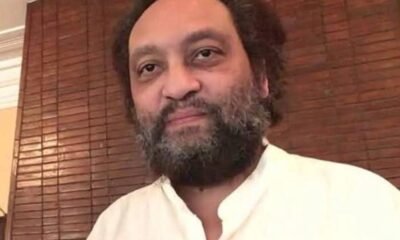
Also speaking at the event, educationist Anis Haffar underscored the importance of critical thinking in an era increasingly influenced by artificial intelligence (AI).
He noted that while technology had transformed access to information, it could not replace human values, creativity and independent reasoning.
“Critical thinking is one skill that AI cannot do for us. We must teach our children to think for themselves and become responsible citizens,” he said.
By Esinam Jemima Kuatsinu





News
GES directs Ashanti Regional, Obuasi Municipal Education Directors to step aside over Obuasi SHTS scandal

The Management of the Ghana Education Service (GES) has directed the Ashanti Regional Director of Education, Dr. William Amankrah Appiah, and the Obuasi Municipal Director of Education, Mr. Kwamena Owusu-Nketiah, to step aside with immediate effect.
The directive forms part of ongoing investigations into allegations of sexual misconduct involving the headmaster of Obuasi Senior High Technical School (SHTS), Mr. Zakaria Abdulai.
According to GES, the decision is intended to ensure that the investigations proceed without potential interference, nor the perception of it.
The two directors are to hand over their offices and all state property in their possession to the Deputy Ashanti Regional Director of Education, Mr. Thomas Kwame Boateng.
Management added that the headmaster, Mr. Zakaria Abdulai, also remains interdicted and therefore urged the public to ignore any news circulating that he has been cleared.
Management is calling for calm, support and cooperation as thorough investigations into the matter continue.
By Edem Mensah-Tsotorme
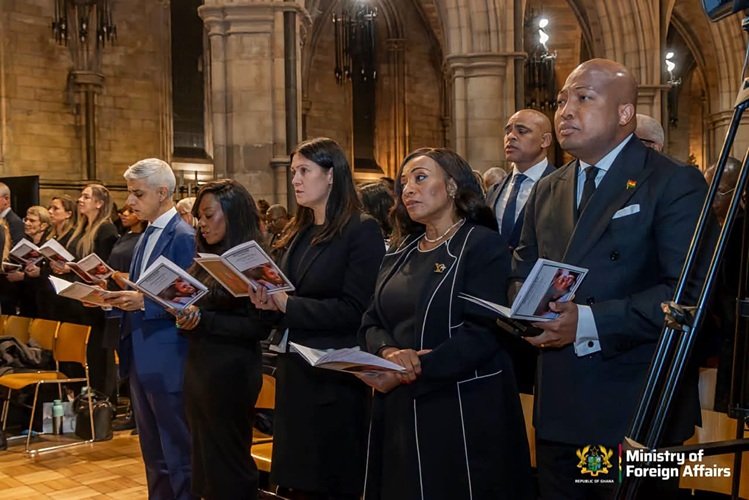
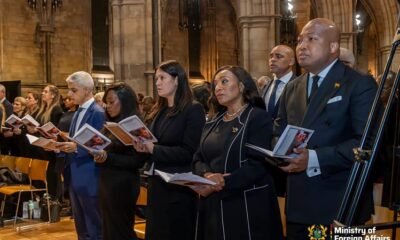
The Minister for Foreign Affairs, Samuel Okudzeto Ablakwa, has joined the family of the late Professor Jason Atta Kwei Arday, the Ghanaian community in the UK, and other dignitaries for a memorial service in Southwark, UK.
In a post, Mr. Ablakwa described the service as deeply moving and unforgettable, held in honour of the late professor’s memory.
According to him, in keeping with the government’s pledge, he joined the family, Ghana’s High Commissioner to London, British MPs, Ministers, the Mayor of London, Cambridge scholars, Prof. Arday’s students and loved ones to pay respects and honour his inspiring legacy.
Mr. Ablakwa noted that Prof. Arday’s accomplishments as the youngest Black professor appointed at the University of Cambridge and his widely appreciated charitable contributions will continue to inspire generations.
“The Government and People of Ghana will continue to stand by our compatriots everywhere they are in the world. As we do so, we profess our commitment to justice, equality and the creation of a new world,” he said.
He prayed for fortitude for the family in what he described as an extraordinarily difficult time.
“We shall always remember Prof. Arday for his response when asked what he will wish to do to change the world: ‘I would take a thread and a needle, and I’d interweave love into our society’,” Mr. Ablakwa added.
By Edem Mensah-Tsotorme