Hot!
ANU President underscores the need for well-trained emergency medicine workforce to support healthcare delivery

- /home/u249204778/domains/spectator.com.gh/public_html/wp-content/plugins/mvp-social-buttons/mvp-social-buttons.php on line 27
https://spectator.com.gh/wp-content/uploads/2023/11/20231118_115332.jpg&description=ANU President underscores the need for well-trained emergency medicine workforce to support healthcare delivery', 'pinterestShare', 'width=750,height=350'); return false;" title="Pin This Post">
- Share
- Tweet /home/u249204778/domains/spectator.com.gh/public_html/wp-content/plugins/mvp-social-buttons/mvp-social-buttons.php on line 72
https://spectator.com.gh/wp-content/uploads/2023/11/20231118_115332.jpg&description=ANU President underscores the need for well-trained emergency medicine workforce to support healthcare delivery', 'pinterestShare', 'width=750,height=350'); return false;" title="Pin This Post">
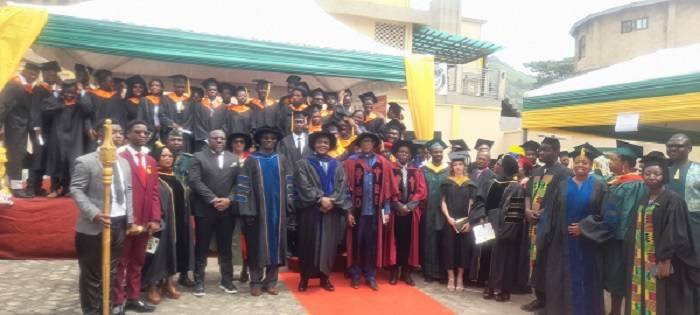
A GROUP PHOTO OF MANAGEMENT OF ANU AND GRADUATES
President of the All Nations University (ANU), Dr Samuel Donkor has stated the need for the country to have a well-trained emergency medicine workforce to support healthcare delivery.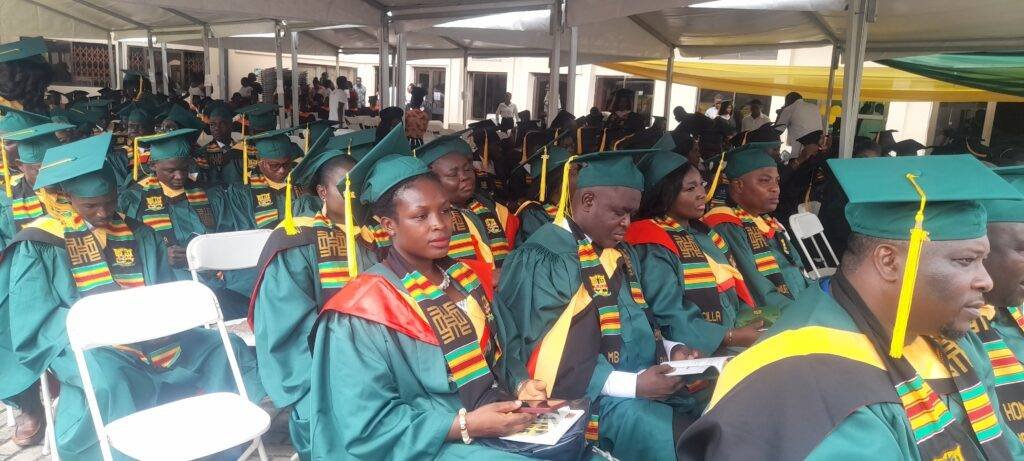
According to him, such an emergency medicine workforce could help streamline the healthcare system by reducing overcrowding in emergency departments, improving triage processes, and efficiently managing resources in the country’s hospitals.
“This will enable a smooth transition from the scene of emergency to the hospital and will allow for timely interventions which will ultimately lead to cost savings,” he said.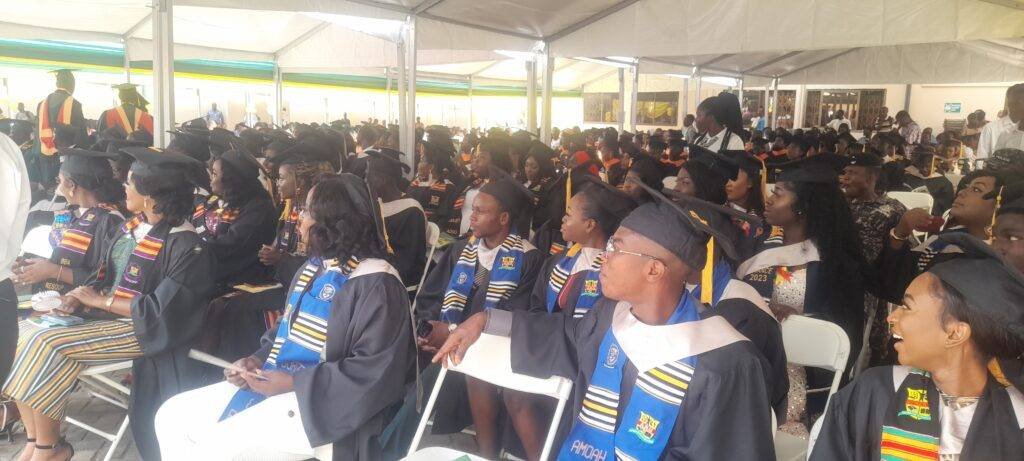
Dr Samuel Donkor made this known during the 30th Convocation ceremony of the graduating class of 2023 held in Koforidua on the theme: “The Impact of Emergency Services on Ghana’s Healthcare Delivery.”
The graduation ceremony saw the first batch of 57 Graduate students graduating from the university in various disciplines including Human Resource Development, Banking and Finance, and Accounting, among others.
258 Undergraduate and eight Diploma students also graduated from the university in the same disciplines.
Dr Donkor continued that although Ghana’s healthcare system has made progress in improving access to care and health outcomes, it was important for healthcare facilities to get a well-trained emergency medicine workforce to help resolve issues of overcrowding and ensure quick response to emergency cases to save lives.
He said the workforce has become necessary, especially after the devastation of the COVID-19 pandemic which has wreaked havoc on many educational institutions and the lives of countless individuals.
Dr Donkor said the University has received accreditation to offer a 4-year-Bachelor’s degree in Emergency Medicine Technology, where healthcare professionals would be trained with skills and knowledge to provide immediate and appropriate emergency care.
He stated that the training of such professionals could help to significantly improve patients’ outcomes and would help to reduce morbidity and mortality rates.
“Pre-hospital is a critical component for emergency injuries in accidents, heart attacks among others and pre-hospital interventions can significantly affects a patient’s outcome and are akin to the care provided in the hospital,” he said and added that well-trained graduates would provide first aid, emergency and disaster management to victims before they get to the hospital.
He added that graduates would have numerous opportunities to work with the Ghana Ambulance services, Police, and Army among others.
Congratulating the graduates, Dr Donkor stated that the graduates after acquiring their degrees have embarked on a new journey to the unknown and urged them to use the knowledge and skills acquired to achieve higher heights while he hoped that would prosper in good health for successful careers in their future endeavours.
For his part, the Executive Chairman of JL Holdings and Member of the Board of Governors of ANU, Dr James Orleans-Lindsay noted that estimates suggested that emergency care could address 54 to 90 per cent of deaths and 900 million to 2.5 billion disabilities in low and middle-income countries.
He said the data underscores the need for sufficient logistics, infrastructure, education and training of the human resources to help save lives in the country, and added that ANU’s desire to contribute to the global paradigm was heartwarming.
He said the theme was a call to action and a reminder of collective responsibility towards building a resilient and compassionate nation and urged stakeholders to support and strengthen emergency services by ensuring that the country continued to thrive in unforeseen challenges.
From Ama Tekyiwaa Ampadu Agyeman, Koforidua


General Secretary of the New Patriotic Party (NPP), Justin Kodua Frimpong, has filed his nomination to contest the position of General Secretary again as the party begins its rebuilding efforts ahead of the 2028 general elections.
He was accompanied by party stalwarts and supporters who were in high spirits, expressing confidence that he is the right person to hold the position.
Speaking after filing his nomination, Mr Kodua Frimpong assured the rank and file of the party that he would not disappoint them.
“I can assure you that the faith the rank and file of the party have had in me, I will never disappoint them,” he said.
He also pledged to run a clean campaign devoid of personal attacks.
“I can assure you that our internal campaign will be devoid of personal attacks,” he told his fellow contestants and the rank and file of the party as he seeks to retain his position.
His tenure has seen the party through the 2024 general elections, where the NPP lost power to the National Democratic Congress (NDC) after eight years in government.
The party is currently in a rebuilding phase, with internal elections scheduled to elect new national executives to lead its reorganization towards the 2028 polls.
The General Secretary position is considered one of the most influential in the party’s administrative structure, responsible for the day-to-day running of the party secretariat and implementation of party decisions.
By Edem Mensah-Tsotorme

The University of Ghana Medical Centre (UGMC) has disputed claims made on social media by comedian Michael Blackson concerning the treatment given to his late mother, saying a review found that the allegations did not accurately reflect what happened during her stay at the hospital.
In a statement issued in Accra on August 5, 2026, the management of UGMC expressed condolences to Mr. Blackson and his family over the death of his 83-year-old mother, who died at the facility on July 16, 2026.
The hospital said it had taken the concerns raised by Mr. Blackson seriously and conducted a thorough review in line with its clinical and administrative procedures.
According to the statement, the facts presented by Mr. Blackson on social media contained “numerous inaccuracies” and did not accurately reflect the medical care provided to his mother.
UGMC explained that she was referred to the facility from another hospital and received treatment there from May 27 to July 16, 2026, a period of about eight weeks.
The hospital stated that it would not release details of her diagnosis, treatment, medical records or other aspects of her care because it had a duty to protect patient confidentiality, even after death.
It said the decision was intended to respect the dignity of the deceased and the privacy of her family.
UGMC further stated that all clinical decisions at the facility are made by qualified healthcare professionals based on medical judgment, established standards of care and the best interests of the patient.
The statement added that such decisions are made in consultation with authorised family representatives where necessary and that billing and financial procedures are governed by institutional policies and are separate from clinical decision-making.
The hospital noted that it values feedback from patients and their families and considers both positive and negative comments important for improving the quality of care.
Mr. Blackson had earlier used social media to criticise the care his mother received at UGMC, prompting the hospital’s response.
By: Jacob Aggrey