Hot!
An expedition through Prince Kojo-Hilton’s world of art


Prince Kojo-Hilton is not new to the art industry. He has over 18 years experience as an innovative Art Director, producing dynamic visuals for both theatre and film projects.
He is an expert in graphic design, art direction and project management with his works gaining local and international recognition.


Today, The Spectator delves into his artistic background while focusing on one of his works known as the ‘Amanua’, produced in May 2020, to celebrate the hard work of health workers in Africa for their dedication to the fight against COVID-19.
Artwork
The piece of art gives a summary of the genesis and exodus of the corona virus in Africa and is described as “a historical piece that must be well secured while taking a tour around the world.”
The name AMANUA, according to the artist is of Ga origin and an acronym for “Art Movement Against Novel-coronavirus Upon Africa.”
He believes the “true duty” of an artist is to solve problems hence the decision to initiate the project as a contribution towards combating the deadly disease. Mr Hilton said he intended to auction the piece of art and donate the funds to health workers.
Elements of the colourful painting, he explained, include “a graveyard with dead creepy trees, representing the millions of lives lost or otherwise impacted by the pandemic, and the overall decimation of economies worldwide.”
‘Amanua’ depicts a nurse armed with a sword and shield as she cuts a virus particle behind her into two. With a stethoscope around her neck, a breast watch, and her name tag, ‘AMANUA’, the nurse stands on a rock with cracks on the surface.
The rock, he says, signifies the government, World Health Organisation and the many institutions working to combat the disease while the cracks refer to challenges the government and organisations face.
Among several other relatable ideas, the art again has the Adinkra Symbol, “Gye Nyame”, meaning “Except God” symbolising the gravity of the pandemic and the content or orgin of the Art piece.
Apart from the attractive concepts, the Afrocentric ‘Amanua’ masterpiece, according to the designer, represents courage and sacrifice.
Background
Prince Kojo-Hilton is a product of the National Film and Television Institute (NAFTI) with a major in Art Direction and Production Design (2014).
Due to his hard work, passion and creativity, he had the opportunity to understudy his uncle, Dr. Johnson Edu, at the Technical Department of the National Theatre, Accra. From this point, he took his career to another level.
He studied scenic design, props design, make-up and special effects, set design and construction, among others. He had, over the years, applied his skills on a number of projects and has gained recognition as the first artist to create “the first ever man-made Volcano in Africa” for the Guinness’ Big Eruption Concert in Accra.
He has worked on a number of films, TV commercials, TV studio sets, music videos, theatre productions and many live stage events.
Describing himself as “a hard worker with great time management skills and the ability to meet deadlines,” he says he enjoys working within organisations with opportunities for professional development and job satisfaction.
Experience
Adding to his repertoire, he has worked as a Scenic Artist with Hollywood Directors of The Matrix Trilogy (the Wachowskis) on the science fiction series ‘Sense 8’ which was shot in Nairobi, Kenya, in 2014.
As an art advocate, he has trained and mentored many young talents in Ghana, Nigeria, Gambia, Kenya, and South Africa.
In August 2021, he was sworn in as a Special Envoy by the United Nations Youth Association of Ghana (UNYA-GH) at the International Youth Day Celebration held at the Accra International Conference Centre.
In 2020, he was awarded an Honorary Doctorate by the International Forum for Creativity and Humanity, Morocco and again received the ‘2020 Extraordinary People Award’ by La Expose Productions, USA.
He was adjudged Production Designer of the Year in 2016 at the Osagyefo Pan Africa Eminence Awards, and in 2017, he received an Honorary Award from the School of Performing Arts, University of Ghana, Legon.
Recognition
He is the Pan African Art Ambassador – Pan African Republic Honorary Awards, a Lifetime achievement Award he received from The Confederation of Governance Assessment Institute since 2019.
He was nominated for Gold Coast Excellence Awards in 2019, and received also the 40 Under 40 Award for the Theatre and Arts category in 2019.
University of Yale awarded him a Citation of Inspiration in 2018. Same year, two of his best stage design works were selected and displayed at the Prague Quadrennial of Performance Design and Space in Czech Republic.
As African Section for Set Design and Costume, 2019, in Nigeria, he was celebrated as a Living Legend by the World Institute of Peace and became the recipient of the World Icon of Peace Award.
Other events and Projects initiated by Kojo-Hilton include: Supports Arts Foundation (SAF), The Arts Legendary Wall of Fame Honours, The CombArt Show, Hilton Honorary Art Awards, Pan African States University of Art (PASUA) and The Community Art Festival (TCAF), among others.
He is the Founder of Visual Art Students Empowerment Project (VASEP) and former Greater Accra Regional Chairman of Ghana Association of Visual Artists (GAVA).
By Spectator Reporter


The professor who spends his days exploring the intricacies of African languages found himself at the centre of a different kind of lesson on Friday, October 2, 2026. 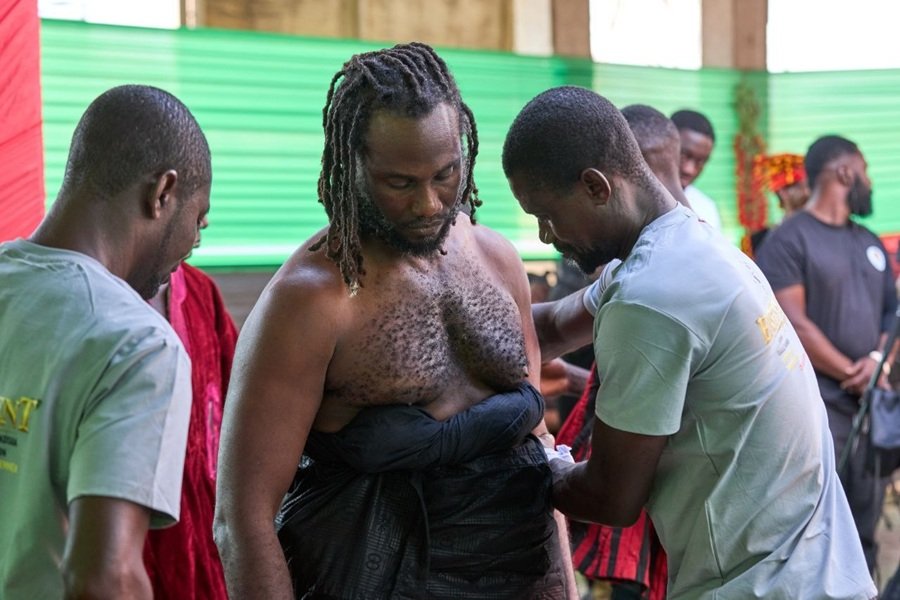
This time, there were no lecture notes, academic arguments or university classrooms. Instead, there was the weight of tradition, the rhythm of a community celebration and the solemnity of an oath at a royal palace.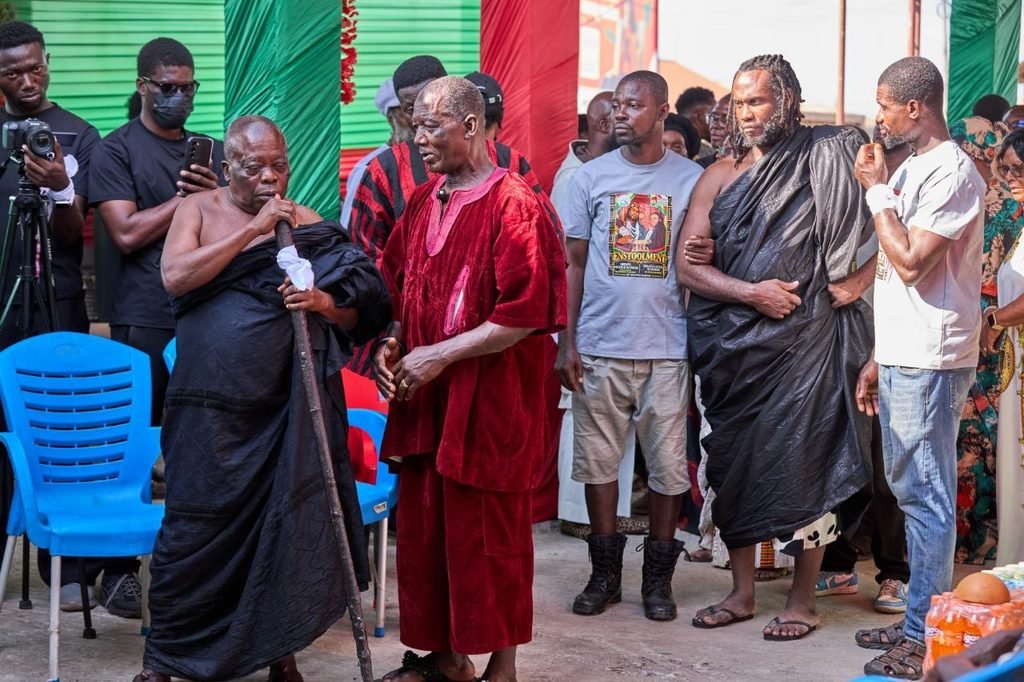
Professor Ọbádélé Kambon, a full Professor of African Linguistics at the University of Ghana, was enstooled as Apagyahene and Sunsum Ɔsahene of Akuapem Mampong in the Eastern Region in a ceremony that brought academia and traditional authority together.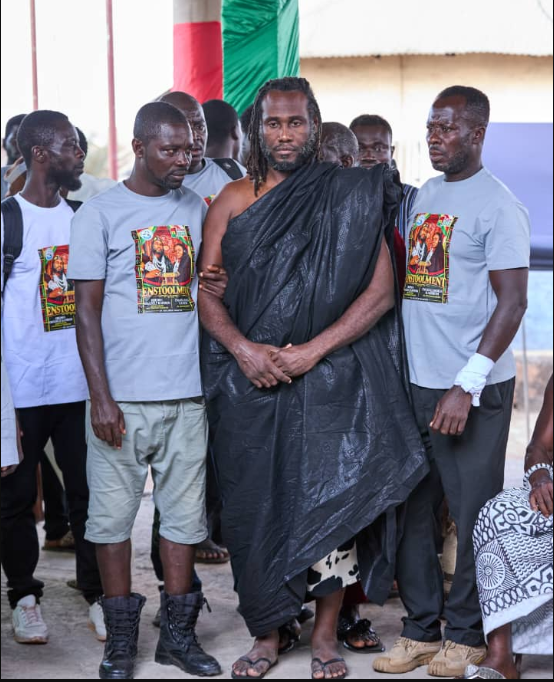
For the professor, the occasion was more than a new title. It was a moment that connected his academic interests in African languages and indigenous knowledge with the living traditions of an Akan community.
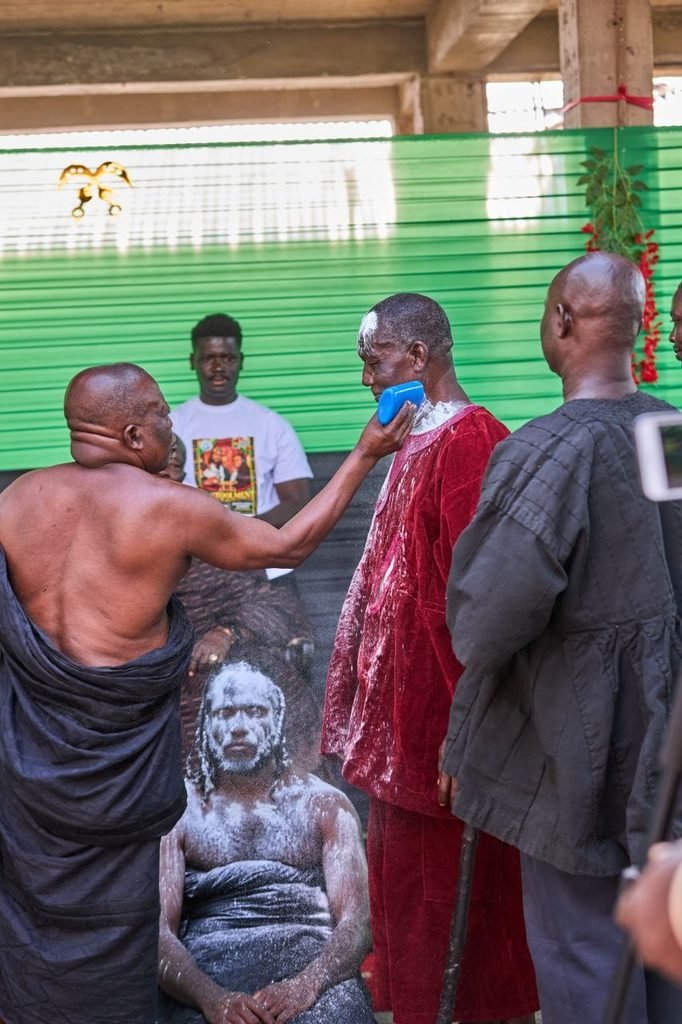
The day’s events unfolded through a series of customary observances. Kambon was first taken to the compounds of the Ɔkyeamehene and Gyasehene, where the preparations for his installation continued.
Then came the application of hyire, the white kaolin powder associated with traditional rites.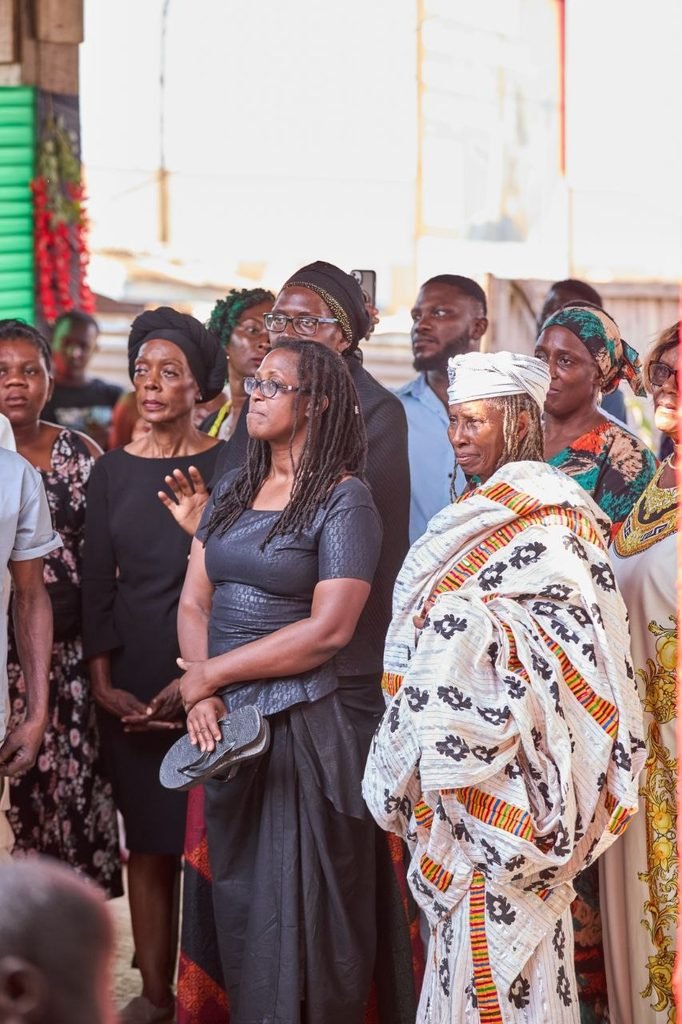
With the customary proceedings underway, the new chief was lifted onto the shoulders of celebrants and carried along the main thoroughfare of Akuapem Mampong.
The procession transformed the streets into a public stage for a ceremony rooted in the community’s traditional institutions.
There was something striking about the image, a university professor, accustomed to the measured language of academic discourse, being carried through the town in a display of traditional recognition.
Yet the celebration was not complete with the procession.
A ram was sacrificed at the Mamponghene’s compound before Kambon was taken to the palace, to swear the oath associated with his new offices.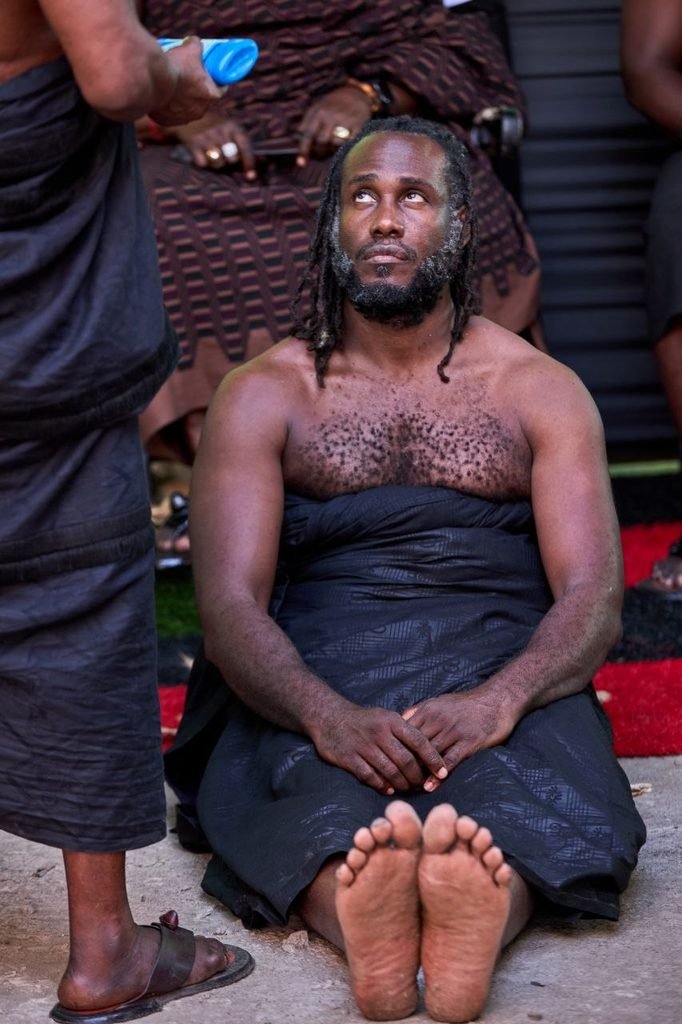

The ceremony brought him formally into his roles as Apagyahene and Sunsum Ɔsahene.
Beyond the colourful proceedings, the titles themselves carry layers of historical meaning.
Kambon in his research explores the historical connections between Apagya and Akan political and military organisation.
Accounts cited in his work linked Apagya to an asafo, or military company, while historical writing traces an Apagya stool in Asante to the reign of Opoku Ware I in the eighteenth century.
These historical associations offer a glimpse into the institutions that have shaped Akan society over generations, although they do not automatically define the precise responsibilities of the office in Akuapem Mampong.
Kambon’s own professional life reflects a similar interest in preserving and examining African knowledge.
His work encompasses Akan language structure, naming practices across the Black world, proverbs and indigenous intellectual traditions.
Through Abibitumi, the platform he founded, he also promotes language learning, scholarship and cultural engagement.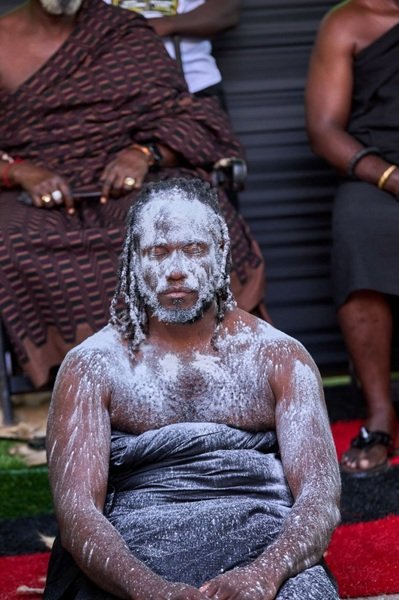
But tradition was only one part of the story that day.
When the formal ceremony gave way to a reception, the occasion expanded into a celebration of three milestones: Kambon’s enstoolment, his promotion to full professor and his daughter Ama’s admission to the University of Ghana.
The gathering therefore carried a personal significance that went beyond the honours bestowed on one man. 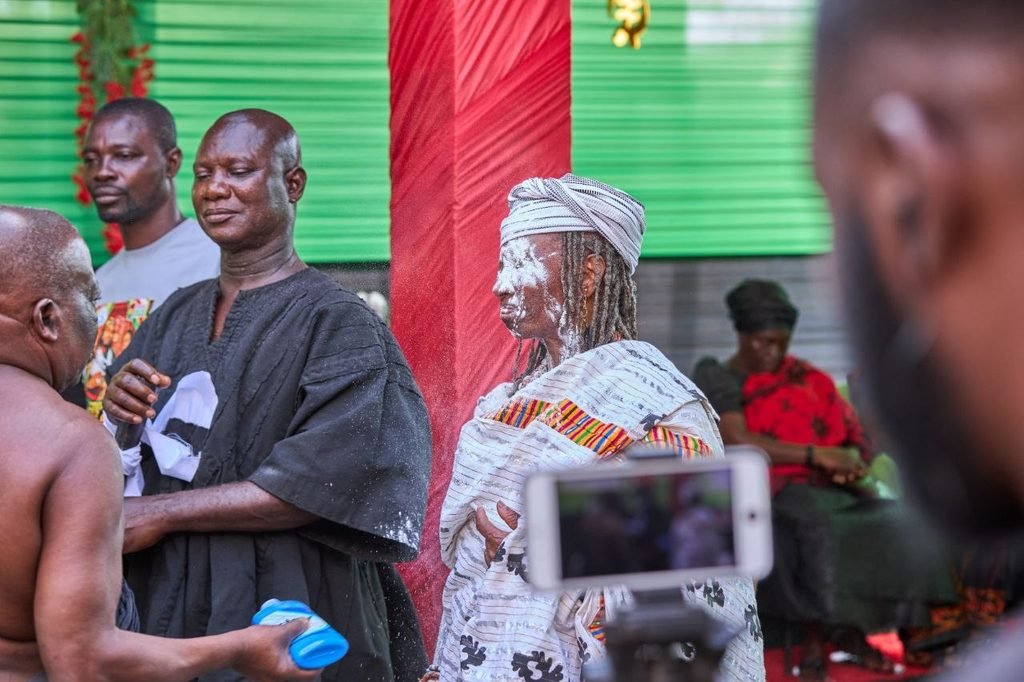
It celebrated professional advancement, the continuation of family aspirations and a connection to cultural heritage.
For a father, seeing a daughter gain admission to the same university where he holds a distinguished academic position offered another reason to celebrate.
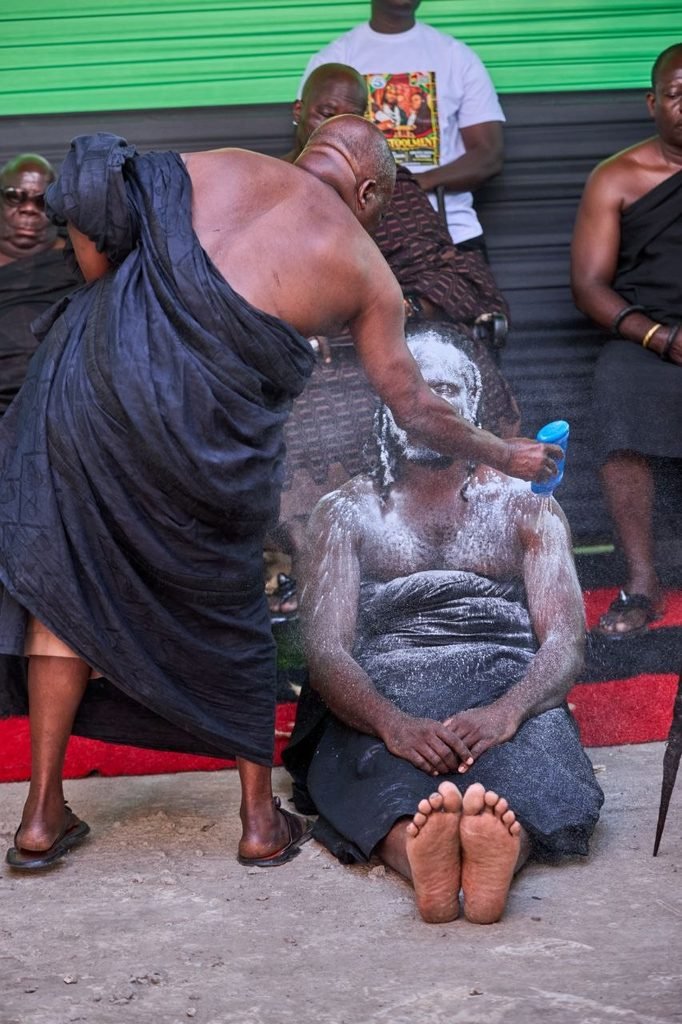
For the professor, the moment placed family achievement alongside his own professional and traditional milestones.
Kambon had already established a place in the traditional life of Akuapem Mampɔn through an earlier installation as Banmuhene Kyidɔmhene, recorded in 2017.
His latest enstoolment adds another chapter to that relationship.
In Akuapem Mampɔn, the day brought together the university, the palace and the family table in one celebration. And for Kambon, the journey from the lecture room to the traditional procession showed how scholarship, cultural responsibility and family achievement could converge in a single memorable occasion.
By Enoch Ntiamoah Siaw
SKIP THE QUEUE, TAP THE NEWS
You can now read the Ghanaian Times and The Spectator newspapers from the comfort of your device via TimesNewsPlus.
Join our WhatsApp Channel: https://whatsapp.com/channel/0029VbBElzjInlqHhl1aTU27

Intercity STC Coaches Limited has interdicted a driver captured in a viral video allegedly hitting a Sprinter bus during an overtaking manoeuvre at Pokuase before driving away from the scene.
In a public notice, the company described the driver’s conduct as unacceptable, stressing that it did not reflect the safety standards and professionalism it upholds.
Management said it had commenced an immediate investigation into the incident and identified the driver, who has been interdicted pending the outcome of the disciplinary process.
The company added that it was awaiting an official report from the Pokuase Police Command to help establish the facts surrounding the incident.
STC reaffirmed its commitment to passenger safety and responsible road use, while thanking members of the public for bringing the incident to its attention.
Management assured the public that appropriate action would be taken following the investigation.
By: Jacob Aggrey