Features
An encounter with the VELD ‘colonel’

- /home/u249204778/domains/spectator.com.gh/public_html/wp-content/plugins/mvp-social-buttons/mvp-social-buttons.php on line 27
https://spectator.com.gh/wp-content/uploads/2026/09/A-woman-learning-how-to-drive.jpg&description=An encounter with the VELD ‘colonel’', 'pinterestShare', 'width=750,height=350'); return false;" title="Pin This Post">
- Share
- Tweet /home/u249204778/domains/spectator.com.gh/public_html/wp-content/plugins/mvp-social-buttons/mvp-social-buttons.php on line 72
https://spectator.com.gh/wp-content/uploads/2026/09/A-woman-learning-how-to-drive.jpg&description=An encounter with the VELD ‘colonel’', 'pinterestShare', 'width=750,height=350'); return false;" title="Pin This Post">
I was always very uncomfortable when I was driving without a driver’s license. Once a policeman stopped me and asked for my license. I gave him my Insurance booklet.
“I say your license.”
I searched frantically for a non-existent license and told the cop the damn license wasn’t showing up in my briefcase. Next time I’d get it for him. He opened the insurance booklet and studied it.
“Are you the writer?”
“Yes sir,” I saluted.
“Carry on.”
The Inspector would have gotten me gaoled if he hadn’t recognised me as the Sikaman Palava man. But I realised that the cop-master wouldn’t spare me a second time so I decided to go for a license.
The Vehicle Examination and Licensing Division (VELD) in Accra is a perpetual beehive of activity. You’d see trainee drivers meekly trailing their instructors, enroute to a tiny office downstairs to meet the man who looks and works like a very efficient Colonel. Mr Joseph Amamoo is the name.
You’d also be privileged to meet ‘connection men’ right at the gate. They’d stop you and politely enquire whether you want a licence. They could get you one in exactly 15 minutes whether you believe it or not.
“Or are you coming to do ownership? That one would take 10 minutes.”
“No I am only coming to see the director here.”
I drove in and was ushered in to see the Acting Director of VELD, the living legend in the person of Mr. J.M.Y. Amegashie. He is the VELD Field Marshall,
“What can I do for you?”
“I want a license.”
“Know the road signs?”
“Yes.”
“Go downstairs and see Mr Amamoo and go for the various tests.”
“Oh, I can drive,” I reminded the director.
“So go and prove it.”
Mr Amamoo was busy taking a trainee-driver through the road signs. The guy was shivering and I wondered whether he was suffering from malaria.
Apparently, he didn’t know half the signs…
“Go back and study the signs well and come back next week,” he was told. It was my turn. The guy left extremely disappointed.
“There are four things you have to do when you want to overtake a vehicle. State them!” Mr Amamoo ordered me. I also went through the drill of identifying all the road signs, and now…
“Did you bring a car?”
“Yes sir.”
Let’s go for the test.”
It was now my turn to shiver. I die finish. I should be careful I do not mistake the accelerator brake.
“You are going to drive through some parts of the capital.”
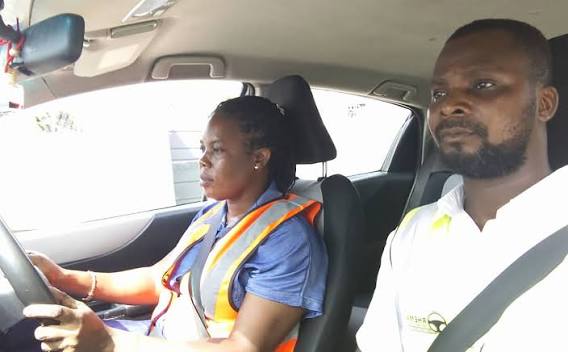
“Yes sir.” I got in and while reversing I hung my elbow stylishly on the car door.
“Get your arm off the door,” Mr Amamoo growled at me. “You must know that you are at a driving test. You are not in your sitting room.”
“No problem sir,” I said and took off the arm. I drove and got to a junction and stopped although could have gone ahead.
“It is alright for you to stop, but because of the volume of traffic these days, It is always advisable to watch before you get near a junction so that you can enter without stopping if it is clear. You don’t necessarily have to stop at every junction, so watch approach.”
We went round and round through intersections, double lanes, U-turns, whatever. Then we got to a steep slope, I was instructed to stop and then ordered to climb the slope without coming back in the least. I prided myself to being a master driver and executed the task almost effortlessly.
I then forgot and put my arm again on the “You don’t like taking instructions-eh. Take off your arm,” he barked this time.
“Sorry-o.”
When we returned, I was made to go through a process of signing my name here and there, filling one form after another. A whole lot of elaborate procedure that made me impressed with the thoroughness the system applies to the issuance of licences.
CONNECTION MEN
“Mr Amamoo, why do you allow these connection men at the gate,” I asked.
“They are the people who issue fake drivers’ licences to people,” he said. “When a driver is in possession of a driving license without going through the process you have undergone, you can be sure that the license is fake. If you go through the process, you’d have every necessary record at VELD so that in case your license is lost, we’d only have to refer to the records and issue you with a new one. The connection men hang around here and you can’t drive them away because you can’t identify them.”
“But we hear people come here to VELD officials and are given licences without taking the tests,” I said.
“Then those licences are not genuine. Look, whenever the police mount operations to check licences, they seize 15 to 20 fake licences every single day. Those licences were not issued by VELD but by the connection men. If you come to VELD for a licence, you’d certainly go through the process. If a VELD official gives you a licence without a test, it is wrong and against the law.”
Mr Amamoo showed me many fake licences, more than a thousand of them. The ‘connection men’ really must be in big business. I would have done some personal investigation on these connection men, I said to myself.
When I was issued with my licence, I saluted Mr Amamoo, got into my car and drove away, my arm on the car door.
This article was first published on October 31, 1998

Features
Confronting newborn abandonment in Ghana: When a cry for help is heard in a dustbin – Part 2

The root causes: It is never just one reason
My years of counselling at CPAC show me abandonment is rarely an act of malice. It is the tragic endpoint of seven overwhelming distresses:
1. Severe maternal mental illness —The hidden emergency
a) Clinical Postpartum Depression (PPD): This is far beyond “baby blues.” It is a severe mood disorder that can appear weeks to months after birth. Due to a massive drop in hormones, extreme sleep deprivation, and emotional exhaustion, the mother feels deep sadness, worthlessness, and complete emotional numbness towards her baby. Picture: A new mother sits by her bed all day, staring blankly. Her baby cries for hours, but she cannot lift her hands to carry the baby. She whispers, “This baby would be better off without me.” She does not hate the baby; she feels she has completely failed as a mother.
b) Peripartum Psychosis (Postpartum Psychosis): This is a psychiatric emergency. Rare but extremely dangerous, appearing suddenly within the first 2-3 weeks after delivery. The mother completely loses touch with reality. She hears commanding voices telling her to abandon the baby, or believes the baby is possessed by an evil spirit or is a “spirit child” who will bring a curse. Picture: A mother genuinely believes she heard a voice saying, “Leave this child at the crossroads at midnight or your family will die.” She abandons the baby not out of hatred, but because her broken mind believes she is obeying a higher spiritual order to save her family.
c) Pre-existing untreated Schizophrenia: This is a chronic, severe mental disorder that existed before the pregnancy. The stress of pregnancy and labour shatters her fragile coping. She suffers from paranoid delusions — believing people want to poison her and the baby — flat affect (zero facial expression), and grossly disorganised thinking, making it impossible to plan how to feed or clean a baby. Picture: A young woman whose family called her illness “spiritual attack” instead of taking her for medication wanders away after delivery, completely forgetting she even gave birth, leaving the infant behind.
2. Extreme socio-economic deprivation: For many girls in some parts of Ghana such as Kasoa, Madina, or Bekwai, poverty is not a statistic; it is a daily panic. No money for antenatal care, no money for hospital delivery, no money for baby diapers or formula. When a mother cannot feed herself, the thought of feeding another mouth feels impossible. Some mothers say, “I left her where someone richer would find her, because I could not watch her starve to death in my hands.” It is a distorted act of survival.
3. Intense societal stigma and shame: In Ghana, pregnancy outside marriage, teenage pregnancy, or pregnancy from rape can bring extreme family rejection. The girl is called “spoilt,” beaten, banned from church, or sacked from school. The fear of bringing shame to the family name is heavier than the fear of police. So she hides the pregnancy for 9 months, delivers alone, and abandons in secret to protect her family’s “honour.”
4. Paternal abandonment — The Man Who Ran Away: Behind almost every abandoned baby is a man who vanished. He says, “It is not mine,” or “Abort it,” and switches off his phone. The mother is left utterly isolated — no emotional, financial, or social support. She is criminalised alone, but the abandonment started with him. Psychological research shows paternal denial is one of the strongest predictors of maternal panic and newborn abandonment.
5. Substance abuse disorders: Alcohol, tramadol, and other drug addiction impair the brain’s executive functioning — the ability to plan, judge consequences, and process emotions. A mother struggling with addiction may give birth in a highly intoxicated or withdrawal state, unable to comprehend the needs of the newborn, leading to neglect and eventual abandonment.
6. The spirit child cultural phenomenon and superstition: In some remote pockets of Northern Ghana and even in few parts of Central and Ashanti regions, public health research shows babies born with congenital deformities, severe disabilities, or whose mothers die in childbirth are branded as “spirit children” or cursed. In extreme instances, families, under cultural pressure, mandate that such babies be exposed or abandoned at shrines or bushes. This is not mental illness, but a harmful cultural belief system that still kills.
The invisible wounds
On the baby: Risk of death from hypothermia, sepsis, and infection. Survivors suffer Anaclitic Depression and Failure to Thrive due to lack of touch. As adults, they battle Reactive Attachment Disorder, chronic mistrust, and identity crisis — “Why did my mother leave me in a dustbin?”
On the mother: Lifelong hidden grief, intense guilt, chronic PTSD, depression, and elevated suicide risk. A prison cell does not heal this.
On the nation: Overburdened orphanages like Osu Children’s Home, draining health budgets, and overworked Social Welfare officers.
SKIP THE QUEUE, TAP THE NEWS

You can now read the Ghanaian Times and The Spectator newspapers from the comfort of your device via TimesNewsPlus.
Join our WhatsApp Channel: https://whatsapp.com/channel/0029VbBElzjInlqHhl1aTU27
Most people do not consider the effect that their statements could have on others, given their pedigree in society.
The crazy rush for fame is really influencing a lot of people to do everything and anything to attract followers on social media platforms.
Some Christian leaders have destroyed the faith of some young Christians by their words and actions.
A Pastor who is popular on social media, made a statement to the effect that, Pastors pray for people to get jobs but there are no jobs for them to go for. The question that readily comes to mind is that, why pray for something you do not believe is achievable, that is something that God is not going to answer?
When a Pastor makes such a statement, it shakes the foundation of a lot of young believers especially, in churches where the Pastor has made the members to believe that he is more or less their Jesus.
Members begin to lose trust in Men of God when such statements are made, and eventually in Christianity.
When someone calls you and dispatches you to execute a mission, you go out there to execute his expressed instructions. You do not go out there to do things to please yourself but to do things that are in line with the instruction received so as to please the one who sent you.
Any Pastor who claims he is called by God into the Pastoral ministry, always seeks to act in a manner that seeks to please the Lord. He or she does not draw attention to himself or herself but goes about things in a manner that projects Jesus. Those who are really called are never in a rush to engage in self promotion antics but are always focused to preach Christ and him crucified to save mankind.
They do not make controversial comments that shifts attention from Jesus unto themselves. The called ones, are careful in their delivery of sermons with the intention of glorifying God.
In the case of the Pastor I earlier talked about, what he said he does, is a deliberate deception because if you know there are no jobs and yet praying for people to get non-existent jobs, then that is deception.
He is consciously or unconsciously portraying men of God as charlatans. This contradicts the numerous testimonies that abound of people getting job opportunities after being prayed for.
What prayer does is to activate God’s favour for somebody to remember you, just simply offer you a job opportunity or for your eyes to open to an existing opportunity. I am a living testimony of what prayer can do as far as jobs are concerned.
To preach that Pastors praying for people to get jobs is an error, shows that, that Pastor is just ignorant or is not called by God but has called himself into the Pastoral Ministry because those God calls, he equips to teach correctly.
In Genesis Chapter 21, we see a maidservant Hagar, who had been sacked from her master’s house together with her child and was wandering in the desert and desperately needed water for her child.
The Bible says that God opened her eyes and she saw water and she used it to refresh her son. The water had been there all the time but it took prayer, for God to open her eyes to see opportunity of water and that is exactly what prayer does for the believer. Prayer provides ideas that a child of God can implement to create a business to get wealth. It is not everybody that should go look for a job from someone.
Some people are supposed to be job creators to employ other people. It is through prayer, that the revelation would come for what is to be done and therefore for a man of God to make such a statement, demeaning prayer, smacks of self-calling and not divine calling. God bless.
By Lord Kiss-Mensah