News
African agro businesses empowered to access and thrive in EU markets under ITA’s Lab Innova initiative

- /home/u249204778/domains/spectator.com.gh/public_html/wp-content/plugins/mvp-social-buttons/mvp-social-buttons.php on line 27
https://spectator.com.gh/wp-content/uploads/2026/02/WhatsApp-Image-2026-02-25-at-15.55.28.jpeg&description=African agro businesses empowered to access and thrive in EU markets under ITA’s Lab Innova initiative', 'pinterestShare', 'width=750,height=350'); return false;" title="Pin This Post">
- Share
- Tweet /home/u249204778/domains/spectator.com.gh/public_html/wp-content/plugins/mvp-social-buttons/mvp-social-buttons.php on line 72
https://spectator.com.gh/wp-content/uploads/2026/02/WhatsApp-Image-2026-02-25-at-15.55.28.jpeg&description=African agro businesses empowered to access and thrive in EU markets under ITA’s Lab Innova initiative', 'pinterestShare', 'width=750,height=350'); return false;" title="Pin This Post">
Italian trade promotion body, Italian Trade Agency (ITA), has organized an interactive skill acquisition session for businesses and entrepreneurs in Africa’s agro-food value chain under a structured program dubbed “Lab Innova for Africa”—a capacity building initiative on scaling African agro exports to the European market.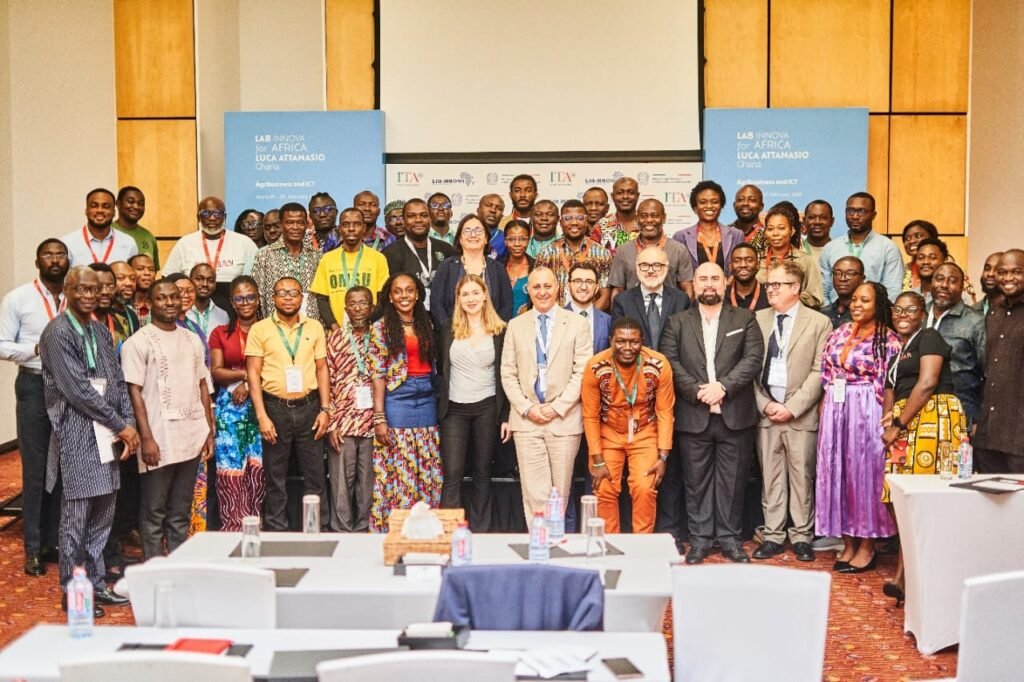
The week-long training featured selected African agribusiness owners and entrepreneurs in a high-impact training programme designed to equip participants with the technical, managerial, and market-access skillsets required to compete successfully in the European Union (EU).
Lab Innova is a specialised training programme for the agro-food sector in Africa, promoted by the Italian Trade Agency in close collaboration with key Italian partners, including Macfrut—one of Europe’s leading agro-food trade fairs.
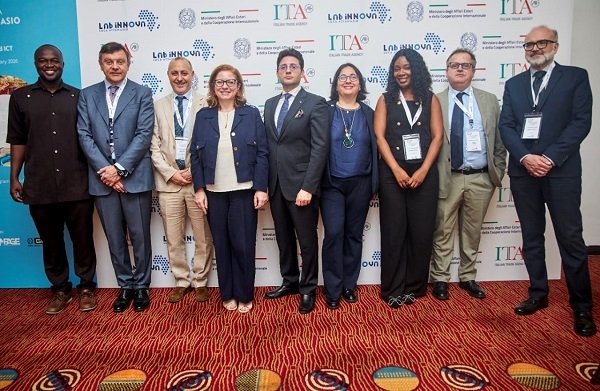
Laura Ranalli, Italian Ambassador to Ghana (4th from left), with facilitators at the just-ended training program
In an interview, ITA’s Accra director, Mr. Luigi Puca, said the week-long interactive session was to get participants familiarized to the specific export requirements that would empower them to trade in the European market
“Through these trainings, we update African countries on Italy’s economic policy and legal frameworks in order to enhance their competitiveness and readiness for international trade. It’s also a win-win situation because through information exchanges, our small and medium enterprises will grow up together with their African counterparts,” said Mr. Puca
Broadly, the training aims to increase the technical and managerial capacity of African agri-food companies by equipping participating businesses with the requisite skillset and operational interventions that meet EU standards. This is expected to facilitate their access to European markets and to build mutually beneficial partnerships with Italian firms.
Participants were taken through intensive courses focused on business management, negotiation, international marketing, food safety regulations, logistics, packaging solutions, and environmental sustainability, facilitated by ITA experts specialised in the selected topics.
According to Mr. Puca, the training offered an opportunity to showcase market-leading innovations and update participants about specific food safety protocols especially for agribusinesses and actors within the agro exports value chain.
He added: “We have a framework of regulations and laws that have to be known by foreign companies and foreign producers. With this training, we are not only focusing on the technical aspect or marketing aspect, but also talk about the legal framework that stays around international trade.”
Beyond skills development, Lab Innova serves as a launchpad for technology transfer and innovation, drawing inspiration from Italy’s highly successful agri-food district model. These districts—clusters of interconnected producers, processors, technology providers, and research institutions—have been central to Italy’s global competitiveness in agro-food exports.
The training is seen as a timely intervention considering the EU’s stringent export measures on food safety and quality standards, packaging, traceability and sustainability—requiring that local agro-businesses get acquainted with the needed strategies to access the European market.
On his part, training coordinator Uberto Trulli, described Lab Innova as a forward-looking and mutually beneficial initiative that will enhance the technical and trade capacity of value chain actors within the African agro-food export space.
“This collaboration seeks to enhance exposure and global competitiveness for African agribusinesses. The main goal and target for this project is to give technical instruments and assistance to agri-food African businesses and to create bonds and interaction with Italian companies,” he emphasized.
To him, Lab Innova is a win-win relationship that supports the Italian marketplace with high demand for tropical fruits in EU market whilst African businessmen can adopt Italian agri-food technology, irrigation systems and the tools.
A participant and president of the Vegetable Producers and Exporters Association of Ghana—who is also the vice-president of the Federation of Association of Ghanaian Exporters, Dr. Felix Kamassah said the initiative was highly impactful and insightful.
“The European market is a different market altogether, and I’m so excited because Lab Innova provides the opportunity for agribusinesses and entrepreneurs in Africa’s agro exports value chain to access and thrive in this competitive market,” he shared.
He added: “I’ve gained practical knowledge about the demand of the European market and how I could explore existing gaps and opportunities as an entrepreneur and exporter—including understanding product branding and packaging.”
This year’s Lab Innova will be climaxed with a five-day study tour at this year’s Macfrut event to be held in Rimini, Italy—that includes a guided tour of the exhibition, visit to company sites, business-to-business and networking sessions.
It was organized in partnership with local business associations and state institutions namely the Ghana Export Promotion Authority (GEPA), the Federation of Association of Ghanaian Exporters (FAGE), and the Chamber of Agribusiness Ghana (CAG).
ITA is the official government body responsible for promoting the trade interests of Italian businesses around the globe as well as attracting foreign investments into Italy—focusing highly on agribusiness, manufacturing and technology transfer. It is also the bridge between Italy and global markets leading trade, investment and cooperation.





Residents of Brodi, a farming community in the Tain District of the Bono Region, have been left in shock and mourning following the alleged murder of a 45-year-old woman by her husband, who later died by suicide.
According to information gathered by the Ghana News Agency (GNA), the suspect, popularly known as Kwabena Jack, believed to be in his 50s, allegedly attacked and killed his wife, Abena Donkor, while the couple were working on their farm on Monday, August 11, 2026.
Mr Kingsley Obah, Assembly Member for the Brodi Electoral Area, confirmed the incident to the GNA.
He explained that after news of the woman’s death spread through the community, residents launched a search for the suspect. His lifeless body was later discovered in a nearby bush on Tuesday, August 12, 2026.
Police have since conveyed both bodies to the Tain District Government Hospital, where they have been deposited for preservation and autopsy.
Investigations into the incident are ongoing. -GNA

Hawkers and roaming preachers have taken over the five-metre high Madina REDCO footbridge and adjoining streets, making it increasingly difficult for pedestrians to use the facility intended to promote safe road crossing.
The traders have virtually turned sections of the footbridge into a marketplace, displaying their wares on the floor using jute sacks, plastic sheets and metal trays, while others have occupied both sides of the walkway with their merchandise.
Foodstuffs such as okro, garden eggs, pepper, onions, dried fish, smoked fish, grains, spices and other groceries are openly sold on the footbridge and along the roadside, forcing pedestrians to weave through the crowded path.
Clothing and fashion accessories including slippers, brassieres, panties, socks, bags and other household items are also displayed for sale, leaving only limited space for commuters to use.
The situation is worsened by the presence of itinerant preachers who position themselves on the footbridge with public address systems to evangelise, drawing crowds to further obstruct pedestrian movement.
Head porters are also seen crossing the highway through the median while carrying heavy loads instead of using the footbridge, exposing themselves to the danger of being knocked down by speeding vehicles.
Also, portions of the footbridge are showing signs of deterioration. Several metal railings are rusted, bent and loosely secured with pieces of wire, raising concerns about the safety of users, especially children, the elderly and persons with disabilities.
Sections of the concrete surface are worn and chipped, while makeshift wooden supports attached to parts of the structure suggest temporary repairs.
After a visit by The Spectator last week, it emerged that many commuters preferred crossing the busy Madina Highway instead of using the footbridge because of the congestion created by the trading and preaching activities.
For years, successive attempts by the police, the military and the La Nkwantanang Madina Municipal Assembly to address congestion around the REDCO and Zongo Junction enclave have yielded little success, with the area becoming notorious for roadside trading, indiscriminate parking and pedestrians refusing to use the footbridge.
A pedestrian, who gave her name only as Maame Yaa, described the situation as worrying, saying the footbridge, which was constructed to protect lives, had gradually lost its purpose because of the growing encroachment by traders and preachers.
According to her, many pedestrians were discouraged from using the facility because navigating through the crowded walkway had become difficult and uncomfortable.
She appealed to the La Nkwantanang Madina Municipal Assembly and other relevant authorities to intensify enforcement to prevent unauthorised trading and other activities on the footbridge and ensure it served its intended purpose of promoting pedestrian safety.
However, during the visit, personnel of the Ghana National Fire Service (GNFS) were seen carrying out a decongestion exercise to remove hawkers from sections of the roadside around the footbridge as part of efforts to improve public safety and ease the movement of both pedestrians and motorists.
The exercise forms part of a pilot project initiated by the Municipal Fire Commander for Madina, Division Officer II (DO II) Abdul Salia, who assumed command of the Madina Municipal Fire Station three months ago.
Speaking in an interview with The Spectator, DO II Abdulai Salia, who is also a long time resident of the community, said the month long project began on July 1 and ended on July 31, with 30 firefighters deployed daily to regulate traffic, clear hawkers from the streets and footbridge, and create access for emergency vehicles.
Continued on page 12
By Esinam Jemima Kuatsinu