Features
Abandoned projects: Ghana’s monument to neglect (Part 2)

- /home/u249204778/domains/spectator.com.gh/public_html/wp-content/plugins/mvp-social-buttons/mvp-social-buttons.php on line 27
https://spectator.com.gh/wp-content/uploads/2022/07/KNUST-Teaching-Hospital-Project-in-ruins.jpeg&description=Abandoned projects: Ghana’s monument to neglect (Part 2)', 'pinterestShare', 'width=750,height=350'); return false;" title="Pin This Post">
- Share
- Tweet /home/u249204778/domains/spectator.com.gh/public_html/wp-content/plugins/mvp-social-buttons/mvp-social-buttons.php on line 72
https://spectator.com.gh/wp-content/uploads/2022/07/KNUST-Teaching-Hospital-Project-in-ruins.jpeg&description=Abandoned projects: Ghana’s monument to neglect (Part 2)', 'pinterestShare', 'width=750,height=350'); return false;" title="Pin This Post">
Last week, I wrote about how successive governments abandon on-going projects, either initiated by a previous administration, or by the party in power itself.
The projects span various spheres of national development such as health and educational facilities, housing schemes, sports infrastructure, roads and highways, among other things.
For starters, I cited the abandonment of the $200 – million Saglemi Affordable Housing Scheme at Prampram, as a classic example of a monument to neglect.
By that I mean Ghana’s notorious tendency to waste our scarce resources by pumping vast sums of money into projects already investigated and certified feasible, only to discontinue them, sometimes even when almost completed.
The 300-acre Saglemi project initiated by the previous NDC regime comprises a 5000-unit residential facility to accommodate middle and low-income earners within Accra and its environs and reduce the housing deficit in the metropolis.
When the NPP took over from the NDC in 2016, the first phase of the project, consisting of 180 blocks of flats with 1,500 residential units, had already been completed at the cost of $200 million. But to date, no allocations of the completed flats has been made.
The ruling government’s explanation is that it has detected evidence of financial impropriety in procurement as well as inconsistencies in contract documents handed over to it by the previous administration.
Meanwhile, the workers for whom the project was undertaken, continue to wallow in squalid living conditions while the buildings deteriorate at a fast rate.
Whatever the problem, and for the sake of the beneficiaries, is there no way allocations can be made while investigations into allegations of financial malfeasance are conducted?
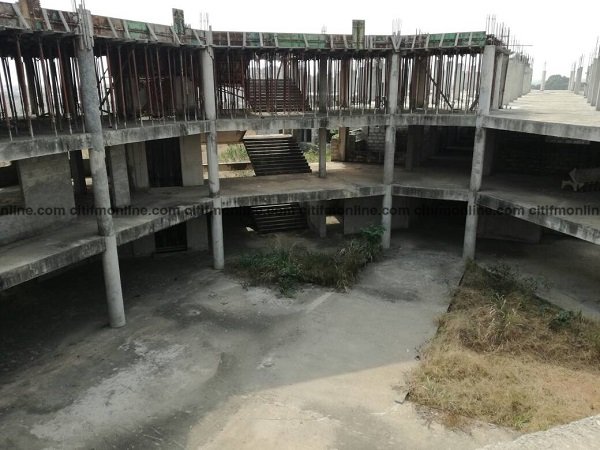
This week I continue with another project which can be rightly categorised as a monument to neglect. I am referring to the Kwame Nkrumah University of Science and Technology (KNUST) Teaching Hospital.
The project was initiated in 2007 by the university’s College of Architecture and Planning with support from the Ghana Education Trust Fund (GETFund) under the auspices of former president J.A. Kufuor.
The university banked on its internally-generated funds and donor support to raise enough money to supplement government’s contribution.
However, the project did not begin until 2008. Amid much fanfare, the Asantehene, Otumfuo Osei Tutu who is the Chancellor of KNUST, cut the sod for the $125-millionwork to begin in earnest.
The 800-bed capacity hospital, was expected to be one of the leading medical training and healthcare facilities in the country, to enable patients to access the facility towards easing the unnecessary pressure on other health facilities in the Ashanti Regional capital of Kumasi.
Apart from providing health care services, the project was also expected to serve as a teaching, research, and training facility for health and allied professionals critically needed for efficient health service delivery in the country and beyond.
Covering a land area of some 71 acres, the project, which is sited at Boadi in the Oforikrom Municipality, has among its features, a cardiothoracic and neurosurgical centre, a diagnostic unit and laboratory, morgue, administration and Out-Patient-Department (OPD) blocks, wards, security post, effluent chambers as well as a laundry unit.
It was expected to be completed in six years which should have been 2014, with the first phase comprising the administration block and facilities required to kick-start operations projected to be ready for use within two years.
But after the superstructure was only partially completed, this very important project was abandoned due to inadequate inflows from the KNUST’s internally generated funds and external donors. For that reason, the project has remained stalled for over a decade. What?
Do we not have any sense of urgency? Where do our national priorities lie? How can we sacrifice so beneficial a programme as improved health care for the people with the unjustifiable excuse that we do not have money?
But we have money for other useless ventures that serve the parochial interests of advocates of such projects. Even if other constituencies have overwhelming comparative advantage for the siting of certain projects, some unscrupulous players in government, would scheme and pull all kinds of tricks to have them situated in areas that would ensure personal dividends. For them the end justifies the means.
It took repeated reminders from the Asantehene to get the project resumed, as it were, only recently. About four years ago, that is, in 2018, at the 52nd graduation ceremony of the university, attended by the then Minister of Education, Matthew Opoku Prempeh, the monarch urged the government to release funds to ensure the completion of the project
Then, two years later in 2020, during the investiture of Professor Rita Akosua Dickson as the new Vice-Chancellor of KNUST, Otumfuo repeated his concerns about the neglect of the project in the presence of President Nana Addo Dankwa Akufo-Addo.
The Akans have a time-tested proverb that, if you want to communicate with God, just speak into the air. That is the wisdom Otumfuo applied, and it worked.
In an urgent and emotional direct appeal to the President, Otumfuo Osei Tutu said: “I have written a series of letters to the Ministry of Finance and to the office of His Excellency the President, but it appears no action has since been taken.”
“The KNUST,” he said, “has been very instrumental in the development of the country’s health systems and the completion of this facility will go a long way to contribute to the sustenance of such support…The time to act is now!” the Asantehene stressed.
In response, President Akufo-Addo assured that the project would be completed soon, saying that the tenure of the new Vice-Chancellor would be marked by the construction of the teaching hospital which is so dear to the heart of the Asantehene and the university community.
Another Ghanaian proverb in Akan says: “Treeeeeempoantremu a, wosekoko?” This loosely translates to: “Even when you poured it (maybe milk or any other drink) liberally, it was not sufficient for me, how much less would mere squeezes of drops suffice?
My point is, for over a decade the first phase which was supposed to be completed in six years did not reach anywhere.
Now the president says very soon the first phase will be completed. My Nigerian friends would say, “OK ooo, we shall see.”Not that I do not believe it. It is just too good to be true. Besides, my fear stems from that favourite word of politicians- soon. That is the snag. Why not put a timeline on it for us to be sure?
Probably, it will work this time. In fact, in 2021, the Government, according to the Asantehene, in response to his numerous appeals, initiated moves by releasing funds for the continuation of the project.
Media reports have quoted the Asantehene as saying that information available to him indicated that the first phase of the KNUST Teaching Hospital project would be completed by October 2022.
Otumfuo Osei Tutu revealed that government had already resumed construction works on the project, adding that the government had also made the necessary provisions for the second phase of the project in this year’s budget.
Contact: teepeejubilee@yahoo.co.uk
By Tony Prempeh


There is a culture that permeates all aspects of leadership in the advanced countries which I believe has contributed to the success in all aspects of their national lives. Citizens strive to excel so that they will not find themselves in a situation where they would have failed, to necessitate a decision to resign.
Countries where failure is frowned upon, it pushes the citizens to strive for success. In our part of the world, failure and mediocrity has become an accepted norm and therefore, there is no shame in failing in a particular position of leadership.
A head of an organisation mismanages the place and he does not see the need for him to resign. The appointing authority does not also see the need to sack him and so the merry go round continues.
It becomes friends and family as usual and if care is not taken, the rest of the world will leave us far, far behind.
The practice of resignation in parts of the world for failure in some parts of the world has to be institutionalised in our country too. It encourages the principle of accountability which is good for any organisation, sector of an economy or a country.
It promotes good governance, a necessary ingredient in the growth of the economy of any country.
When this practice becomes a culture, every individual, privileged to hold a position of trust, gives his or her full attention to the job assigned him or her, to ensure that objectives are achieved.
This trickles down to every individual down the chain of command and there are no rooms for errors.
That is how efficient systems are built over time and this is the difference between advanced nations and third world countries.
Where systems are designed such that people take responsibility for things that go wrong under their supervision or ultimate responsibility, there is evidence of development.
There are a few people that I admire in Ghana as far as this culture of resignation based on principled stance. One of them is the late Mrs Emma Mitchell. She was a cabinet member but chose to resign after the confrontation between late President Jerry Rawlings and late Vice President Kow Akaah.
She was not prepared to be part of a cabinet which was lying to the general public that Rawlings did not assault Akaah.
She was of the conviction that telling the truth is more honourable than telling lies and that if she was bound by confidentiality oaths to tell a lie, then she would resign and she did exactly that.
That is how we build a culture of truth and accountability. We have people in positions who have not lived up to expectation but are still holding on to their positions not prepared to let go of it.
This is a clear case of display of selfishness, trying to be a Boss instead of a Servant to serve the people, which leadership is all about.
The ineffectiveness of some leaders, often result in waste of resources which could have been channeled to other sectors of the economy which could have been more productive. A culture of voluntary resignation must be advocated for by all stakeholders, especially the CSOs, traditional leaders and the clergy.
This is the only way the needed growth in every sector of our national life would manifest.
Presidents, Prime Ministers, heads of reputable organisations have voluntarily resigned by taking ultimate responsibility and it is about time, we started seeing it manifest in our country.
The people in charge of our sports especially our soccer, can initiate this long desired culture and resign in view of the embarrassment witnessed from the defeat of the Black Stars by Gambia. God bless.
BY LAUD KISS-MENSAH
SKIP THE QUEUE, TAP THE NEWS
You can now read the Ghanaian Times and The Spectator newspapers from the comfort of your device via TimesNewsPlus.
Join our WhatsApp Channel: https://whatsapp.com/channel/0029VbBElzjInlqHhl1aTU27
THE QUR’AN FORBIDS RELIGIOUS PROVOCATION
There is a remarkable verse in the Qur’an which every Muslim preacher should memorise.
Allah says:
“And do not insult those they invoke besides Allah, lest they insult Allah in hostility without knowledge.” (Qur’an 6:108).
Think about this carefully.
Allah knows that the unbelievers worship false gods.
Yet Allah tells Muslims: Do not insult their objects of worship.
Why?
Because your speech may provoke an even greater offence.
This establishes a profound principle:
A Muslim must not fight religious provocation with religious provocation.
If someone insults what we hold sacred, we do not respond by insulting what they hold sacred.
If someone attacks Islam, we defend Islam with knowledge.
If someone misrepresents Muhammad (pbuh), we explain who is Muhammad to him.
If someone lies about Islam, we answer with truth and knowledge.
We do not allow another person’s bad behaviour to dictate our own morality.
LOOK AT MUHAMMAD (PBUH) — HE WAS INSULTED BEFORE WE WERE
Servant of Allah,
Sometimes we speak as though the Prophet (pbuh) lived in a world where everyone respected him.
No.
He was mocked and insulted. Quran 37:36, Quran 15:6
He was called a liar, magician, and a mad man. Quran 51:52, Quran 17:47
He was ridiculed. Quran 6:10
His followers were tortured, and some were killed. Quran 85:8-10
He himself was persecuted, leading to his migration to Madina.
Yet he remained the Messenger of Allah.
Allah said:
“Indeed, we know that your heart is distressed by what they say.” (Qur’an 15:97)
Allah acknowledged the Prophet’s pain.
Islam does not say that insults do not hurt. They hurt.
But the question is: What do you do with the pain?
THE DAY OF TA’IF: WHEN THE PROPHET (PBUH) COULD HAVE CHOSEN
REVENGE
One of the most powerful examples is the journey of the Prophet (pbuh) to Ta’if.
He went seeking support for his message.
Instead, the people rejected him and incited their children and others against him.
He was chased.
He was insulted.
He was struck with stones until his feet bled.
He was physically and emotionally exhausted.
Then the Angel of the Mountains came to him.
The two angels offered to crush the people of Ta’if between the mountains.
The Prophet (pbuh) could have said: “Do it.”
But he did not.
Instead, he hoped that Allah would bring from their descendants people who would worship Him.
This account is recorded in the authentic hadith literature, including Sahih Muslim (Muslim, 1795).
What a lesson!
The Prophet (pbuh) had suffered injustice.
But he did not turn his pain into indiscriminate revenge.
He saw beyond the offender.
He saw the possibility of tomorrow.
And this is one of the greatest characteristics of prophetic leadership:
The Prophet (pbuh) did not merely ask, “What punishment does this person deserve?”
He also asked, in effect: “What can this person become?”
THE PROPHET IN MADINAH: LEADER OF A DIVERSE SOCIETY
When Muhammad (pbuh) migrated to Madinah, he did not enter an empty city.
Madinah contained different communities, including Muslims and Jews, and there were also Christians who interacted with the Muslim community.
The Prophet became the political and communal leader of Madinah.
The Sahifah (A Covenant) of Madinah, preserved in the early sīrah (Prophet’s biography) tradition, established arrangements concerning mutual obligations, security, justice and relations among the communities of the city.
This is important:
The Prophet did not build Madinah by teaching Muslims to hate everyone who was not Muslim.
He built a society governed by covenant, responsibility and justice.
Allah says:
“Allah does not forbid you from being kind and just to those who have neither fought you because of your religion nor driven you from your homes. Indeed, Allah loves those who act justly.” (Qur’an 60:8)
This is not weakness.
This is Islam.
THE PROPHET DEALT WITH JEWS IN MADINAH
‘A’ishah (Wife of the Prophet) narrated that the Prophet (pbuh) bought food from a Jewish man on credit and gave him his iron armour as collateral.
“The Prophet purchased food from a Jew on credit and mortgaged his iron armour to him.” (Sahih al-Bukhari, 2068)
Think about it.
This was Muhammad.
The Messenger of Allah.
Yet he conducted lawful commercial dealings with a Jewish citizen.
He did not say: “He is not a Muslim, therefore I cannot deal with him.”
No.
Islam gave him a relationship governed by justice and trust.
Jabir رضيهللاعنه narrated:
“A funeral procession passed before us and the Prophet (pbuh) stood up, and we stood with him. We said, ‘O Messenger of Allah, it is the funeral of a Jew.’ He said: ‘When you see a funeral procession, stand.’” (Sahih al-Bukhari, 1311)
Another narration records his response: “Is it not a soul?” (Sahih al-Bukhari, 1312–1313)
What kind of heart did Muhammad (pbuh) possess?
A heart that recognised human dignity even in death.
THE PROPHET AND THE CHRISTIANS OF NAJRAN
The Prophet also received the Christian delegation of Najran.
They disagreed with him theologically.
Yet when they requested a trustworthy person, he did not choose someone because of hatred.
He selected Abu ‘Ubaydah ibn al-Jarrah.
The Prophet said:
“I shall send with you a man who is truly trustworthy.”
He then appointed Abu ‘Ubaydah.
This is authentically reported in Sahih al-Bukhari 4380–4381.
Notice something profound:
The Prophet could disagree with people without becoming dishonest toward them.
That is the standard we need today.
The author is the chief Imam of Katamanso Municipal and Certified Counsellor and Governance Expert.