Features
A call on CPP to be a potential force in 2024 general election

A sister of mine, name withheld, told me that she recently dreamt about the party that would form the next government and take over the mantle of leadership of our dear country, Ghana, after the tenure of office of the ruling New Patriotic Party (NPP) in 2024. In that dream, she was directed by the Almighty God to try and get in touch with Comrade Kwesi Pratt, a leading member of the Convention People’s Party (CPP) and Managing Editor of Insight Newspaper, to deliver a special message to him concerning the re-organisation of the party to take over the leadership of this country in 2024. She asked me to assist her to get the contact line of Mr. Pratt so that she could deliver the message to him personally. I did according to her wish and I am very sure that by now, she has been able to get in touch with Mr. Pratt to deliver her message.
MESSAGE TO COMRADE KWESI PRATT
Being so inquisitive, I impressed on her to interpret that dream to me in a more cohesive manner and to my astonishment, she told me that the good Lord had revealed to her that come 2014, the leadership of this country would be transferred to the CPP because Ghanaians were, indeed, tired and fed up with the current government and that of the National Democratic Congress (NDC) and would like to try a third force which is the CPP.
I cannot agree more with my sister about her dream and vision, however, I strongly believe that for that prediction to materialise, much will depend on all the splinter groups of the Nkrumahist tradition to bury their entrenched positions and differences and rally their strength behind the CPP, the party formed by Osagyefo Dr. Kwame Nkrumah of blessed memory and first President of Ghana to regain their fortunes and claim leadership of this country. That can be possible and there is no ambiguity about that vision. It is a fact that those who have been monitoring and following Kwesi Pratt critically about his comments and support for the CPP, believe that he has what it takes to help bring together well-meaning and genuine Nkrumahists who believe in the ideals and tradition of Dr. Kwame Nkrumah to build a formidable CPP to capture power, come 2024.
CPP AS AN ALTERNATIVE PARTY IN GOVERNMENT
It is a fact that Ghanaians who have tried and tested both the administrations of the NPP, which is still in power, and that of the NDC, which handed power in 2016, are not seeing any improvement in their living conditions. Rather, what they are witnessing currently is economic stagnation, hence the deterioration in their living conditions. There have been no proactive measures to arrest the declining state of the economy and the sufferings among the people are, indeed, unbearable. Therefore, the only option and alternative left for Ghanaians is to try the CPP and see what they can also offer this nation. But in doing so, that entrenched positions by the so-called splinter groups which claim their roots from the Nkrumahist tradition must be dismantled to rope in true and genuine CPP members and supporters who because of the unstable nature of the party, have defected to other parties including the NPP and the NDC. It is important and significant for the dormant CPP to regain its original posture and to rub shoulders with the two main political parties in our dear country, Ghana.
This article will not be complete, effective and interesting if it fails to trace and sumarise the historical background of the emergence of the CPP from the Nkrumahist era up the present state where things seem not to be going well with the party because of apathy, individual differences and leadership crisis. It is also a fact that there are quite a number of Ghanaians who are not familiar with the CPP, therefore, they will need some bit of enlightenment about the party and what it stood for in the past.
SHORT HISTORY ABOUT THE CPP
This writer was not born when the CPP was formed but history has revealed that it was a socialist party based on ideas of former president Kwame Nkrumah of blessed memory. It was formed on June 12, 1949, by Nkrumah to campaign for independence of the Gold Coast. It was a governing party under Kwame Nkrumah of the autonomous British Colony of the Gold Coast from 1951 to 1957, and independent Ghana from 1957 to 1966. In 1964, the Constitution was changed to make the CPP the only legal party in Ghana, thus making the nation a one-party state. The party was banned after the 24th February 1966 coup d’etat by the National Liberation Council (NLC). It will interest readers to know that parties that followed the CPP tradition used various names to prosecute their own agenda. It was the first party to rule Ghana after the attainment of independence in 1957.
The CPP started as a vehicle of emancipation of the nation and whole of Africa, and was a party that embraced farmers, fishermen, the rural folks, the rich and the poor alike. In the 2008 presidential and parliamentary elections, the party won one parliamentary seat, the Jomoro Constituency with the daughter of Dr. Kwame Nkrumah, Madam Samia Nkrumah as the member of parliament. The then presidential candidate Dr. Papa Kwesi Nduom, performed below expectation, managing to get 1,4 per cent of the total valid votes cast. The presidential candidate in the 2012 election was Dr. Michael Abu Sakara Foster with Mr. Ivor Greenstreet being the presidential candidate for the party in the 2020 election.
SHAMEFUL SPECTACLE WITHIN THE CPP
It is a shame that the CPP which used to be a party with a larger following is now wandering in the wilderness due to protracted differences, bickering and a host of other problems basically on matters of leadership of the party. The party has men and women of integrity to manage its affairs but the lack of coordination and unity seem to be tearing the party apart. Was it not a shame that the CPP has no representation in parliament ever since Samia Nkrumah’s mandate expired in 2016?
The turn of events in this country in which the cost of living has become unbearable for the average Ghanaians, demands that the CPP must get its act together, bring all those who professed in the ideals and vision of Dr. Kwame Nkrumah together and launch a positive campaign to win the needed support for the party come 2024 general election. Now is the time for the founding members of the party, some of whom are still alive to call a spade a spade and see how best they can unite the party under one umbrella which is the CPP to make a positive impact on the country’s democratic process. Ghanaians are yearning for a third force to save them from the harrowing experiences they are currently going through.
This country is not the preserve of any group or political party to govern, it belongs to each and every Ghanaian and Ghanaians deserve every right to choose the party of their choice to run the affairs of the nation. That is why a clarion call is being made to the CPP to organise itself well to battle for the leadership and show what the party can also offer to salvage the country from the downward trend.
To borrow from the lyrics of the greatest and popular Jamaican reggae and soul musician, Jimmy Cliff, “There is suffering in the land” and Ghanaians will need selfless, dedicated and visionary leaders to lift them out of their sorrowful state as well as the current economic hardship they find themselves in.
Ghanaians have tried and tested the two major political parties-NPP, NDC- and things, especially issues regarding the economy are not working in their favour, therefore, the only alternative left for them is to look elsewhere for their salvation. The CPP can be a potential force if it can unite and re-organise itself before the 2024 general election.
Contact email/WhatsApp of author:
0277753946/0248933366
By Charles Neequaye


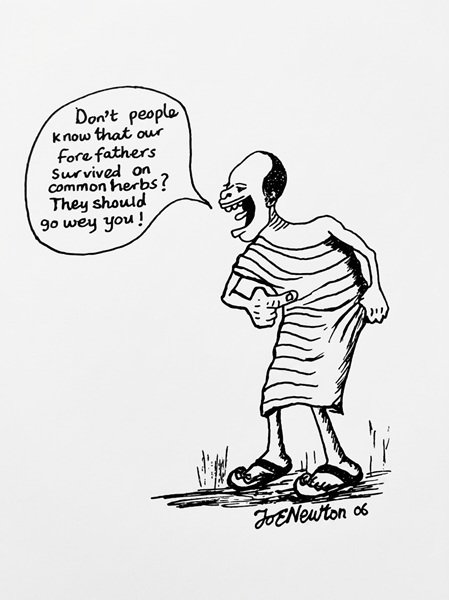
THE typical itinerant salesman in Sikaman is a herbalist. He is normally a slim macho with the capacity to perambulate the expanse of area covering the triangle of Accra-Tema-Ashiaman. In short, he can walk a total of 60 miles a day, marketing a product that cures every disease, including poverty. 
The door-to-door herbal pharmacist advertises his product by word of mouth. He has nothing to do with the Food and Drugs Board (FDB). After all, his concoctions do not feature on FM stations.
Those herbalists who cannot walk to propagate the herbal gospel, liaise with drivers of mass transportation and their mates. They are, therefore, given the chance to sell their products on Benz buses that ply the routes.
Normally, the herbalist starts his sales message with a prayer and Bible study. He asks the passengers to bow down their heads in supplication to God the father, the son, the Holy Spirit.
When a herbalist asks the passengers to close their eyes and bow their heads, Moslems on board naturally feel offended. They feel that the herbalist has no right to assume that every passenger is a Christian. They think such an assumption is an affront to Islam.
So a Moslem on board will raise the hand for a point of order. He’ll remind the herbalist that it would be in his own interest to mind his language.
“Be careful the way you address people in a public place. Not every person here is a Christian,” he’d state assertively.
Of course, the herbalist will promptly ignore him, but would all the same “watch” his tongue. Who knows whether or not the Moslem brother is inspired by Quoranic zeal to defend the tenets of Islam to the hilt?
When he starts saying, “Wallahi!” and “Inshallah!” it could be the beginning of proclaiming Islam as supreme, a point which must be driven home with talibanic precision.
So the herbalist must tread carefully lest he steps on fire.
The herbalist could even add a measure of mirth to it all, by announcing that Christians on board today have very interesting company on the journey, but that should not detract from the business of the day.
The Moslem brother will weigh the words carefully and offer a wry smile.
He must be careful the occasion does not degenerate into the use of semantics and proverbial oration to deride his conviction that public utterances must be mindful of religious sensibilities. He has made his point very clear and expects that it is taken in good faith in the interest of a peaceful journey.
The herbalist will now open the New Testament and preach salvation, stating clearly that salvation can come only through Jesus Christ and NOBODY else.
The Moslem brother will now start twitching his moustache. The visible and almost revolutionary reflexes of his upper lip can be an indication that sentiments have begun superseding reason, and the outcome could well be tragic now shift uneasily in his seat.
The time has come for him to also express his right to the religion of his fore-bears. He’ll put his hand into his pocket and rise to his feet. The time has indeed come!
This article was first published on Saturday, September 9, 2006
When the cause of a particular problem like sickness, disease, sudden illness, a social issue etc. are not known, it stands to reason that resolving it becomes a huge challenge.
Citizens would understand the government when public announcements are made to the effect that government is trying to find a solution to the issue, even though it is taking a while for it to be resolved because citizens are rational beings.
On the other hand, if the solution to a particular issue is known to everybody but the government for whatever reason, is dragging its feet in resolving it, citizens become frustrated and begin to lose trust in their leaders.
One such issue is the heavy traffic along a section of the Kasoa – Odokor road. A short stretch of bad road between the traffic light at the Weija Government Hospital and the entrance to the entrance of the overhead that leads to the N1, is the cause of the problem but nothing is being done about it, day after day, week after week, month after month. Thus is clearly unacceptable.
Another issue that requires urgent attention is the lack of pavements along a lot of streets in parts of the various Municipal Assemblies. Exercise is a prerequisite for long life and healthy living and for those of us who it has become a way of life, this issue of people putting up structures right to the edge of the drains beside the roads, are making life difficult for us.
We are compelled to walk along the roads, putting our lives at serious risk. Pedestrians should never be compelled to compete with vehicles on our streets and roads. Roads and streets are made for vehicles and pavements are made for pedestrians. That is the norm. Any attempt to normalise a situation where pedestrians are mingling with vehicles is insanity.
It is the road regulations that makes it so and therefore district or municipal assemblies are to take responsibility and ensure that spaces for pavements are not encroached upon. Citizens have rights that must be protected by their leaders and making pavements available to pedestrians, is one of them.
When we hear of teachers having sex with students, it appears it is something recent. It is not a new phenomenon. It has been there since Adam. Perhaps this issue is getting much attention due to the proliferation of social media. It was an open secret in times past when Teachers were in relationships with female students and some married them immediately after completion of school.
Some teachers were also known to be having unholy interactions with female pupils but due to the times that these acts occurred, human rights issues and the awareness around it, allowed such unscrupulous teachers to get away with their crimes.
Now we are in a different era and so a Headmaster is now in hot waters. He is alleged to have raped about 19 female students and as usual, some officials tried to cover it up and are also in hot waters and their actions or inactions in the matter are under investigation.
Why the man has been allowed to roam freely without being arrested is simply mind boggling. It appears that the law applies differently, depending on who you are. This issue came to public attention sometime in August this year, yet the police had not arrested or invited this man for question regarding the rape allegation.
It has come out that he is a Constituency Secretary of the ruling party and the question in the public domain is that, is it because he is a political figure that is why he is still walking around without questioning? I believe in the rule of law so let us hold our breadth and let the proper thing be done.
The police must however be seen to be active in this matter. God bless.
SKIP THE QUEUE, TAP THE NEWS
You can now read the Ghanaian Times and The Spectator newspapers from the comfort of your device via TimesNewsPlus.
Join our WhatsApp Channel: https://whatsapp.com/channel/0029VbBElzjInlqHhl1aTU27