News
Oxfam in Ghana donates medical equipment and essential drugs worth GH¢1.5 million to Kasoa Polyclinic


- /home/u249204778/domains/spectator.com.gh/public_html/wp-content/plugins/mvp-social-buttons/mvp-social-buttons.php on line 27
https://spectator.com.gh/wp-content/uploads/2026/06/WhatsApp-Image-2026-06-24-at-16.03.53-1.jpeg&description=Oxfam in Ghana donates medical equipment and essential drugs worth GH¢1.5 million to Kasoa Polyclinic', 'pinterestShare', 'width=750,height=350'); return false;" title="Pin This Post">
- Share
- Tweet /home/u249204778/domains/spectator.com.gh/public_html/wp-content/plugins/mvp-social-buttons/mvp-social-buttons.php on line 72
https://spectator.com.gh/wp-content/uploads/2026/06/WhatsApp-Image-2026-06-24-at-16.03.53-1.jpeg&description=Oxfam in Ghana donates medical equipment and essential drugs worth GH¢1.5 million to Kasoa Polyclinic', 'pinterestShare', 'width=750,height=350'); return false;" title="Pin This Post">
Oxfam in Ghana has donated medical equipment and essential drugs worth about GH¢1.5 million to the Kasoa Polyclinic to strengthen maternal and reproductive healthcare services in the municipality.
The presentation, which took place on Tuesday, June 24, 2026, at the premises of the clinic in Kasoa, formed part of the sustainability and legacy activities under the Power to Choose (P2C) Project.
The donated items included delivery beds, maternity beds, oxygen cylinders, neonatal resuscitation equipment, blood pressure monitors, newborn weighing scales, suction machines, delivery kits, essential medicines, medical theatre wear and other critical supplies to support quality healthcare delivery.
The Power to Choose Project is a seven-year initiative being implemented by Oxfam in Ghana in partnership with the Planned Parenthood Association of Ghana (PPAG), WiLDAF Ghana, SEND Ghana, Norsaac and PARDA, with funding from Global Affairs Canada through Oxfam Quebec.
The project seeks to improve sexual and reproductive health and rights for young people, particularly adolescent girls, young women and young men living in vulnerable and marginalised conditions.
Addressing nurses and management of the hospital, the Country Director for Oxfam in Ghana, Mohammed-Anwar Sadat Adam, said the project, which began in 2021 and will run until early 2028, is being implemented in seven countries across Africa, Latin America and the Middle East.
He said Ghana and the Democratic Republic of Congo are the two African countries benefiting from the project.
Mr. Adam noted that the project has already trained about 102 health workers in areas including youth-friendly services, emergency obstetric and neonatal care, family planning, gender-based violence response, respectful maternity care and inclusive healthcare delivery.
He said Oxfam and its partners conducted assessments at beneficiary facilities and identified equipment needs to help improve healthcare delivery.
According to him, the donation would create safe spaces where young women and girls could seek healthcare services without fear or stigma and would improve health outcomes in the community.
Mr. Adam thanked the Government of Canada, the Ghana Health Service, the Society of Obstetricians and Gynaecologists of Ghana (SOGOG), World Health Ghana and other partners for supporting the implementation of the project.
He urged the beneficiary facilities to ensure that the equipment is properly used and maintained to serve the community for many years.
A speech by the Municipal Health Director for Awutu Senya East, Dr. Stanley Kweku Yaidoo, which was read on his behalf by the Municipal Accountant, Rev. Dr. Askari Thomas, described the donation as timely and important.
He said quality healthcare delivery depends on manpower, financial resources and equipment, adding that healthcare workers cannot effectively deliver services without the necessary tools.
Dr. Yaidoo thanked Oxfam and its partners for selecting Kasoa as one of the beneficiary facilities and assured them that the equipment would be put to good use.
The Acting Medical Superintendent of Kasoa Polyclinic, Dr. Papa Kojo Arthur, expressed appreciation to Oxfam for its continuous support over the years through training and capacity building.
He said the equipment would greatly support the effective management of patients, particularly in maternal and child healthcare.
According to him, the donation would help reduce maternal and perinatal mortality in the municipality.
The donation formed part of efforts to strengthen the capacity of youth-friendly health facilities in eight implementing districts across five regions of Ghana to continue providing quality and accessible sexual and reproductive healthcare services beyond the lifespan of the project.
By: Jacob Aggrey




Residents of Brodi, a farming community in the Tain District of the Bono Region, have been left in shock and mourning following the alleged murder of a 45-year-old woman by her husband, who later died by suicide.
According to information gathered by the Ghana News Agency (GNA), the suspect, popularly known as Kwabena Jack, believed to be in his 50s, allegedly attacked and killed his wife, Abena Donkor, while the couple were working on their farm on Monday, August 11, 2026.
Mr Kingsley Obah, Assembly Member for the Brodi Electoral Area, confirmed the incident to the GNA.
He explained that after news of the woman’s death spread through the community, residents launched a search for the suspect. His lifeless body was later discovered in a nearby bush on Tuesday, August 12, 2026.
Police have since conveyed both bodies to the Tain District Government Hospital, where they have been deposited for preservation and autopsy.
Investigations into the incident are ongoing. -GNA
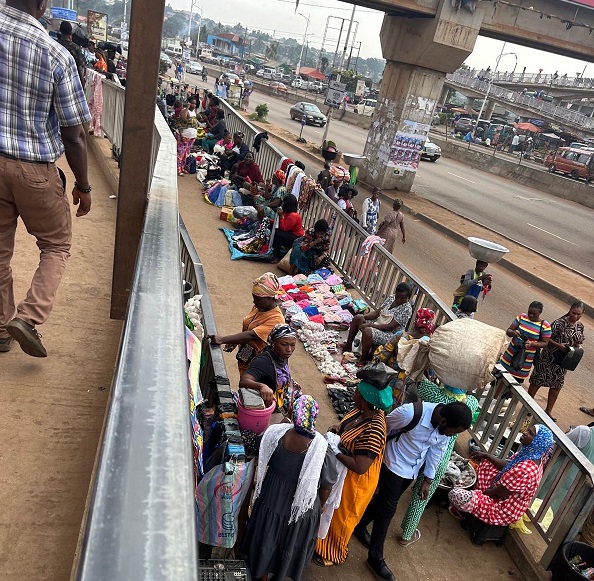
Hawkers and roaming preachers have taken over the five-metre high Madina REDCO footbridge and adjoining streets, making it increasingly difficult for pedestrians to use the facility intended to promote safe road crossing.
The traders have virtually turned sections of the footbridge into a marketplace, displaying their wares on the floor using jute sacks, plastic sheets and metal trays, while others have occupied both sides of the walkway with their merchandise.
Foodstuffs such as okro, garden eggs, pepper, onions, dried fish, smoked fish, grains, spices and other groceries are openly sold on the footbridge and along the roadside, forcing pedestrians to weave through the crowded path.
Clothing and fashion accessories including slippers, brassieres, panties, socks, bags and other household items are also displayed for sale, leaving only limited space for commuters to use.
The situation is worsened by the presence of itinerant preachers who position themselves on the footbridge with public address systems to evangelise, drawing crowds to further obstruct pedestrian movement.
Head porters are also seen crossing the highway through the median while carrying heavy loads instead of using the footbridge, exposing themselves to the danger of being knocked down by speeding vehicles.
Also, portions of the footbridge are showing signs of deterioration. Several metal railings are rusted, bent and loosely secured with pieces of wire, raising concerns about the safety of users, especially children, the elderly and persons with disabilities.
Sections of the concrete surface are worn and chipped, while makeshift wooden supports attached to parts of the structure suggest temporary repairs.
After a visit by The Spectator last week, it emerged that many commuters preferred crossing the busy Madina Highway instead of using the footbridge because of the congestion created by the trading and preaching activities.
For years, successive attempts by the police, the military and the La Nkwantanang Madina Municipal Assembly to address congestion around the REDCO and Zongo Junction enclave have yielded little success, with the area becoming notorious for roadside trading, indiscriminate parking and pedestrians refusing to use the footbridge.
A pedestrian, who gave her name only as Maame Yaa, described the situation as worrying, saying the footbridge, which was constructed to protect lives, had gradually lost its purpose because of the growing encroachment by traders and preachers.
According to her, many pedestrians were discouraged from using the facility because navigating through the crowded walkway had become difficult and uncomfortable.
She appealed to the La Nkwantanang Madina Municipal Assembly and other relevant authorities to intensify enforcement to prevent unauthorised trading and other activities on the footbridge and ensure it served its intended purpose of promoting pedestrian safety.
However, during the visit, personnel of the Ghana National Fire Service (GNFS) were seen carrying out a decongestion exercise to remove hawkers from sections of the roadside around the footbridge as part of efforts to improve public safety and ease the movement of both pedestrians and motorists.
The exercise forms part of a pilot project initiated by the Municipal Fire Commander for Madina, Division Officer II (DO II) Abdul Salia, who assumed command of the Madina Municipal Fire Station three months ago.
Speaking in an interview with The Spectator, DO II Abdulai Salia, who is also a long time resident of the community, said the month long project began on July 1 and ended on July 31, with 30 firefighters deployed daily to regulate traffic, clear hawkers from the streets and footbridge, and create access for emergency vehicles.
Continued on page 12
By Esinam Jemima Kuatsinu