News
Don’t leave children’s eye care solely to health professionals

- /home/u249204778/domains/spectator.com.gh/public_html/wp-content/plugins/mvp-social-buttons/mvp-social-buttons.php on line 27
https://spectator.com.gh/wp-content/uploads/2026/05/A-child-going-through-an-eye-screening.webp&description=Don’t leave children’s eye care solely to health professionals', 'pinterestShare', 'width=750,height=350'); return false;" title="Pin This Post">
- Share
- Tweet /home/u249204778/domains/spectator.com.gh/public_html/wp-content/plugins/mvp-social-buttons/mvp-social-buttons.php on line 72
https://spectator.com.gh/wp-content/uploads/2026/05/A-child-going-through-an-eye-screening.webp&description=Don’t leave children’s eye care solely to health professionals', 'pinterestShare', 'width=750,height=350'); return false;" title="Pin This Post">
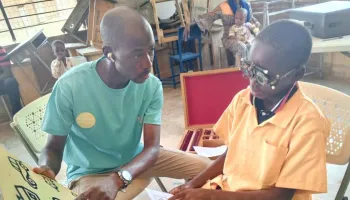
Dr Zakarea Al-Hassan Balure, an Optometrist, has urged parents to take active responsibility for the eye health of their children instead of leaving it solely in the hands of health professionals.
He said good eyesight was essential for effective learning and overall child development, emphasising the need for parents to seek regular eye screening services for their children.
“Parents are always concerned about their children’s academic performance, but without good eyesight, learning becomes difficult.
“It is important that parents seek regular eye screening services for their children at the health facility, and not to wait for free screening services, though they are also good,” he stated.
Dr Balure, the Manager of Bliss Eye Care, a private eye clinic in Wa, made the call after a free eye screening exercise organised at Tanina in the Wa West District under the Blissful Sight for Kids (BS4Ks) Programme.
The programme, implemented by the Bliss Eye Care in partnership with Ghana Vision, a Swiss-based charity organisation, has, since its inception about a decade ago, impacted thousands of children in the Upper West region and beyond through free eye screening and treatment services.
The exercise in Tanina recorded improved attendance compared to patronage in the district in previous years, an indication of growing awareness among parents about the importance of child eye care.
A total of 684 children were screened during the exercise, out of which 42 were found to have normal eye conditions.
However, 623 children were diagnosed with pathological eye conditions requiring medication, eleven had refractive errors requiring eyeglasses, while eight cases of cataract and glaucoma were also detected.
Dr Balure commended parents and guardians within the Tanina circuit for travelling far distances to access the service for their children.
He called for sustained awareness creation and community participation in eye health programmes to improve their children’s vision, which is necessary for improving educational outcomes and the well-being of children.
Speaking to the Ghana News Agency (GNA), Mr Mahama Abdul Fatawu Mwinibang, the Assembly Member for the Tanina Electoral Area, expressed gratitude to Bliss Eye Care and Ghana Vision for the intervention, as it helped bridge a critical healthcare access gap in the area.
He, however, appealed to the organisers to consider including older persons in subsequent screening exercises.
He encouraged parents and guardians to maintain close relationships with their children to enable them detect eye-related problems early for treatment. –GNA







The Dagbon Kingdom on Friday witnessed another defining moment in its centuries-old history as Kampakuya Naa Yakubu was formally enskinned as Regent following the passing of the Overlord of Dagbon, Ndan Ya-Na Abukari II.
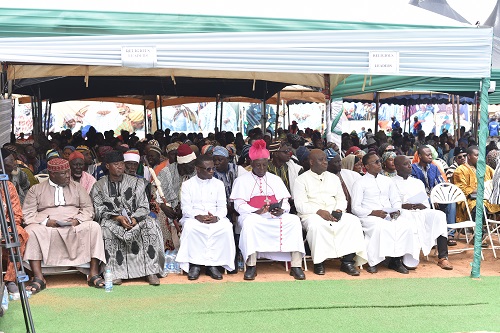
The traditional ceremony, steeped in the customs and heritage of the Dagomba people, took place at the historic Gbewaa Palace in Yendi in an atmosphere of grief, reverence and hope.
In attendance was President John Dramani Mahama, who in his tribute described the late Overlord as a distinguished traditional ruler whose leadership strengthened peace, unity and development in Dagbon.

Former Vice President Dr Mahamudu Bawumia also conveyed his condolences to the people of Dagbon.
Also in attendance were chiefs, queen mothers, elders, royal family members, religious leaders and thousands of mourners gathered to witness the installation.
The enskinment of the Kampakuya Naa as Regent is one of the most significant stages in the transition of leadership in the Dagbon Kingdom. It ensures continuity of authority and the preservation of the kingdom’s customs until a substantive Ya-Na is selected by the kingmakers in accordance with Dagbon tradition.
Friday’s ceremony reflected the resilience of one of Ghana’s oldest traditional kingdoms, where centuries-old customs continue to guide leadership transitions with dignity and order.
The late Ya-Na, Ndan Abukari II, who ascended the skin in 2019, is widely remembered for consolidating peace, unity and reconciliation in Dagbon following years of chieftaincy disputes.
Throughout Yendi, the mood remained solemn as residents lined the streets while traditional drumming, chanting and customary rites echoed through the ancient capital. Men, women and children, mostly dressed in black, paid their respects to a monarch whose reign restored confidence in the kingdom’s future.
The installation of Kampakuya Naa Yakubu as Regent now places upon him the sacred responsibility of overseeing the affairs of Dagbon during the mourning period while ensuring that the customs and traditions of the kingdom are faithfully upheld ahead of the enskinment.
After a successful enskinment, attention now turns to the traditional processes that will eventually culminate in the selection and enskinment of a new Overlord. Until then, the Regent will serve as the custodian of the Dagbon Kingdom, ensuring that the customs, authority and dignity of one of Africa’s oldest traditional kingdoms remain intact.
From Geoffrey Buta, Yendi
The Ghana Health Service, with UNICEF support, has trained 100 healthcare providers on adolescent-friendly maternal healthcare services as it expands its Safety Net Intervention programme to 44 additional health facilities in the Central Region.
The one-day training, held in two sessions, equipped midwives, community health nurses, health information officers and district focal persons with the knowledge and practical skills needed to implement the initiative effectively and improve pregnancy outcomes among pregnant adolescents.
The Safety Net Intervention is a special initiative that seeks to address health and social challenges associated with adolescent pregnancy with a comprehensive service including antenatal and postnatal care, skilled delivery services, postpartum family planning, home visits and connections to education and social support services.
By this intervention, the GHS and UNCEF are seeking to mitigate the incidence of adolescent pregnancy, maternal deaths among adolescent girls, neonatal deaths among babies born to adolescent mothers, and child marriage.
They are also seeking increased uptake of postpartum family planning among adolescent mothers and improved educational continuity and economic resilience for adolescent girls.
Mrs Emma Delali Foli, the Central Regional Focal Person for the Safety Net Intervention, explained that pregnant adolescents often faced heightened health risks and limited social support, highlighting the need for specialised healthcare and social interventions.
She said the intervention was introduced in six districts in the Central Region in 2020 and had expanded steadily over the years to 16 of the region’s 22 districts.
Following the addition of the 44 new facilities, the programme was now being implemented in 176 health facilities, with a goal of covering all 22 districts in the short possible time, she added.
Mrs Foli noted that since its introduction, the programme had benefited more than 5,000 pregnant adolescents in the Central Region, while strengthening collaboration with institutions such as the Department of Social Welfare, the Ghana Education Service, the National Youth Authority and the Domestic Violence and Victim Support Unit (DOVVSU).
The intervention, she said, had also contributed to increased uptake of postpartum family planning, stronger referral systems, greater access to social protection services and enhanced involvement of caregivers throughout pregnancy and childbirth.
Mrs Foli indicated that the newly trained health workers were expected to replicate the training at their respective facilities to ensure that other members of the healthcare team were adequately equipped to implement the intervention.
“This is new to them and so they have been trained on the concepts, objectives and goals of the Safety Net Intervention. The components of the intervention, as well as the importance of documentation and reporting, have also been emphasised,” she said.-GNA