News
Centre for National Culture (CNC) – Accra sensitises local communities to ways of curbingCOVID-19 through drama

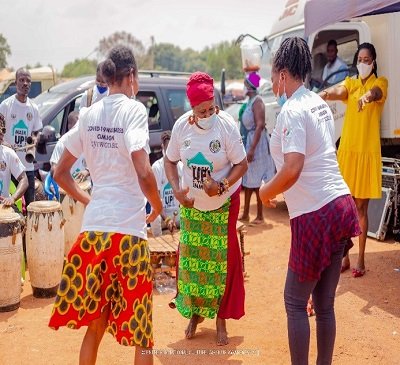
The Greater Accra Regional Centre for National Culture, under the auspices of National Commission on Culture (NCC) has adopted drama as a way of creating awareness and sensitising people within the Region on COVID-19.
Dubbed: ‘Mask-Up”, the Centre has so far staged drama at Makola, Dodowa and Kpone-Katamanso markets as well as within the Greater Accra Region.
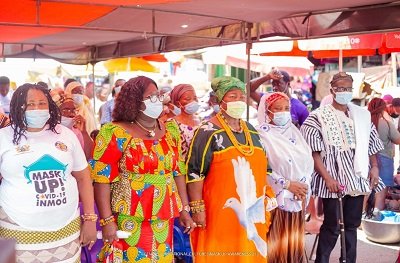
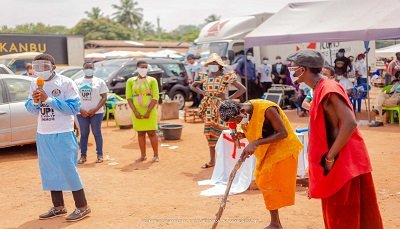
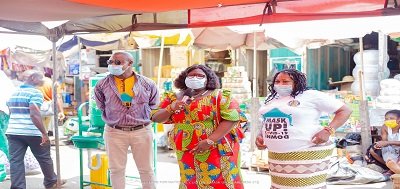
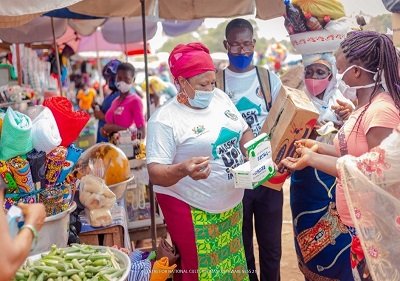
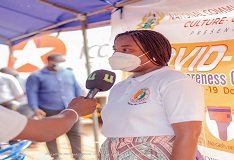
The Centre has been using the event to distribute also hand sanitisers, face masks and T-shirts to people in these areas where the drama was staged.
Purpose
The campaign, funded by the COVID-19 National Trust Fund, is intended to raise awareness and educate people on the safety protocols on the disease.The campaign admonishes citizens on the need to adhere to the COVID-19 safety protocols, help mitigate the spread and impact among residents in the various areas. The Centre’s awareness campaign takes the form of drama, which is a communication tool for community development.
The drama, “COVID-19 Down” performed by the CNC Accra Drama Group involves acting out scenes on coronavirus with actors playing the roles of individual characters in the play and telling “a life-changing story” with scientific facts on the coronavirus pandemic.
The drama is interwoven with informative dialogues and music, helping the audience to remember the story with a visual force. The drama is supported with other performances including, poetry, traditional music and dance.
Appeal
The Director of Accra CNC, Mrs. Alice Alima Kala expressed worry about the current trend of COVID-19, particularly how some people disregarded the safety protocols.She, therefore, appealed to the public to consider the COVID-19 safety protocols one of the surest ways of dealing with the pandemic.
Expectation
On her part, the Executive Director of National Commission on Culture, Ms Janet Edna Nyame, expressed optimism that the campaign “will give the participants the opportunity to once again become“ more conscious about the pandemic and help disseminate their knowledge among their family members, friends and neighbours and make them aware of COVID-19 health issues”.
Expressing excitement about the campaign, the Public Relations Officer of the Centre for National Culture, said as the drama was performed in a local language for a local audiencehas the tendency to reach out to a larger target audience with a particular message that could make a lasting impact.
Support
A non-governmental organisation, Rescue Volunteers – Ghana, supported the campaign with some PPE.
Country Coordinator of Rescue Volunteers – Ghana, Mrs. Lydia Tsotsoo Odai Tettey expressed worry on the low use of PPE and the breach of the social distancing rule by the traders and said her agency would continue to distribute PPE and hand sanitisers to traders at the market centres.


In a world where fathers are increasingly consumed by work and the pursuit of financial security, Bishop Michael Quartey, the Regional Overseer of the Perez Chapel International, has urged fathers to prioritise spending quality time with their children.
This, he said makes them develop trust, love and sense of security in building confident responsible adults.
Bishop Michael Quartey made this known in an interview with The Spectator ahead of the Father’s Day celebration tomorrow.
He noted that while many fathers are providing the financial needs of their families, children also require emotional support, guidance and quality time from their fathers.
“A lot of children are engaged in a lot of negative things just because of the absence of their fathers and it is about time we sit up.”
Bishop Quartey explained that fatherhood goes beyond meeting financial obligations and involves being physically and emotionally present in the lives of their children.
“Fathers serve as role models whose actions and decisions often influence the values and attitudes of their children” he disclosed.
He also elaborated that regular communication, participation in school activities and involvement in children’s daily life could significantly strengthen family bonds and contribute to the overall well –being of the children.
He added that though the modern day fathers are doing so well, we need to continue to change the narrative by putting in extra effort in the upbringing of our children.
“Being a father is a great joy and it is very necessary for fathers to be celebrated because they go through a lot,” he indicated.
Mr Quartey used the opportunity to encourage all fathers to continue doing their best and pray for their children as well.
By Linda Abrefi Wadie

A new cultural, trade, and diplomatic platform celebrating Ghana-Norway ties was launched on Saturday, June 13, at Palms by Eagles Hotel, Accra.
Dubbed the ‘Akwaaba Nsuo & Velkommen Fjord Durbar 2026’, the event draws on the symbolism of Ghana’s rivers, -Nsuo, and Norway’s fjords to highlight water as a shared cultural, economic, and environmental identity.
The three-day event is scheduled for July 31 – August 2, 2026 in Oslo, Norway. Activities will include a trade exhibition, durbar of chiefs, and B2B networking sessions.
Speaking at the launch, CEO of the Durbar, Kofi Mulan, said Ghana’s rivers like the Volta, Pra, and Ankobra have long sustained livelihoods through fishing, transport, and spirituality.
“Similarly, Norway’s fjords represent the cornerstone of its maritime heritage, global leadership in ocean industries, and environmental stewardship,” Mr Mulan added.
“These parallel relationships with water form the philosophical and thematic spine of the entire event. The Akwaaba Nsuo & Velkommen Fjord Durbar 2026 is therefore framed as a convergence of heritage and innovation,” he said.
Organisers say participants will benefit from Global visibility and cultural diplomacy in Europe, stronger ties with Norway, and increased market access for exports like fashion, crafts, agribusiness, and processed goods under AfCFTA frameworks on the Ghana side.
On the Norway side, they noted access to Norwegian expertise in maritime technology, aquaculture, and renewable energy, plus opportunities in fisheries, offshore energy, and sustainability projects.
The Durbar is positioned as a high-level exchange platform to deepen trade and diplomatic relations between Ghana and Norway.
By Edem Mensah-Tsotorme