News
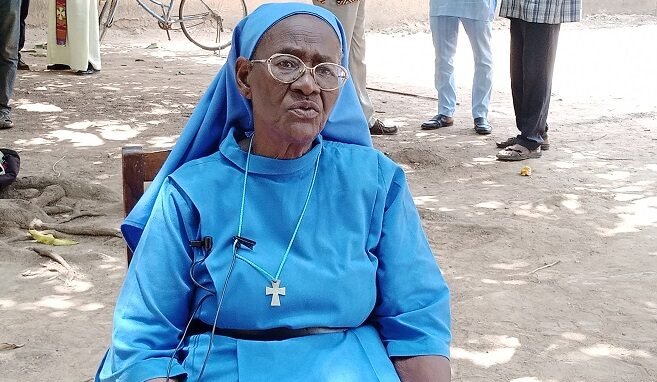
Reverend Sister forms association to support widows

- /home/u249204778/domains/spectator.com.gh/public_html/wp-content/plugins/mvp-social-buttons/mvp-social-buttons.php on line 27
https://spectator.com.gh/wp-content/uploads/2022/04/Reverend-Sister-Gabriel-Nonaah-e1651238809843.jpg&description=Reverend Sister forms association to support widows', 'pinterestShare', 'width=750,height=350'); return false;" title="Pin This Post">
- Share
- Tweet /home/u249204778/domains/spectator.com.gh/public_html/wp-content/plugins/mvp-social-buttons/mvp-social-buttons.php on line 72
https://spectator.com.gh/wp-content/uploads/2022/04/Reverend-Sister-Gabriel-Nonaah-e1651238809843.jpg&description=Reverend Sister forms association to support widows', 'pinterestShare', 'width=750,height=350'); return false;" title="Pin This Post">
Just like Dorcas in the Bible who organised widows and orphans and provided for them, a Catholic Sister in the Dafiiama-Bussie-Issah District in the Upper West Region, has taken it upon herself to organise and assist widows.
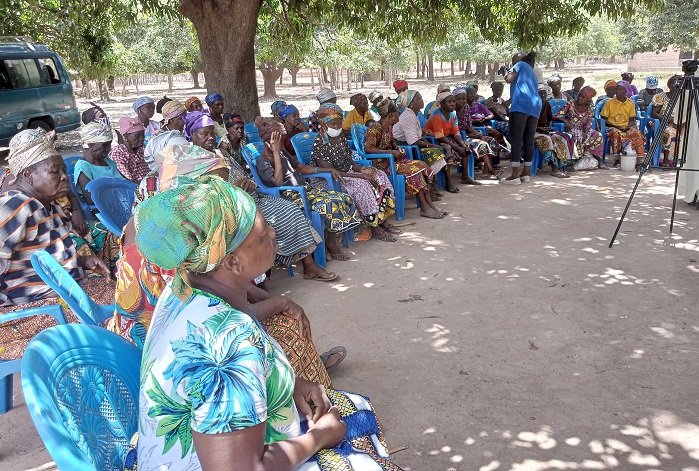
Reverend Sister Gabriel Nonaah of the Daffiama Parish, now an octogenarian (80 years and above) has been doing the benevolent work since 1990 and now has over 780 widows under her stewardship called the St Monica’s Widows Association.
Sister Nonaah told TheSpectator that she had the call in a dream to start the association when she came to terms with the suffering of widows in the area.
“From the stories they shared with me about the physical and emotional trauma they went through, I was touched and decided to help them with the little I can and that birthed the association in 1990,” she narrated.
She explained that she was unable to cater fully for the needs of the widows but supported them emotionally with soothing words that encouraged them to live decent lives.
She said she had to step in to educate some of them about some outmoded traditions when she first started the association.
Through sensitisation, the association has been able to save many of the widows from such practices and encouraged to be economically active.
“It has not been smooth sailing, we really have challenges because I cannot cater for 780 widows as you can see and many of them have dependent children and the number keeps adding on”, she said.
She explained that during the floods that occurred in the region last year which washed away young seedlings on people’s farms, many of the widows were affected and life became very unbearable for them.
She lamented that many of the widows were currently living in undesirable conditions and were mostly starved because they did not have any farm produce to depend on.
Sister Nonaah used the opportunity to call on benevolent institutions and individuals to come to their aid and support the women in whichever way possible either through skills training for the younger ones or support in petty trading.
“I am very old now, so I have started training a young lady to take over from me but she will still need the assistance of people to be able to help these women”, she said.
She mentioned Lawyer Thaddeus Sory, Managing partner at Sory@Law, a law firm in Accra as one of their regular donors who had made a point to make food donation in large quantities to them annually.
Some of the widows interacted with this reporter and shared harrowing experiences.
“I lost my husband six years ago and I have six children”, Madam Christy Kpianyanga, a widow narrated. She said her youngest child was seven years old and was not in school just because she could not provide for him in addition to the others.
She indicated that it was difficult providing three square meals a day particularly after last year’s floods where she lost her crops to the water.
Another widow, Afia Wadieh had four children when her husband died 10 years ago leaving them with no farmland to feed on. She was in a dilemma as she had no working capital either.
She was however grateful to the Association for the support it continued to provide since its inception.
From Lydia Darlington Fordjour, Wa


Residents of Brodi, a farming community in the Tain District of the Bono Region, have been left in shock and mourning following the alleged murder of a 45-year-old woman by her husband, who later died by suicide.
According to information gathered by the Ghana News Agency (GNA), the suspect, popularly known as Kwabena Jack, believed to be in his 50s, allegedly attacked and killed his wife, Abena Donkor, while the couple were working on their farm on Monday, August 11, 2026.
Mr Kingsley Obah, Assembly Member for the Brodi Electoral Area, confirmed the incident to the GNA.
He explained that after news of the woman’s death spread through the community, residents launched a search for the suspect. His lifeless body was later discovered in a nearby bush on Tuesday, August 12, 2026.
Police have since conveyed both bodies to the Tain District Government Hospital, where they have been deposited for preservation and autopsy.
Investigations into the incident are ongoing. -GNA

Hawkers and roaming preachers have taken over the five-metre high Madina REDCO footbridge and adjoining streets, making it increasingly difficult for pedestrians to use the facility intended to promote safe road crossing.
The traders have virtually turned sections of the footbridge into a marketplace, displaying their wares on the floor using jute sacks, plastic sheets and metal trays, while others have occupied both sides of the walkway with their merchandise.
Foodstuffs such as okro, garden eggs, pepper, onions, dried fish, smoked fish, grains, spices and other groceries are openly sold on the footbridge and along the roadside, forcing pedestrians to weave through the crowded path.
Clothing and fashion accessories including slippers, brassieres, panties, socks, bags and other household items are also displayed for sale, leaving only limited space for commuters to use.
The situation is worsened by the presence of itinerant preachers who position themselves on the footbridge with public address systems to evangelise, drawing crowds to further obstruct pedestrian movement.
Head porters are also seen crossing the highway through the median while carrying heavy loads instead of using the footbridge, exposing themselves to the danger of being knocked down by speeding vehicles.
Also, portions of the footbridge are showing signs of deterioration. Several metal railings are rusted, bent and loosely secured with pieces of wire, raising concerns about the safety of users, especially children, the elderly and persons with disabilities.
Sections of the concrete surface are worn and chipped, while makeshift wooden supports attached to parts of the structure suggest temporary repairs.
After a visit by The Spectator last week, it emerged that many commuters preferred crossing the busy Madina Highway instead of using the footbridge because of the congestion created by the trading and preaching activities.
For years, successive attempts by the police, the military and the La Nkwantanang Madina Municipal Assembly to address congestion around the REDCO and Zongo Junction enclave have yielded little success, with the area becoming notorious for roadside trading, indiscriminate parking and pedestrians refusing to use the footbridge.
A pedestrian, who gave her name only as Maame Yaa, described the situation as worrying, saying the footbridge, which was constructed to protect lives, had gradually lost its purpose because of the growing encroachment by traders and preachers.
According to her, many pedestrians were discouraged from using the facility because navigating through the crowded walkway had become difficult and uncomfortable.
She appealed to the La Nkwantanang Madina Municipal Assembly and other relevant authorities to intensify enforcement to prevent unauthorised trading and other activities on the footbridge and ensure it served its intended purpose of promoting pedestrian safety.
However, during the visit, personnel of the Ghana National Fire Service (GNFS) were seen carrying out a decongestion exercise to remove hawkers from sections of the roadside around the footbridge as part of efforts to improve public safety and ease the movement of both pedestrians and motorists.
The exercise forms part of a pilot project initiated by the Municipal Fire Commander for Madina, Division Officer II (DO II) Abdul Salia, who assumed command of the Madina Municipal Fire Station three months ago.
Speaking in an interview with The Spectator, DO II Abdulai Salia, who is also a long time resident of the community, said the month long project began on July 1 and ended on July 31, with 30 firefighters deployed daily to regulate traffic, clear hawkers from the streets and footbridge, and create access for emergency vehicles.
Continued on page 12
By Esinam Jemima Kuatsinu