Hot!
2021 BECE begins smoothly

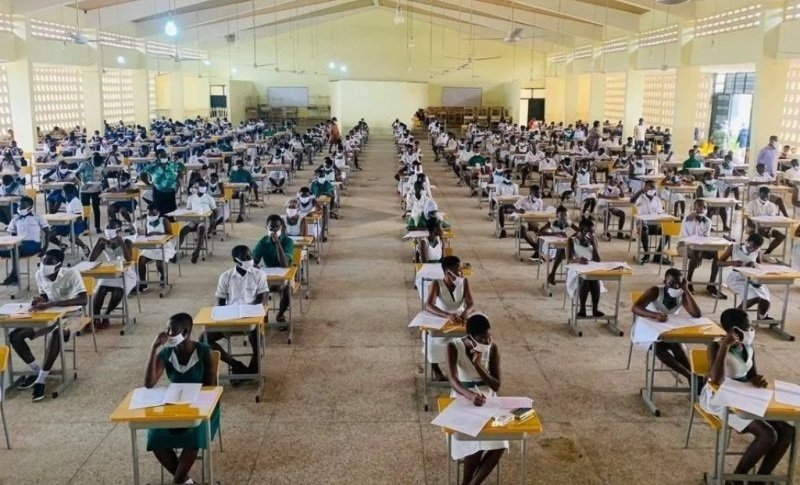
This year’s Basic Education Certificate Examination (BECE) has started smoothly across the country.
Apart from the late start of the examination at a few centres in the Greater Accra Region, no major irregularity was recorded an hour into the examination.
A total of 571, 894 candidates are writing the examination from today, Monday, November 15, 2021, to Friday November 19, 2021 at 2,158 centres nationwide with a total of 20,124 invigilators, 2,158 supervisors and 1,853 assistant supervisors.
Mrs Agnes Teye-Cudjoe, Head of Public Affairs, West African Examinations Council’s National Office, in an interview with the Ghana News Agency (GNA), said the Council had put in place stringent security measures to prevent leakages in this year’s examinations.
She said officials of the National Intelligence Bureau monitored the production process – printing, sorting and packaging of the papers- and confident that there would be no leakages of the papers before and during the exams.
“The Council has also increased the number of depots storing confidential materials under strict surveillance to ensure that the papers did not leak before and during the examinations,” she said.
Mrs Teye-Cudjoe said all COVID-19 safety protocols would be observed during the examination, stressing that all candidates would be given hand sanitisers and that “should a candidate fall sick and a medical report is available, a committee will look into the situation and take a decision.”
A statement signed by Mrs Cassandra Twum Ampofo, the Head of Public Relations, Ghana Education Service, commended teachers, school heads, parents, and other stakeholders for preparing the candidates for the examination.
The statement entreated all stakeholders to desist from any form of examination malpractice.
It said details of the selection process for the Senior High School would be communicated in due course and wished all candidates success and good luck.
Mr Peter Korda, Head of Public Relations, Ghana National Association of Teachers, said they expected the BECE results to be better this year despite the long COVID-19 break.
He said teachers did their best to catch up with the curriculum after the 10-month break in 2020 during the COVID-19 pandemic.
“COVID-19 pushed teachers to go the extra mile to adequately prepare students for the examinations through extra classes and online teaching and assignments,” he said.
He advised the candidates to adhere to rules and regulations of the exams.
Meanwhile, male candidates continue to dominate the examination with 287, 605 males writing this year’s examination as against 284, 289 females.
In 2020, out of a total of 531, 705 candidates, the females were 262, 286 against 269,419 males.
In 2019, out of 517, 331 candidates, there were 253, 729 females and 263, 602 males.
For 2018, the females were 246,529 against 263,295 males, totalling 509, 824.
The year 2017 was not different. A total of 226, 905 females wrote the examination against 241, 148 males.
The Ashanti Region, for a very long time, has been registering the highest number of candidates with males outnumbering the females.
In 2017, it had 47,702 males against 45,868 females. In 2018, the males were 54,487 as against 51,121. Similarly, there were 52,945 males and 51,516 females in 2019. A total of 54,025 males and 52,832 females in 2020. And in 2021, the males were 55,829 whereas the females were 55,603.
The case is different for Greater Accra Region, which records more females than males.
In this year’s examination, the Region (Greater Accra) registered 50,815 males and 54,824 females.
There were 45,172 males against 49,271 females in 2020.
Also, whereas 43,273 males were recorded in 2019, the females were 47,311.
In 2018, the male candidates stood at 42, 643 against 45,710 females.
The males in 2017 were 41,022 against 44,019 females.
Below is the regional breakdown for this year’s examination:
Eastern Region, 28,475 males, 27, 455 females.
Central Region, 31,954 males and 31,773 females.
Western and Western North Regions will have 29,718 males and 28,598.
The Bono, Ahafo and Bono East Regions registered 27,138 males against 26127 females.
A total of 21,871 males and 20,222 will represent the Volta and Oti Regions.
The Northern, North East and Savannah Regions will have 24,029 males and 20,809 females.
Upper East, 10,586 males and 11,530 females.
The Upper West Region, 7,290 males and 7,348 females. -GNA



The Member of Parliament for Nsawam Adoagyiri, Frank Annoh Dompreh, has expressed concern over delays in the release of the District Assemblies Common Fund, warning that the situation is stalling development across the country.
On his facebook page, he described as a matter of urgent national importance, the Minority Chief Whip pointed to what he sees as a growing crisis of unpaid contractors, abandoned projects, and halted infrastructure works in many districts.
He noted that several communities are grappling with half completed schools, unfinished health facilities, abandoned markets, deteriorating roads, and stalled sanitation projects.
According to him, many contractors who have executed projects for district assemblies have not been paid, forcing some construction firms to demobilise from sites while workers lose their jobs.
He stressed that the District Assemblies Common Fund is not a discretionary allocation but a constitutional requirement under Article 252 of the 1992 Constitution, intended to support development at the local level.
In his view, years of delayed releases and accumulated arrears have weakened district development financing and disrupted projects meant to improve living conditions in communities.
He further argued that some payments made in recent years were largely the settlement of old debts rather than funding for new or ongoing projects, a situation he believes has affected contractor confidence and local economic activity.
He described the issue as more than a budgetary challenge, characterising it as a development emergency and a governance concern.
He therefore urged the appropriate authorities to pay outstanding DACF arrears, settle contractors who have completed their work, and ensure that transfers to districts are automatic and predictable.
He maintained that decentralisation can only succeed when district assemblies receive adequate and timely funding to carry out development projects.
He emphasised that stalled projects directly affect ordinary citizens, since they rely on such infrastructure for education, healthcare, transportation, sanitation, and economic activities.
He called for renewed attention to grassroots development, insisting that national progress should not be concentrated only in major cities but extended to all communities.
By: Jacob Aggrey

Richard Appiah, the footballer who killed two children and stored part of their bodies in a fridge at Abesim in the Bono Region in 2021 has been handed a lifetime sentence.
This was after a five member panel of judges at the Accra High Court returned a verdict of guilty against the convict.
Appiah, 32, also a draughtsman would spend the rest of his life in prison after he was convicted of murder.
More more more
BY MALIK SULLEMANA