News
Women’s access to fertile land and information way to combat desertification-UW EPA boss

- /home/u249204778/domains/spectator.com.gh/public_html/wp-content/plugins/mvp-social-buttons/mvp-social-buttons.php on line 27
https://spectator.com.gh/wp-content/uploads/2023/06/3b6d1a41-2690-4a30-88f6-0dba715844a7.jpeg&description=Women’s access to fertile land and information way to combat desertification-UW EPA boss', 'pinterestShare', 'width=750,height=350'); return false;" title="Pin This Post">
- Share
- Tweet /home/u249204778/domains/spectator.com.gh/public_html/wp-content/plugins/mvp-social-buttons/mvp-social-buttons.php on line 72
https://spectator.com.gh/wp-content/uploads/2023/06/3b6d1a41-2690-4a30-88f6-0dba715844a7.jpeg&description=Women’s access to fertile land and information way to combat desertification-UW EPA boss', 'pinterestShare', 'width=750,height=350'); return false;" title="Pin This Post">
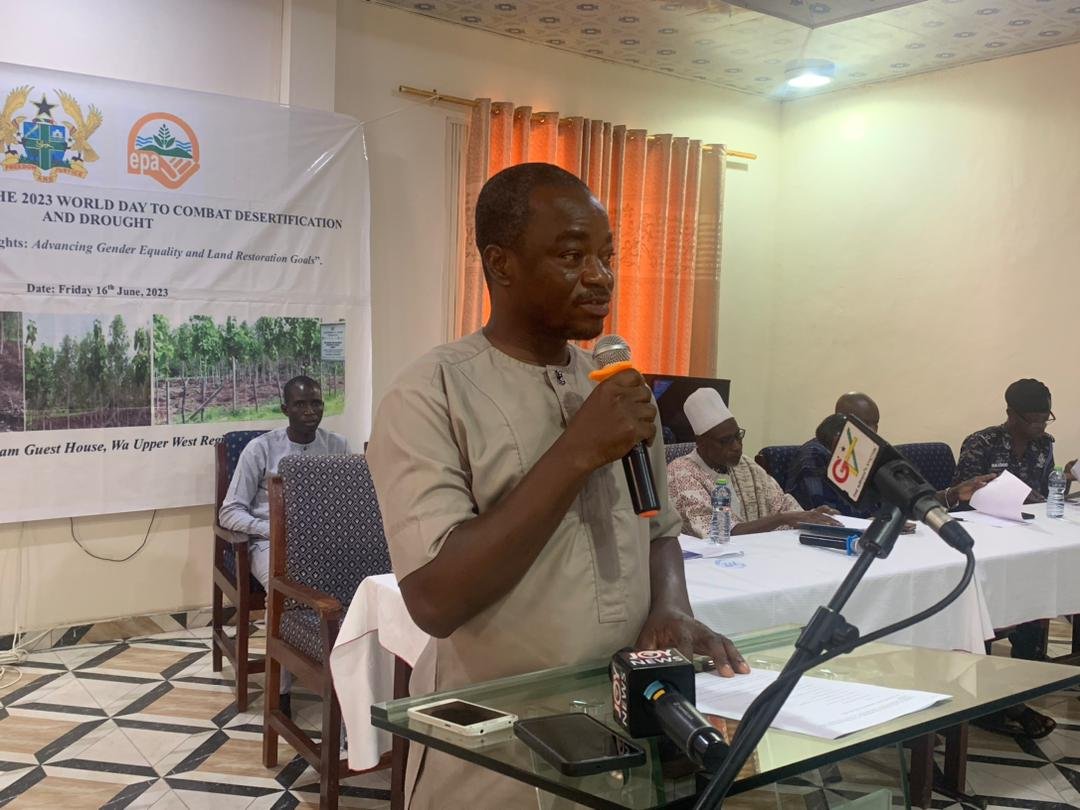
The Upper West Regional Director of the Environmental Protection Agency, Mr Emmanuel Lignule has stressed that expanding women’s access to fertile land and information on sustainable agriculture and land management was one of the ways to combat desertification and drought.
The director noted that women paid attention to detail and would engage in sustainable agriculture if they were given adequate training on the theme and how it would help prevent desertification and promote sustainable land use.
Mr Lignule stated this on Friday when the region joined the rest of the country to mark the World Day to Combat Desertification and Drought to create awareness on the impact of gender equality on land restoration measures in order to influence stakeholders to device measures to combat it.
The day was observed on the theme; ‘’Her land. Her right, advancing gender equality and land restoration goals’’.
Mr Lignule indicated that land restoration and sustainable land management to combat desertification and mitigate the effect of drought was a shared responsibility of everyone and said combating desertification involved using land in ways that prevented or reduced its degradation.
He noted that desert conditions served as challenges to socio-economic development and said it included a decline in supply of wood and non-wood forest products for various uses and low agricultural yield leading to poverty and increased gender inequality.
‘’The purpose of this year’s celebration is to raise awareness on the underlying causes of desertification and drought and to also inspire stakeholders to support the advancement of women’s land right’’, he said.
He said land degradation in regions with prolonged dryness led to the formation of desert conditions such as dry lands with low biological and economic productivity, sparse vegetation and scarcity of water.
He urged stakeholders in land management to take measures to increase women’s access to land and to secure lands right to encourage upscaling of land restoration and sustainable land management.
The Chief Director at the Regional Coordinating Council (RCC), Mr Peter Maala highlighted that land degradation was the core environmental challenge in the region and said it threatened ecosystem services such as water flow and quality regulation.
This he said had been a major source of worry for leadership of the region since majority of people in the region were engaged in agriculture as their only source of livelihood.
He called on stakeholders to support government’s efforts at increasing access to Liquefied Petroleum Gas (LPG) in order to reduce dependence on wood fuel, as well as controlling devastating wildfires and encouraging diversity to livelihood to increase resilience to drought.
The programme brought together staff of the Regional Coordinating Council, traditional authorities, religious leaders, heads of departments and stakeholders across the region.
FROM RAFIA ABDUL RAZAK WA


The Office of the Special Prosecutor (OSP) has taken note of public allegations of extortion and related conduct made against the Minority Leader of Parliament, Alexander Afenyo-Markin.
The allegations were made by the Chief Executive of the Ghana Gold Board (GoldBod), Sammy Gyamfi.
In a brief statement, the OSP said it has also received a joint petition submitted by two persons, as well as two separate petitions from other persons, in relation to the same allegations.
“Given the nature of the allegations, the OSP will assess the case and determine whether it falls within its statutory mandate and whether further investigative action is warranted,” the statement said.
The development comes amid a heated public feud between the Minority in Parliament and the leadership of GoldBod over the operations of the Domestic Gold Purchase Programme.
The Minority, led by Afenyo-Markin, has accused GoldBod and the Bank of Ghana of causing a loss of over $1.7 billion, citing the International Monetary Fund’s August 2026 report. The Minority has vowed to pursue the matter as Parliament has reconvened for an emergency sitting.
GoldBod, on the other hand, has rejected claims by some NPP MPs, including Tano South MP Dr Gideon Boako, that it owes the Bank of Ghana GH¢1 billion in overdrafts, describing the claim as “false and malicious.”
In the latest twist, GoldBod CEO Sammy Gyamfi has accused the Minority Leader of extortion and related conduct, an allegation that has triggered petitions to the OSP.
The OSP is mandated under Act 959 to investigate and prosecute specific cases of alleged or suspected corruption and corruption-related offences involving public officers and politically exposed persons.
By Edem Mensah-Tsotorme

General Secretary of the New Patriotic Party (NPP), Justin Kodua Frimpong, has filed his nomination to contest the position of General Secretary again as the party begins its rebuilding efforts ahead of the 2028 general elections.
He was accompanied by party stalwarts and supporters who were in high spirits, expressing confidence that he is the right person to hold the position.
Speaking after filing his nomination, Mr Kodua Frimpong assured the rank and file of the party that he would not disappoint them.
“I can assure you that the faith the rank and file of the party have had in me, I will never disappoint them,” he said.
He also pledged to run a clean campaign devoid of personal attacks.
“I can assure you that our internal campaign will be devoid of personal attacks,” he told his fellow contestants and the rank and file of the party as he seeks to retain his position.
His tenure has seen the party through the 2024 general elections, where the NPP lost power to the National Democratic Congress (NDC) after eight years in government.
The party is currently in a rebuilding phase, with internal elections scheduled to elect new national executives to lead its reorganization towards the 2028 polls.
The General Secretary position is considered one of the most influential in the party’s administrative structure, responsible for the day-to-day running of the party secretariat and implementation of party decisions.
By Edem Mensah-Tsotorme