Hot!
Women demand support for higher education


- /home/u249204778/domains/spectator.com.gh/public_html/wp-content/plugins/mvp-social-buttons/mvp-social-buttons.php on line 27
https://spectator.com.gh/wp-content/uploads/2021/11/Dr-Gifty-Gyamerafourth-from-left-with-the-participants-Photo-Godwin-Ofosu-Acheampong.jpg&description=Women demand support for higher education', 'pinterestShare', 'width=750,height=350'); return false;" title="Pin This Post">
- Share
- Tweet /home/u249204778/domains/spectator.com.gh/public_html/wp-content/plugins/mvp-social-buttons/mvp-social-buttons.php on line 72
https://spectator.com.gh/wp-content/uploads/2021/11/Dr-Gifty-Gyamerafourth-from-left-with-the-participants-Photo-Godwin-Ofosu-Acheampong.jpg&description=Women demand support for higher education', 'pinterestShare', 'width=750,height=350'); return false;" title="Pin This Post">
The government has been urged to develop deliberate policies to support women pursue higher education. A Senior Lecturer at Ghana Institute of Management and Public Administration (GIMPA), Dr Gifty Oforiwaa Gyamera, who made the call, said that would help bridge the gender parity gap at the higher education level. She said this at a forum last Tuesday to discuss the gender inequality gap in higher education and measures to address it. It was under the Gender Equity and Women in Higher Education Writing Programme, and sponsored by the Centre of Excellence for Equity in Higher Education (CEEHE) at University of Newcastle, Australia. The programme which was developed by the Director of CEEHE, Professor Penny-Jane Burke, and Dr Gyamera, aimed at creating collaboration and mentoring opportunities for women in higher education.
CEEHE has adapted the research Writing Programme for Widening Participation Practitioners to engage women in higher education with the critical theoretical tools to examine questions of gender equity in a collaborative space of co-mentoring and exchange of women’s differently located experiences across a two different national contexts of Australia and Ghana and a range of disciplinary fields. Dr Gyamera observed that there were more male lecturers than female lecturers at higher education level which ought to be addressed. “Now you cannot teach without PhD at the University and so there must be conscious effort by the government or stakeholders to promote female in higher education to pursue their PhD,” she stated. In view of this, she said scholarships must be provided for women to pursue their PhD in order to be at par with their male counterparts at the higher education level. She suggested that the number of ‘academic papers’
that women PhD holders needed to publish to be promoted, though debatable could be reduced for them and urged women to collaborate with their counterparts both in and outside the country to co-author academic publications. At the institutional level, she said, organisations needed to support their female staff to pursue higher education to help train more female lecturers.
“There should also be deliberate policies to emphasise mentorship and coaching particularly for the early career academics,” she added. The Human Resource Director at GIMPA, Mrs Victoria Kumbuor also said academic work at the higher education level favoured men than women. She proposed that “Professors should pair with women who have the capacity to write academic papers for
publication.” That, Mrs Kumbuor said, would help equip them to assume leadership positions at the higher education level. “We do not say that standards must be lowered for women but what we are asking for is support be provided for women to be able to meet those criteria so that they could assume leadership positions and the gap can be bridged,” she added.
By Vivian Arthur



The Tema Regional Police Command has arrested a 32-year-old man for allegedly posing as a soldier and extorting money from unsuspecting members of the public at Ashaiman.
The suspect, identified as Bright Atsu Kudiabor, was arrested by the Ashaiman Police on Wednesday, September 16, 2026, at about 7:00 a.m.
According to the Police, he was arrested at an area known as “I Shall Return”, where he was allegedly parading himself as a soldier and demanding money from people.
The Police said Kudiabor, who is an ex-convict, was initially arrested by personnel of the Ghana National Fire Service in Ashaiman with assistance from other members of the public.
A search conducted on him after he was handed over to the Police reportedly led to the recovery of a set of military camouflage uniform.
The suspect is currently in Police custody and assisting with investigations.
The Tema Regional Police Command said he would be processed for court after investigations are completed.
The Police urged the public to remain vigilant and report anyone who falsely presents themselves as a soldier or a member of another security agency to deceive or extort money from the public.
By: Jacob Aggrey
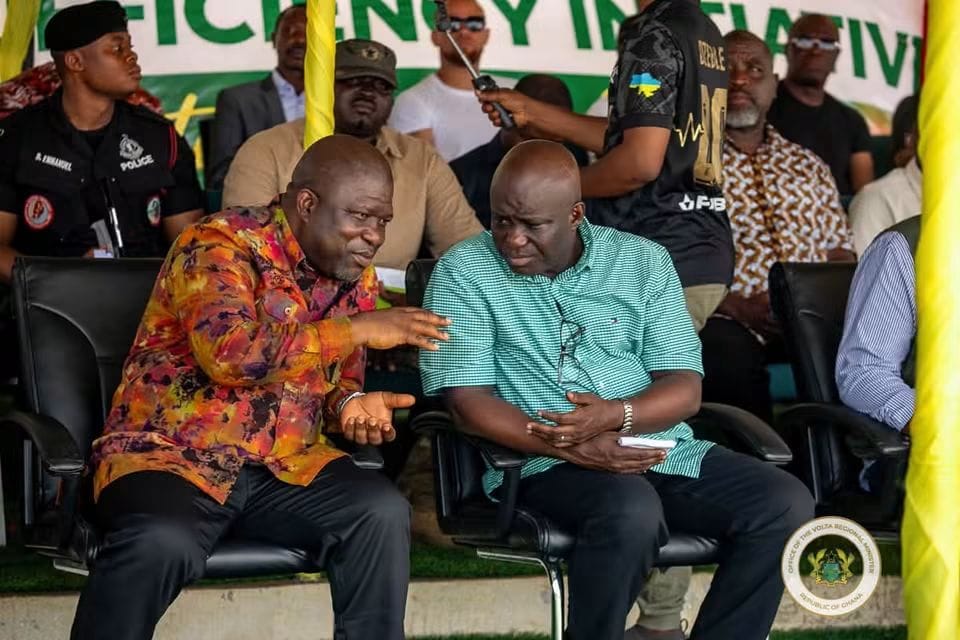
Volta Regional Minister, James Gunu, says the Volta Region holds enormous agricultural potential and efforts must be geared towards connecting farmers to the needed resources to unlock that potential.
He said focus must be on linking farmers to resources, technology, financing and markets to increase production, create jobs and build sustainable livelihoods.
Hon. Gunu made the remarks at the national launch of the Ghana Tomato Self-Sufficiency Initiative (GHATSI) held at Anloga in the Volta Region on Tuesday, September 15.
The initiative, under the theme “Produce at Home. Feed the Nation. Export the Surplus,” seeks to boost local tomato production, processing and marketing while reducing Ghana’s heavy reliance on imported tomatoes.
The launch was attended by the Minister for Food and Agriculture, Eric Opoku, his Deputy, John Setor Dumelo, Feed Ghana Coordinator, Bright Demordzi, Members of Parliament, traditional leaders, MMDCEs, farmers and other stakeholders.
Mr.Gunu expressed appreciation to the Minister for Food and Agriculture for the support announced for the region, including two excavators, 200 cartons of organic fertiliser, and GH¢200,000 for Ms. Kuatudzo Esther Dela, a tomato farmer and processor from Ziope.
He described the initiative as an important step towards making agriculture a stronger driver of food security, job creation and economic growth in the Volta Region.
By Edem Mensah-Tsotorme