Hot!
Agotime-Afefame youth desert town


- /home/u249204778/domains/spectator.com.gh/public_html/wp-content/plugins/mvp-social-buttons/mvp-social-buttons.php on line 27
https://spectator.com.gh/wp-content/uploads/2021/11/River-Tordze-at-Agotime-Afegame.jpg&description=Agotime-Afefame youth desert town', 'pinterestShare', 'width=750,height=350'); return false;" title="Pin This Post">
- Share
- Tweet /home/u249204778/domains/spectator.com.gh/public_html/wp-content/plugins/mvp-social-buttons/mvp-social-buttons.php on line 72
https://spectator.com.gh/wp-content/uploads/2021/11/River-Tordze-at-Agotime-Afegame.jpg&description=Agotime-Afefame youth desert town', 'pinterestShare', 'width=750,height=350'); return false;" title="Pin This Post">
A first-time visitor to the border town of Agotime-Afegame in the Volta Region is struck by the empty houses in the town.
The reason is that majority of the young adults in the area have ‘fled’ the town to other parts of the country in search of comfort and jobs.

• A woman abandons her bags of charcoal due to the absence of market • A deserted house at Agotime-Afegame
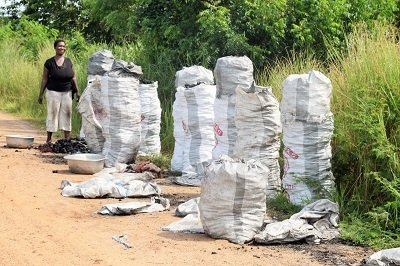
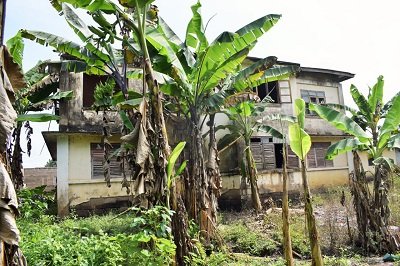
For years, the people of Agotime-Afegame had made their fortune from cross-border trade with neighbouring Togo and also by selling their bountiful harvests of vegetable in ready markets at Ho, Kpetoe, Ziope and other parts of the region.
The massive storey buildings in the town which are now decaying depict lost years of wealth and glory.
In the PNDC era under Flt-Lt J.J Rawlings, Agotime-Afegame was said to be an important spot for intelligence gathering from across the border and that guaranteed security in the town.
Today, Agotime-Afegame is a pale shadow of its excellent past.
For some time now, the people of the border town have been held “hostage” in their homes.
This follows heavy rains which destroyed various portions of the 9.5kilometre untarred road from Agotime-Beh, along the Ho-Aflao road, to the town.
A journey on the road by car which under normal circumstances takes 10 minutes can now take more than one-and-a-half hours due to the nightmarish nature of the road.
In the absence of cellular phone signals, the community which has about 1,300 inhabitants is now in a grave state of uncertainty as the people can hardly contact their relatives in other parts of the country.
The road continues to Kpordzaxo in Togo which is just metres away from Agotime-Afegame, and then to the Republic of Benin.
That international road could rightly be described as an “international ruin”.
In times of downpours the stretch becomes a river course making it totally unusable and further tightening the hostage status of the people of Agotime-Afegame.
Now, the border is still shut, depriving them of their livelihood and with the nature of what is meant to be the road leading to the town, the people cannot sell their farm produce anywhere.
When some journalists waded through the muddy waters and visited the area last month, the atmosphere was a scary one.
The sick cannot access healthcare outside the town.
Plans to bury the dead in the land of their brothers and sisters at Kpordzaxo are frustrated by the official location of Kpordzaxor in Togo.
The road from the Beh junction to the town was constructed in the early 1970s and for more than 48 years the only rehabilitation was occasional reshaping.
In the absence of potable water, the people of Agotime-Afegame rely on River Tordze which according to local residents, is so polluted that one would not even want to use to flush the toilet.
With no link road, no cellular service and no potable water in the wake of little food stocks and an uncertain future, the people of the food basket are gripped with anxiety.
The town once known for wealth has been brought to its knees.
Citizens of the Agotime-Afegame who live in other parts of the country are now avoiding the nightmare in their hometown by keeping their distance from the town.
From Alberto Mario Noretti, Agotime-Afegame



The Tema Regional Police Command has arrested a 32-year-old man for allegedly posing as a soldier and extorting money from unsuspecting members of the public at Ashaiman.
The suspect, identified as Bright Atsu Kudiabor, was arrested by the Ashaiman Police on Wednesday, September 16, 2026, at about 7:00 a.m.
According to the Police, he was arrested at an area known as “I Shall Return”, where he was allegedly parading himself as a soldier and demanding money from people.
The Police said Kudiabor, who is an ex-convict, was initially arrested by personnel of the Ghana National Fire Service in Ashaiman with assistance from other members of the public.
A search conducted on him after he was handed over to the Police reportedly led to the recovery of a set of military camouflage uniform.
The suspect is currently in Police custody and assisting with investigations.
The Tema Regional Police Command said he would be processed for court after investigations are completed.
The Police urged the public to remain vigilant and report anyone who falsely presents themselves as a soldier or a member of another security agency to deceive or extort money from the public.
By: Jacob Aggrey

Volta Regional Minister, James Gunu, says the Volta Region holds enormous agricultural potential and efforts must be geared towards connecting farmers to the needed resources to unlock that potential.
He said focus must be on linking farmers to resources, technology, financing and markets to increase production, create jobs and build sustainable livelihoods.
Hon. Gunu made the remarks at the national launch of the Ghana Tomato Self-Sufficiency Initiative (GHATSI) held at Anloga in the Volta Region on Tuesday, September 15.
The initiative, under the theme “Produce at Home. Feed the Nation. Export the Surplus,” seeks to boost local tomato production, processing and marketing while reducing Ghana’s heavy reliance on imported tomatoes.
The launch was attended by the Minister for Food and Agriculture, Eric Opoku, his Deputy, John Setor Dumelo, Feed Ghana Coordinator, Bright Demordzi, Members of Parliament, traditional leaders, MMDCEs, farmers and other stakeholders.
Mr.Gunu expressed appreciation to the Minister for Food and Agriculture for the support announced for the region, including two excavators, 200 cartons of organic fertiliser, and GH¢200,000 for Ms. Kuatudzo Esther Dela, a tomato farmer and processor from Ziope.
He described the initiative as an important step towards making agriculture a stronger driver of food security, job creation and economic growth in the Volta Region.
By Edem Mensah-Tsotorme