Features
The Prophet (part 11)

Priscilla had gone away. She needed to pay an old debt, and the creditor had promised to visit violence on her whole family if she didn’t pay the GH¢700 by 8pm. Another woman was waiting in the other bedroom. He was about to join her when the voices started.
“You are here already?” Antubam said. “You deserted me completely as I went through the ordeal this morning.”
“Your own stubbornness got you into that situation. You must never approach those book people again. Do not get into any argument with them. Enjoy the money, the power and the women we have given you. You can never win.”
“And what about the man, Gidigidi.”
“The stick will give you all the protection you need. He talks a lot, and he likes fighting. But as you told him, he has no brains.”
“I need people to help me. The two girls were reliable, but they are gone. All the others are thieves.”
“They are thieves? And what are you? Remember that in the business you have chosen, there are many risks and dangers. We will try to help you. But you are very greedy’.
“The girl, Betty, told me that I will receive punishment sooner or later for deceiving people and for using the name of God. Is it true? Can you help me avoid this punishment?”
“Don’t worry about any punishment. Leave everything to us. We will give you all the protection you need. And by the way, the fetish priestess has made a request to Nana Kofi Broni to release you to her one day every month to keep her company.”
“That must be a very big joke. I will never, never again sleep with that old drunkard with rotten teeth. Never.’’
“She has already presented drinks at the shrine. If you don’t go, we are under instructions to fly you there by five o’clock and take you back home by six o’clock. If you don’t obey, your manhood will vanish and never return’.
“Have you people come to help me or torment me? Why can’t you find someone else to satisfy the old witch’s desires?”
“Next time you say such a thing again you will receive more lashes than you did last time. Start preparing for Sunday’s service. You are about to become the most popular prophet in Ghana.” The voices seized, and a strange silence seized the atmosphere.
Antubam was perplexed. What, he wondered, had he gotten himself into? He only wanted to grab that beautiful girl, Betty, marry her and have five or six beautiful children with her. But his desire for that girl seemed to have released a chain of confusing events.
Apart from the fiasco at the shrine for which he had to go and perform pacification rites at the shrine, he was compelled to have sex with that stinking old priestess. Her mirrors couldn’t bring up the image of Betty, yet she blackmailed him into having sex with her. And now the dwarfs want him to make that repulsive act a monthly ritual.
How annoying. But could he afford to lose his manhood? What would he do with the regular supply of two women a day? And how could he give birth to children? And what was he going to do with the threat from that fool of a competitor, Gidigidi? The stick provided by the Okomfo saved him on that occasion, but what would happen when he was eating, having a shower, or sleeping?
And now the dwarfs claim he was about to become one of the most popular prophets in Ghana. He was thrilled at the prospect. It meant more money, more power and control over people’s lives, and of course, more women. But at what cost? At the back of his mind, he felt an urge to go to Betty, confess everything to her, and ask her to help him start all over.
It was clear, Antubam thought, that a power far greater than Nana Kofi Broni was behind Betty. From their own mouths, the Okomfo, the stinking priestess and even the dwarfs had all indicated that Betty and her ‘book’ were too much for them.
But did it make sense to go to a girl you badly want to subdue and, having failed to achieve your aim, now go to her for help? How could a proud man like Kofi Antubam go through that? No, the cost of going to Betty was too high. He would continue to enjoy being a false prophet for now. Perhaps, if he got into trouble sometime in the future, he would go to her for help. But as for now, the show must go on.
Betty and Mary started work with Morrison Construction, and established a relationship that continued for many years. Completely satisfied with their honesty and hard work, Mr Morrison entrusted the acquisition and supply of materials in the Eastern Region to them, and concentrated on the other aspects of his work.
He paid for their admission to the University of Technology to undertake a sandwich programme in building construction, which they did online and on some weekends. They forgot about Antubam completely.
Kofi Antubam continued in the church business for many years. He became very popular for his miracles, and for several other things. On a few occasions police were called to the church premises to control his assistants who often exchanged blows over the sharing of money.
Quite a number of husbands confronted him for destroying their marriages, and he became known for raining insults on radio callers who asked him ‘stupid questions’. But he faced his main problem at home.
At first, he was only dealing with dwarfs who only spoke in shrill voices. But over time, all manner of creatures appeared before him, physically and during his sleep. On several occasions he tried to call or go to Betty, but the dwarfs restrained him. He sought solace in whisky and gin, and quietly hoped that Betty, or Mary, or Suzzie, would find a way to save him.
“That must be a very big joke. I will never, never again sleep with that old drunkard with rotten teeth. Never.’’
By Ekow de Heer


When Abigail Fremah steps up to the Armwrestling table, the noise fades, the tension settles, and order takes over.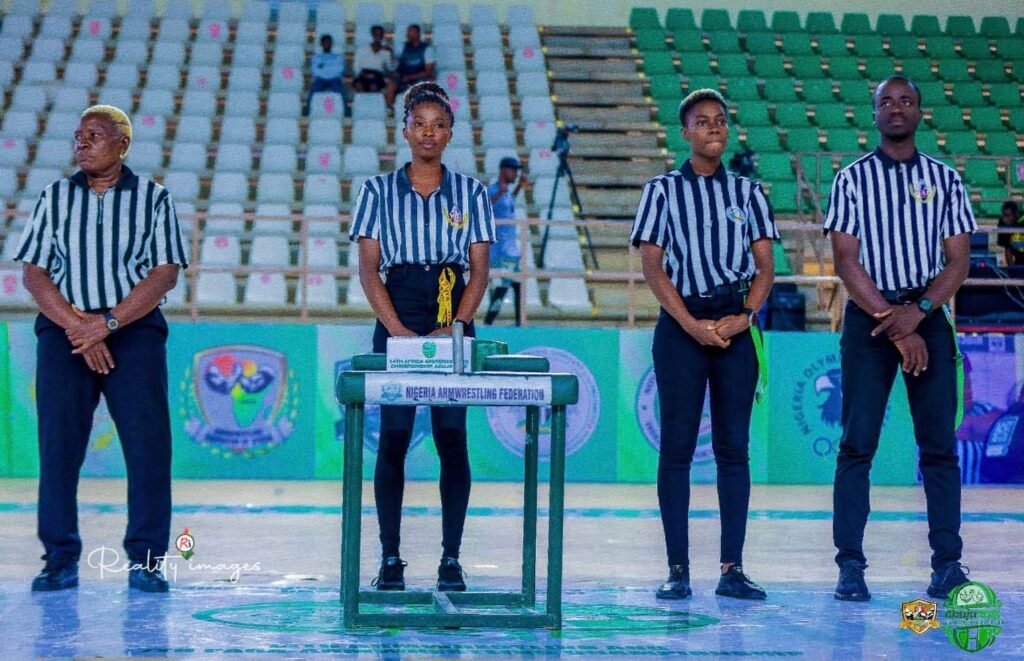
Despite a calm, but firm and meticulous disposition, she has become one of the quiet forces shaping Ghana’s growing reputation in the sport, not as an athlete, but a referee trusted on the continental stage.
Abigail’s journey into Armwrestling did not begin at the table. Like many Ghanaian sports enthusiasts, she grew up playing several disciplines. Football was her first love, but she also featured in volleyball and basketball during her school years. Sports, she says, was simply a way of life not just for her.
“It runs through the family. All my siblings are into sports,” she stated.
“I was involved in almost every sport in school, football, volleyball, netball, hockey; I did everything,” she recalls.
Her academic background in Health, Physical Education and Recreation laid a solid foundation for her sporting career. While on scholarship at the university (University of Cape Coast), she often used her modest budget to support young athletes, sometimes sharing skills and even T-shirts at programmes she attended. Giving back, she explains, has always been part of her motivation.

However, as she matured as an athlete, Abigail made a critical self-assessment.
“Armwrestling involves a lot of strength,” she admits. “Looking at my body type, I realised I couldn’t fit properly as a competitive athlete.”
That moment of honesty pushed her to a different trajectory but equally important path in sports; which is officiating.
During her National Service, she was encouraged by Mr Charles Osei Asibey, the President of the Ghana Armwrestling Federation (GAF), to consider officiating. He introduced her to a technical official, Mr Hussein Akuerteh Addy, who formally took her through the basics of Armwrestling officiating in 2021.

“I started as a case official,” she says. “We moved from region to region every week, officiating competitions. That’s where it all began.”
By 2022, Abigail was actively involved in national assignments, though she missed the African Championship that year. Her breakthrough came in 2023, when Ghana hosted the African Armwrestling Championship.
It was her first experience officiating at a major international competition and it changed everything.
“That was my first national and international exposure at the same time,” she says. “It really opened my eyes.”
Today, Abigail is a World Junior Armwrestling Referee, a status earned through performance, consistency and discipline. She explains that progression in officiating was not automatic.
“It’s all about performance, your appearance at African Championships, your conduct, how you handle pressure; that’s what takes you to the world level,” she stressed.
As a referee, Abigail’s priority is safety and fairness. Armwrestling, she notes, comes with risks, particularly injuries to the wrists, elbows, shoulders and arms.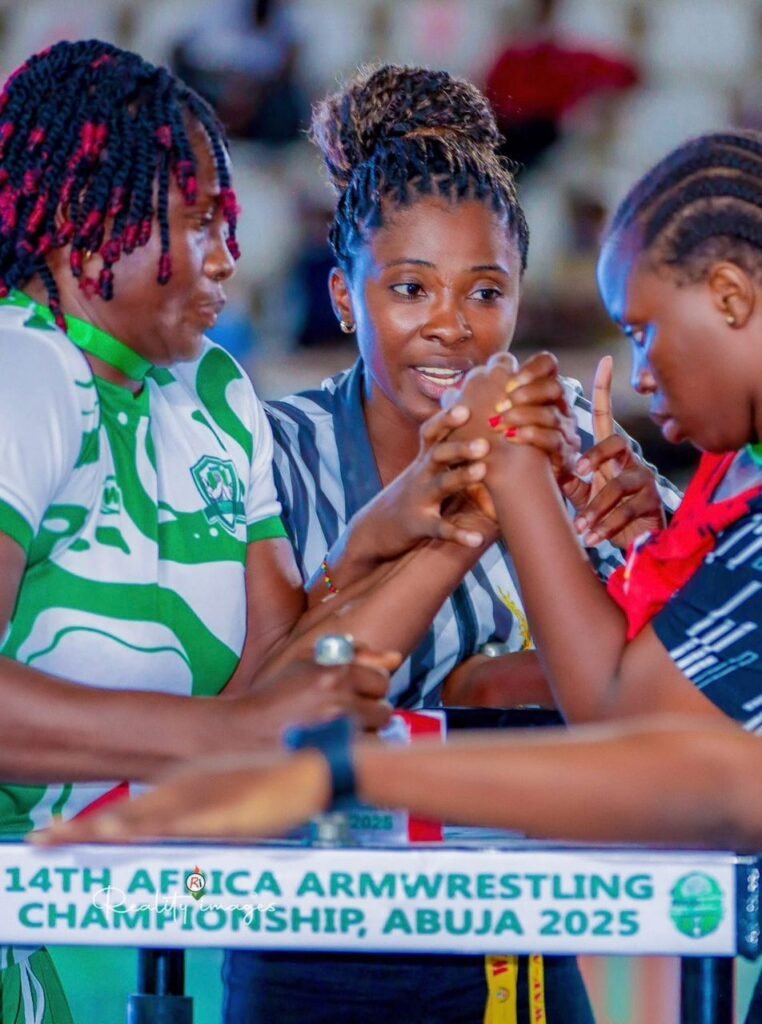
“If athletes don’t follow the rules or refuse to listen to officials, injuries can happen,” she explains, adding that focus was everything.
Before every match, she ensures that all equipment which includes elbow pads, hand pegs and table alignment were properly set. Athletes are not allowed to cover their elbows, must grip correctly, and must follow the referee’s commands precisely.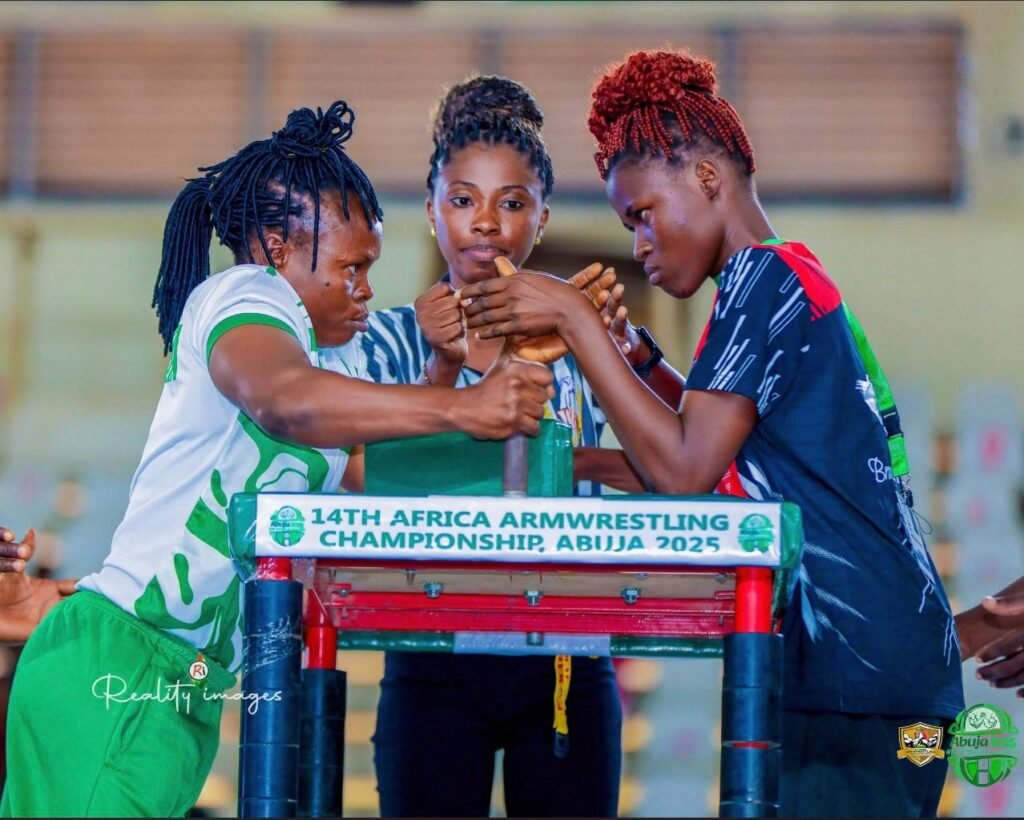
“We make sure everything is fixed before the grip,” she says. “Once we say ‘Ready… Go’, there should be no confusion.”
She is also firm on discipline. Warnings are issued for infractions, and repeated misconduct attracts penalties.
“The referee must be respected, if you don’t listen, the rules will deal with you,” she says.
Abigail credits her confidence partly to her sporting family background. Her mother was a volleyball player, while other family members also participated in sports. Though they were initially concerned about her safety, her rise to the top reassured them.
“They were afraid at first,” she admits. “But they were also very proud, especially because some of them never got the opportunity to reach this level.”
Looking ahead, Abigail is optimistic about the future of Armwrestling in Ghana. In less than a decade, the country has produced African and world-level medalists, a sign, she believes, of great things to come for Ghana.
“Whenever we go out, we come back with medals such as gold and silver,” she says, and to her that was a sign of growth.
In the next five to ten years, Abigail sees herself rising to become a World Master Referee, the highest officiating level in the sport. Until then, her routine remains intense, training four times a week, working closely with athletes, standing on her feet for hours, and constantly refining her understanding of the rules.
“I love this sport,” she says simply. “That love is what keeps me going.”
Abigail encouraged women to be bold and intentional about their place in sports saying “don’t limit yourself because of fear or stereotypes.”
She also urged women to invest in learning, discipline and consistency, stressing that respect was earned through performance.
For Abigail, as Ghana’s armwrestlers continue to make their mark, she will remain where she is most effective at the table, ensuring the game is played right.
By Esinam Jemima Kuatsinu
Join our WhatsApp Channel now!
https://whatsapp.com/channel/0029VbBElzjInlqHhl1aTU27

As he had promised Aperkeh, the elderly man and his wife and three daughters stopped by Aperkeh’s parents’ house. Mr Amando and his family were preparing to settle in for the night.
“Brother Ben and family”, Mr Joshua Amando said warmly, “although I know you are here on a matter that can hardly be described as joyous, it is still good to see you. You are welcome. Please sit down while I bring you water”.
“Yes, we will take water, even though we are hardly thirsty, because this is our home”.
“Okay, Ben”, he started after they had drank, “Let me go straight to the point. My daughter Priscilla has told me about the goings on between her brother Aperkeh and our daughter Stella.
Before informing me, Priscilla had expressed concern to Aperkeh about some habits he is adopting, especially the late nights and the drinking. She tells me that one Saturday morning, she was there when Stella complained about his drinking and some girls who had come to the house to look for him, and he assaulted her.
I called him and complained, but all he could say was that I don’t know what caused him to react that way, so I could not judge him. Now he does not answer my calls.
I have sent Priscilla to his house to call him, but he has refused to come. Unfortunately, Ben, my son is a much different person than the young boy who completed university and started work at the bank. I am really embarrassed about his treatment of Stella”.
“Joshua, let me assure you that even though what is happening is very unfortunate, it will not affect our relationship.
We have been friends since childhood, and I thought that with their parents’ blessing, the relationship between Aperkeh and Stella would grow to become a blessing to all of us. But there appears to be a real challenge now.
Stella thinks that Aperkeh wants her out of his house, and indeed Aperkeh himself told me that, about an hour ago.
So I’m taking my daughter home. I suggest that you do what you can to straighten him out, but if it does not work out, let’s accept the situation and continue to be one family.
I am sure that being the well behaved girl that she is, Stella will meet a young man who will cherish her. Fortunately, this problem is happening early in the day, so they can sort things out if possible, or move on with their lives if they are unable to stay together”.
“I’m really grateful for that, Ben. I will do my best in the next few days to reason with him, because apart from the relationship with Stella, Aperkeh is risking his job and career with this lifestyle.
A good job and salary offers an opportunity to gather momentum in life, not to destroy yourself”.
“Okay Brother Joshua. We will say goodnight. I hope to hear positive news from you”.
As he descended in the lift from the fourth to the ground floor, Aperkeh wondered who would be waiting at the reception to see him at nine on Monday morning. He had spent good time with both of his new girls during the weekend, so it had to be someone else. He got out of the lift and pulled a face when he saw Priscilla.
“Priscilla”, he said as he sat down by her, “what do you want here? You know Monday morning is a busy time at the bank. I am a very busy person, so say what you want, I have work to do”.
“You are very funny, Aperkeh. You are telling me, your sister, that you have work to do, so I should hurry up? Okay, Dad says I should advise you to come home tonight, because he wants to discuss the issue of Stella with you. He sent me to you twice, and you did not come.
He has tried to call you quite a number of times, but you have refused to answer his calls. He says that if you do not come tonight, you will be very surprised at what he will do. He says you will not like it at all, so better come.
“What is all this? Why won’t you people leave me alone? Stella is very disrespectful. I told her that if she wanted to continue to live in my house, she must obey me. It is that simple.
She chose to continue ordering me about, controlling me in my own house, so I told her that if she could not live under my conditions she should leave. And she left. In fact, her own father came and took her away. So what again?’’
“How did she disobey or control you? Was she complaining about your continuous drinking and late nights? And did you slap her on several occasions because of that? Did you tell her that if she could not live under your conditions she should leave? You actually said that to her father? You have forgotten that before she came to live with you, our two parents met and agreed, and gave it their blessing?’
“Why don’t you leave, Priscilla? I don’t have to listen to all that”. “Okay, I will go. Your father who gave birth to you and educated you to university level sends me to you, and you ask me to leave? I wish you would defy him, and refuse to come home as he’s telling you, because he is planning to give you the discipline you badly need. Let me tell you. Stella is such a beautiful and decent girl, and I assure you that someone will grab her before you say Jack. You are only 30 years old, and you have already become a drunkard”.
As he walked towards the lift, Aperkeh decided on what to do. He would go home, and calmly listen to what his father had to say. The old man was very unpredictable, and he wouldn’t dare ignore him. So he would take all the insults and threats, but as for Stella she was history. According to Priscilla, Stella was beautiful and all that, but she had not seen the two curvaceous princesses who were all over him, ready to do anything he asked. And these were not barely literate waakye girls, but university graduates from wealthy homes, really classy girls. With stuff like that, who needs a waakye girl? He smiled as he took his seat.
A few minutes to five, Aperkeh was packing up to leave for home to meet his dad when his phone rang. It was Priscilla.
“Aperkeh, Dad says you don’t need to bother to come. Stella’s dad says she came to him early this morning to plead that she would rather stay at home than return to your house. She thinks you are already decided to be rid of her, and she does not want to risk being assaulted again. So it’s done. You can go ahead and enjoy the nice life you have started”.
Before he could tell her to go to hell, Priscilla hanged up the line. He was partially stung that his dad had virtually cut him off. The last thing anyone would want was to fall out of relationship with his own family, which had always supported him.
But the truth was he was no longer interested in Stella. What was wrong with going by one’s feelings? He could only hope that one day, his parents and sister would try to reason with him.
By Ekow de Heer
Join our WhatsApp Channel now!
https://whatsapp.com/channel/0029VbBElzjInlqHhl1aTU27