News
The price we eventually pay

- /home/u249204778/domains/spectator.com.gh/public_html/wp-content/plugins/mvp-social-buttons/mvp-social-buttons.php on line 27
Warning: Trying to access array offset on false in /home/u249204778/domains/spectator.com.gh/public_html/wp-content/plugins/mvp-social-buttons/mvp-social-buttons.php on line 27
&description=The price we eventually pay', 'pinterestShare', 'width=750,height=350'); return false;" title="Pin This Post">
- Share
- Tweet /home/u249204778/domains/spectator.com.gh/public_html/wp-content/plugins/mvp-social-buttons/mvp-social-buttons.php on line 72
Warning: Trying to access array offset on false in /home/u249204778/domains/spectator.com.gh/public_html/wp-content/plugins/mvp-social-buttons/mvp-social-buttons.php on line 72
&description=The price we eventually pay', 'pinterestShare', 'width=750,height=350'); return false;" title="Pin This Post">
At some time or other, perhaps everyone asks himself or herself: Why should I conform to the rules? Why should I maintain standards and ideals? Why should the promises or threatened punishments of a remote hereafter restrict my way of life? Maybe this old adage about virtue’s being its own reward is just an old-fashioned idea. There are many answers to this line of questioning but suppose for the moment we forget about heaven and the hereafter and confine our answers to what we positively know about ourselves here and now.
It has, for example, been established as a physiological fact, that such negative emotions as worry, anger, hate, and jealousy generate within us those substances which can and do impair our physical and mental well-being. Even to the skeptic this can now be demonstrated. And it isn’t necessary for a herald from heaven to pronounce the penalty. Anyone who hates his or her neighbour, anyone who must make mental excuses for his or her own misconduct, is experiencing the relentless operation of the laws of reward and punishment, as they affect every man every day. And what is true negatively is also true positively.
So there comes forward in the train of our thoughts a much-discussed question; the question of moral force. Moral force is a thing to be reckoned with, has it always been in the affairs of men. It ‘is one of the few weapons in the world that does not become obsolete. It has led many peoples to victory after they have suffered physical defeat. Yet, without it fortresses crumble, guns become useless, and men lose heart and give up. It is one of the few things that a dictator cannot ignore and ride over.
There is something about the nature of man that makes it necessary for him to justify himself, to seem right in the eyes of others before he can effectively sustain his position. That is one reason men in public power so frequently take the trouble to explain themselves, even when seemingly they don’t have to. That is why the dictators of our day still give excuses for their infamous actions. No country has been violated, no right has been disregarded, no principle has been set aside without some attempt at justification, without some excuse of emergency or expediency without some effort to make the world think it was a right cause and a right course, because even a dictator must justify himself to exist, no matter how completely he controls the material and physical elements about him. He may force the people to goose-step, to go through the motions of loyalty, to labour long for his cause, to raise hands in salute, to cease the outward forms of their accustomed worship, to come to him for bread; he may force them to vote as he wishes, to perpetuate him in office, and to become dependent upon him for all of the physical elements of life—but he can’t prevent a man from thinking against him and praying against him, and contributing with moral force to his ultimate downfall.
It is no small thing to face 10 people whose wills are set against you, even if you have no physical harm to fear from them. And it is cumulatively more terrifying to face a hundred. And then think what it means to contemplate that there may be a million or a 100 million or many 100 millions who are thinking and praying and hoping against you; to know that you stand convicted in the eyes of man and God. It is no imaginary thing of this power of moral force. It is a power that overrides in its own time and in its own way all of the barriers set up against it and all of those who disregard it. It is a power so real that no wise man reckons without it, and no fool can for long.
In an atmosphere of trust, of good will, of kindness, and of good conduct there is an observable tendency toward physical and mental wellbeing, which has its bearing on health and happiness. To wrestle with a gnawing, troubled conscience, devoid of peace, is a punishment which no scriptural fire and brimstone can equal, and which takes its toll physically, mentally, and spiritually. Of course, there is good authority for the fact that rewards and punishments are not confined wholly to the present. Sometimes the mills of the gods grind slowly. Sometimes it seems that justice is not done in this life. And why it should be so may have to be left for answer beyond the bounds of this world. But to those who do not care to project their thinking beyond their present life’s expectancy, to those who want to know only what a given course will do for them here and now, let it be said that, in a very real sense, every day brings its own reward and punishment. “And the work of righteousness shall be peace; and the effect of righteousness quietness and assurance forever.”
By Samuel Enos Eghan


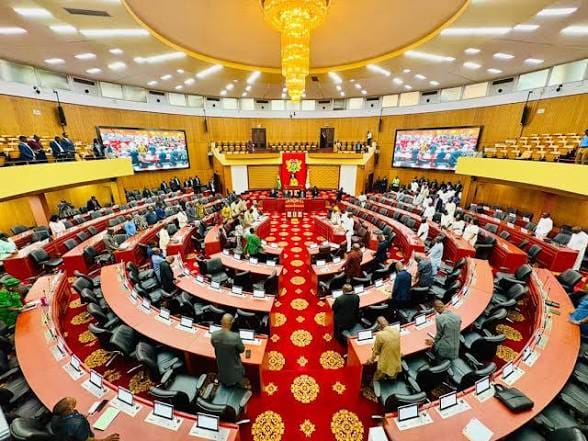
Parliament has clarified public commentary on social media regarding a notice on its notice board that read “No Vacancy for National Service Personnel 2026/2027. Kindly go for reposting.”
In a statement, signed by the Director of Media Relations, David Sebastian Damoah, Parliament said the notice has been misconstrued and was not a policy statement, a freeze on national service placements, or a change in its support for the National Service Scheme.
According to Parliament, the notice was a routine administrative message to prospective personnel who reported to the House, informing them that it has received more personnel than it can accommodate for the 2026/2027 service year and that they should seek reposting to other institutions.
It said it remains committed to the National Service Scheme and values the contribution of service personnel to its work, and regrets any confusion or inconvenience the wording may have caused.
By Edem Mensah-Tsotorme

Ghanaian public advocate Hopeson Yaovi Adorye has been elected to the Board of Directors of the World Taxpayers Association (WTA).
The election took place on Sunday, October 5, 2026, during the Association’s conference in Kraków, Poland.
His election marks a significant addition to his international leadership portfolio and provides a platform for Ghanaian and African perspectives to contribute to global discussions on taxpayer rights, responsible taxation, transparency and prudent management of public resources.
Reacting to his election, Mr. Adorye expressed appreciation to the leadership and members of the WTA for the confidence reposed in him.
“I am deeply honoured by this confidence and conscious of the responsibility that comes with it. Taxpayers are at the heart of every economy, and they deserve fairness, transparency, accountability and value for the taxes they pay. I look forward to working with colleagues from across the world to strengthen the voice of taxpayers and promote responsible fiscal governance,” he said.
According to him, taxation should not be viewed solely as a mechanism for raising government revenue, but also as an important component of the social contract between citizens and the state.
Mr. Adorye said governments have a responsibility to ensure taxes are collected fairly and public resources are utilised efficiently to deliver quality infrastructure, healthcare, education, security and other essential services.
His election also creates an opportunity to bring African experiences into international conversations on taxation and public expenditure.
Mr. Adorye, who is Executive Director of Taxpayers League Ghana, has previously served as Global Board Chairman of the International Youth Network for UN Security Council Resolution 2250, an NGO associated with the United Nations Economic and Social Council (ECOSOC).
He is expected to use his new role to champion fiscal accountability, taxpayer education, good governance and stronger citizen participation in public financial management.