Features
Smooth transfer – Part 1

My name is David Forson. I was fortunate to have been blessed with three elder sisters, who contributed to give me a smooth tertiary education.
My dad taught Economics in senior high schools all his working life, mostly in the Central Region and my mother worked as a matron or catering officer, either in the same school with Dad, or in senior high schools and polytechnics close by.
They gave their four children a good upbringing and education. Interestingly, all my three sisters studied catering at the polytechnic, and after a few years working in government establishments, established the Sankofa Restaurant and Catering, where they provided first class local dishes for patrons and delivered regular orders.
They were strategically located on the Circle-Achimota road, and many customers stopped for breakfast, lunch and supper all day.
I was a ‘retirement baby’, born ‘by accident’ when my parents were close to retirement, so my sisters took over all issues relating to my education.
I sailed smoothly through university, earning a first class degree in development economics.
I did my National Service with the Electricity Company of Ghana, and was offered a job in the Projects Department, but my sisters advised me to acquire a postgraduate qualification, so with the ECG experience in mind, I did an 18 month Master’s Degree in Project Management at the Ghana Institute of Management and Public Administration, during which time I often went to help my colleagues at the Projects Department.
I was re-engaged at the ECG, but six months into the new job my fatherly Head of Department, Mr Osekre, encouraged me to apply for the job of Northern Sector Project Manager at what was advertised as a ‘development agency’.
It turned out to be the European Union, which gave me the responsibility of coordinating the development jobs being done by various contractors in the northern regions.
I was offered a comfortable flat in Tamale, and given a new pick-up truck. I established good rapport with the contractors, and sent monthly reports which informed them about the progress of work. I established an online portal which enable them to easily monitor what was happening in all the projects.
This was greatly appreciated, and the Commissioner wrote to thank me, and informed me that due to my work, the regular visits by expatriate staff to the north had become unnecessary.
And better still, the offices in Brussels and other countries heard about me. I was sent to several African countries to help them establish similar online facilities, and was soon promoted to Consultant.
I often came to Accra by air to spend a few days with family and friends, but I preferred to drive, because it gave me the opportunity to bring a substantial amount of foodstuffs for use in the restaurant.
Of course, I was very well paid, upon the advice of my elder sisters and my mentor Mr Osekre, I took two major decisions. I decided to find a stable lady partner to marry and start a family.
I also decided to invest in housing projects. Mr Osekre took me to some areas in Accra with several uncompleted buildings, and suggested that I buy a couple of these houses, finish them and sell.
Under his guidance, I did extensive investigations to find the actual owners of the properties and completed negotiations with them. With all the resources I could muster, I put them into perfect condition, and buyers rushed to take them even when I was putting final touches to them.
Having made a substantial profit, I registered a company, opened an office and employed two graduates to do the jobs of scouting for properties, conducting searches on property documents, and arranging meetings with the owners of the properties.
This became a very successful business to which I could retire anytime I wanted.
On the relationship side, I reconnected with Abena Gyasi, who was two years behind me at the university, and was working in a recruitment agency. We had gone out a few times, and I had visited her family and enjoyed their company.
Apart from the fact that her parents were well known to mine, we got on well together, and although I did not say anything to her directly, all indications pointed to our heading towards marriage. She was tall and quite elegant with a commanding presence, and I felt proud about the glances that were cast in her direction when we went out.
We enjoyed each other’s company, and spent long hours on the phone when I was out of town. Everything went well until I went to her house one morning, and she introduced her friend Jennifer, who was her mate in senior high school. She was a big girl, quite fashionable and outgoing.
They talked excitedly about new fashion trends, and called other mates to chat. I was quite glad that she had found someone to spend time with when I was not around. She smiled and even joked with me, but I felt a bit uneasy that she was not too excited about me. I thought this was normal, as she perhaps wanted Abena all to herself.
A few weeks later, Abena started asking about my job, even though I had told her a lot about my work in the north. On Mr Osekre’s advice, I had only told my family about the investment business.
It was better to wait till it was on firm ground, he advised, and that would take at least a couple of years. Of course, I would tell her everything when we decided to get married.
She started asking some funny questions like ‘did you say you were doing agricultural extension work or development projects?’ Initially I gave her answers with some details, but when she persisted along the same lines,
I said out of exasperation, ‘Abena, why do you keep asking the same questions even though I have answered you?’ Listen, there is nothing wrong with agricultural extension work, but that is not my line of work.
But if that is what you wish to believe, then please go ahead, if it makes you happy. I just don’t understand this’. Not long after, some friends said they had seen her with Jennifer eating lunch with some guys.
I complained, and said that I would prefer it if she went out with only me at that stage in our relationship. And if she needed to go out with others, I had to know. To my great surprise, she brushed it off, saying ‘but David, what is wrong with going out for lunch with friends? As for this one, I think you are doing too much?’ That was the beginning of the end.
By Ekow de Heer

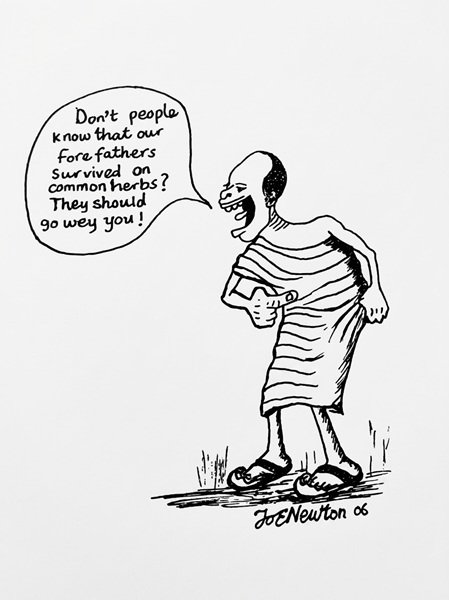
THE typical itinerant salesman in Sikaman is a herbalist. He is normally a slim macho with the capacity to perambulate the expanse of area covering the triangle of Accra-Tema-Ashiaman. In short, he can walk a total of 60 miles a day, marketing a product that cures every disease, including poverty. 
The door-to-door herbal pharmacist advertises his product by word of mouth. He has nothing to do with the Food and Drugs Board (FDB). After all, his concoctions do not feature on FM stations.
Those herbalists who cannot walk to propagate the herbal gospel, liaise with drivers of mass transportation and their mates. They are, therefore, given the chance to sell their products on Benz buses that ply the routes.
Normally, the herbalist starts his sales message with a prayer and Bible study. He asks the passengers to bow down their heads in supplication to God the father, the son, the Holy Spirit.
When a herbalist asks the passengers to close their eyes and bow their heads, Moslems on board naturally feel offended. They feel that the herbalist has no right to assume that every passenger is a Christian. They think such an assumption is an affront to Islam.
So a Moslem on board will raise the hand for a point of order. He’ll remind the herbalist that it would be in his own interest to mind his language.
“Be careful the way you address people in a public place. Not every person here is a Christian,” he’d state assertively.
Of course, the herbalist will promptly ignore him, but would all the same “watch” his tongue. Who knows whether or not the Moslem brother is inspired by Quoranic zeal to defend the tenets of Islam to the hilt?
When he starts saying, “Wallahi!” and “Inshallah!” it could be the beginning of proclaiming Islam as supreme, a point which must be driven home with talibanic precision.
So the herbalist must tread carefully lest he steps on fire.
The herbalist could even add a measure of mirth to it all, by announcing that Christians on board today have very interesting company on the journey, but that should not detract from the business of the day.
The Moslem brother will weigh the words carefully and offer a wry smile.
He must be careful the occasion does not degenerate into the use of semantics and proverbial oration to deride his conviction that public utterances must be mindful of religious sensibilities. He has made his point very clear and expects that it is taken in good faith in the interest of a peaceful journey.
The herbalist will now open the New Testament and preach salvation, stating clearly that salvation can come only through Jesus Christ and NOBODY else.
The Moslem brother will now start twitching his moustache. The visible and almost revolutionary reflexes of his upper lip can be an indication that sentiments have begun superseding reason, and the outcome could well be tragic now shift uneasily in his seat.
The time has come for him to also express his right to the religion of his fore-bears. He’ll put his hand into his pocket and rise to his feet. The time has indeed come!
This article was first published on Saturday, September 9, 2006
When the cause of a particular problem like sickness, disease, sudden illness, a social issue etc. are not known, it stands to reason that resolving it becomes a huge challenge.
Citizens would understand the government when public announcements are made to the effect that government is trying to find a solution to the issue, even though it is taking a while for it to be resolved because citizens are rational beings.
On the other hand, if the solution to a particular issue is known to everybody but the government for whatever reason, is dragging its feet in resolving it, citizens become frustrated and begin to lose trust in their leaders.
One such issue is the heavy traffic along a section of the Kasoa – Odokor road. A short stretch of bad road between the traffic light at the Weija Government Hospital and the entrance to the entrance of the overhead that leads to the N1, is the cause of the problem but nothing is being done about it, day after day, week after week, month after month. Thus is clearly unacceptable.
Another issue that requires urgent attention is the lack of pavements along a lot of streets in parts of the various Municipal Assemblies. Exercise is a prerequisite for long life and healthy living and for those of us who it has become a way of life, this issue of people putting up structures right to the edge of the drains beside the roads, are making life difficult for us.
We are compelled to walk along the roads, putting our lives at serious risk. Pedestrians should never be compelled to compete with vehicles on our streets and roads. Roads and streets are made for vehicles and pavements are made for pedestrians. That is the norm. Any attempt to normalise a situation where pedestrians are mingling with vehicles is insanity.
It is the road regulations that makes it so and therefore district or municipal assemblies are to take responsibility and ensure that spaces for pavements are not encroached upon. Citizens have rights that must be protected by their leaders and making pavements available to pedestrians, is one of them.
When we hear of teachers having sex with students, it appears it is something recent. It is not a new phenomenon. It has been there since Adam. Perhaps this issue is getting much attention due to the proliferation of social media. It was an open secret in times past when Teachers were in relationships with female students and some married them immediately after completion of school.
Some teachers were also known to be having unholy interactions with female pupils but due to the times that these acts occurred, human rights issues and the awareness around it, allowed such unscrupulous teachers to get away with their crimes.
Now we are in a different era and so a Headmaster is now in hot waters. He is alleged to have raped about 19 female students and as usual, some officials tried to cover it up and are also in hot waters and their actions or inactions in the matter are under investigation.
Why the man has been allowed to roam freely without being arrested is simply mind boggling. It appears that the law applies differently, depending on who you are. This issue came to public attention sometime in August this year, yet the police had not arrested or invited this man for question regarding the rape allegation.
It has come out that he is a Constituency Secretary of the ruling party and the question in the public domain is that, is it because he is a political figure that is why he is still walking around without questioning? I believe in the rule of law so let us hold our breadth and let the proper thing be done.
The police must however be seen to be active in this matter. God bless.
SKIP THE QUEUE, TAP THE NEWS
You can now read the Ghanaian Times and The Spectator newspapers from the comfort of your device via TimesNewsPlus.
Join our WhatsApp Channel: https://whatsapp.com/channel/0029VbBElzjInlqHhl1aTU27