Features
Press freedom & the bearded goat


THE journalist is a hunter. He goes after human rats and grasscutters personified, matters about whom he can salt and spice and present as news. The fatter and juicier the catch, the better, because sensation is essentially our cup of tea.

Our job is to sell news and sell it in grand style.
Because the journalist is a hunter and is created with a special kind of nose for sniffing out news, he is usually not welcome in many places. He is seen as someone who has been born to make people uncomfortable.
The problem is that some people don’t want things written about them even if it is promotional and favourable. When it entails publishing their pictures alongside the story, they are doubly scared.
“Please, don’t use my picture. People will think I’ve got money and come for loan,” someone told me.
Anyhow, journalists are seen as intruders, undesirables, born with plenty of okro in the mouth; maybe some also in the nose. Some of my friends are no longer too close because they fear I’d give them full coverage in the Sikaman Palava column. Ha ha ha! What a funny world!
Well, people like my Uncle, Sir Kofi Jogolo, my former classmate and born-mathematician, Kwame Korkorti, and ex-football star cum human-salamander Kofi Kokotako don’t mind featuring in the hilarious inches of this column. Kofi Owuo alias Death By Poverty is one personality who has to be mentioned in this palaver.
These are people who are going to live long, primarily because they see the world as one big ball of fun. When Kwame Korkorti was told that his dear mother was dead at home, he smiled and asked the bearer of the message whether his mother had cooked the afternoon meal before claiming she was dead. Until her death, Korkorti ate his lunch at his mother’s end.
When my Uncle Kofi Jogolo was picked and lost 1,500 dollars and a good amount of Sikaman currency, he didn’t lament the loss. Instead he was amused. In fact, he was almost glad about it, because he grinned from ear to ear, stroked his delicate moustache and congratulated the thief, adding that “He is smarter than I am.” Yeah, Jogolo is the man who employs a Swedish barber to trim his moustache.
And when Kofi Kokotako was unemployed and was nearly hit by an articulated truck, he called the driver a fool. “The idiot should have killed me,” he said to me. “Didn’t he know I was unemployed and suffering?”
Today, Kokotako is employed as a Reverend and is not doing badly at all. Thanks to the regular silver collection.
And what about Kofi Owuo, the celebrated poor man. His wife left him not because he was poor, but because he swore in front of her that he would never prosper.
The following dawn the wife packed bag and baggage and went back to her parents and told them all about her husband’s alliance with poverty. Her parents were bewildered and called the alliance unholy. They had no option than to send back Owuo’s drinks to end the marriage.
Kofi Owuo alias Death By Poverty did not contest the issue. He was more engrossed thinking about how to become poorer than to contest what he called a frivolous matter. The wife could go to hell, he said. These are people longevity smiles upon. Nothing worries them.
Getting back to talking about journalists. I’d say that anywhere there is journalism, the issue of press freedom is not too far away. Is the press free? That’s one question foreigners want answer to when they are on visit.
Well, journalists celebrate a yearly WORLD PRESS FREEDOM DAY to drum home the idea of press freedom as a very important thing in the practice of journalism.
This year’s was celebrated almost a fortnight ago but people didn’t see much of us because we are normally not good celebrants. We should have mounted a float to roam the entire capital, dancing asaboni to brass band music just like PTC did recently.
Although journalists are known to be very good dancers because they walk very much, on that day, they were all busy writing. It was the Minister of Information, Mr Kofi Totobi Quakyi who saved the day by addressing a forum organised to mark the day.
He is a man I’ve always admired since his radical university days. He spoke much on press freedom, cautioning the press not to abuse the freedom granted by the Fourth Republican constitution, but to use it for the progress of society.
Well, press freedom has been defined by many journalists as the freedom to ‘write nonsense’. This definition is not quite accurate. I asked one staff reporter to define press freedom. It took him fifteen minutes to put up something.
“Press freedom is the freedom that is enjoyed by the press that enables journalists to publish or broadcast any kind of material so long as it is absolutely true, is not libelous and slanderous, and is not against the national interest.”
I gave him eight out of 10, a straight A. I guess every journalist is old enough to know that certain things he or she writes is for or against the national interest. We certainly must guard against writing against the national interest; that is very important.
There is also the question of criticising government. The government can be criticized, so long as the criticisms are genuine and the President and his ministers are not insulted and called names. Let us criticize, but let us do it decently so that the journalistic profession can be revered, and its nobility acknowledged. We are not war mongers, are we?
One area in which journalists are not spoken well of is the complaint that they misquote people. Journalists sometimes misquote people, but in four out of five complaints it turns out that nobody is misquoted after all.
When we interview people they say things unreservedly and we publish unreservedly. When the publication is out and their friends or superiors read it and accuse them of having said too much to the press, then they start claiming they were misquoted.
We have encountered these ‘misquotation palaver’ every now and then and reporters are usually accused of this transgression. However, when they bring out their note-books or recorders, it is realised that they wrote nothing out of the way. “Book no lie”.
My advice to people who deal with the press is that if they do not want anything written, they shouldn’t say it. What they want to say is OFF-RECORD, then of course, there is no reason to say it. When you say it, you’re taking a risk. In that instance, you can’t also claim to have been misquoted or words put into your mouth.
And it isn’t every journalist who would be circumspect in matters that are supposed to be off-record, because journalists often want to be as sensational as possible to make their stories saleable. So say just what you want to see published and you won’t later regret it and claim you were misquoted.
Well, I’m not holding brief for journalists, because a few of us are notorious for colouring our reports sometimes sand-papering the words so much that they look very bright in front of readers.
As I once said, when the police tells one such notorious pressman that the thief stole a brown goat, the pressman would want to know whether the goat was bearded. Of course, the police would say ‘Yes’.
However, in the press report, it appears, “A gang of notorious goat-thieves were apprehended in the early hours of yesterday. In the car in which they were riding was a brownish-red goat having a long beard. Upon further examination, it was realised that the goat also had a greyish moustache.”
When the story appears, the police are naturally disturbed. A single thief turns out to be a gang of thieves. The goat also becomes a chameleon and changes colour to brownish-red. And a moustacheless goat overnight wears a greyish moustache whether you like it or not. Luckily the journalist does not add that the moustache was trimmed by a Swedish barber.
Yes, we have a few of such mischief-creating, chronically notorious journalists. But they are one in a hundred. In any case, we make the world. And we shall always do our best to make it a happy place to live in.
This article was first publish on Saturday, May, 20, 1995

On Sunday, October 11, 2026, it was the turn of Ghanaian Catholics in Finland to lead the singing in the church service of the African Catholic Chaplaincy in Finland (ACCF).
It was indeed a spirit-filled feeling for worshippers present. And for the Ghanaian migrants, the occasion also brought back to them memories of church services in their home country, Ghana.
The ACCF has a roster for each country/community to sing from time to time. Next Sunday will be the turn of the Nigerian community. Other communities that usually sing are the Kenyan/Tanzanian community, the Cameroonian, the Ugandan, group, etc.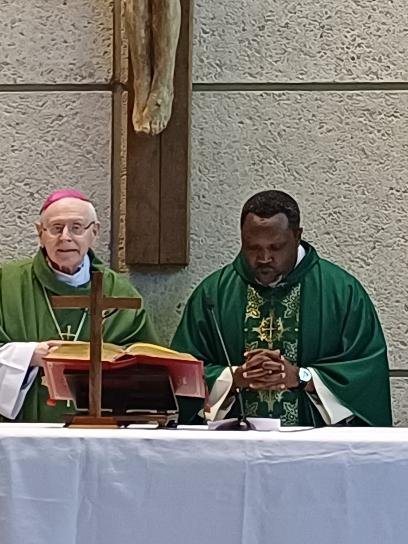
A powerful religious experience
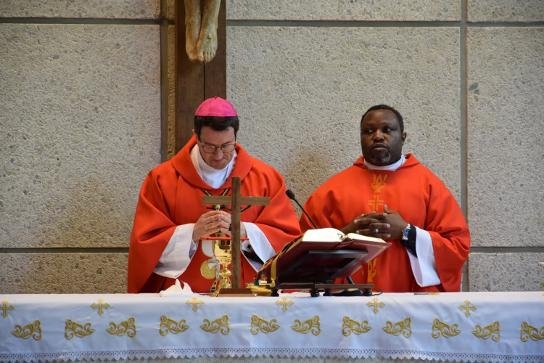
The mass services of the Chaplaincy usually give a powerful religious experience and a display of cultural diversity, especially in occasions such as when the Bishop of Helsinki, Bishop Raimo Goyarrola, celebrated mass with the Chaplaincy on Pentecost Day, May 24, 2026.
There was a similar time of spiritual joy last month (September 27, 2026) when Emeritus Bishop Teemu Sippo, former Bishop of Helsinki, visited the Chaplaincy. Bishop Teemu was the main celebrant, assisted by the Chaplain, Reverend Father Thomas Otieno.
Last Sunday, Reverend Father Bernard Sor, a Ghanaian Catholic priest based in Austria, was the main celebrant in the mass service where he performed a rite of baptism. Fr Bernard had celebrated mass a few months ago when he visited his sister and her husband in Helsinki. 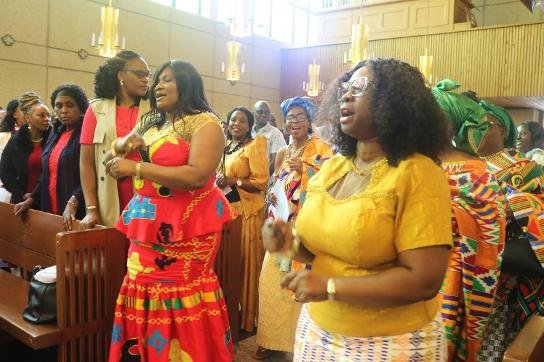
All these well-attended religious occasions indeed leave lasting memories. The homilies (peaching) by the priests usually emphasize religious tenets such as the importance of loving and serving God in truth, existing in peace with our fellow humans to promote unity in diversity, etc.
Unity in diversity and a colourful display of cultures
The African Chaplaincy church services usually produce impressive displays of diverse cultures from different parts of Africa and elsewhere. The events are often spiced by rich cultural displays of dances and colourful attires which are a delight to watch.
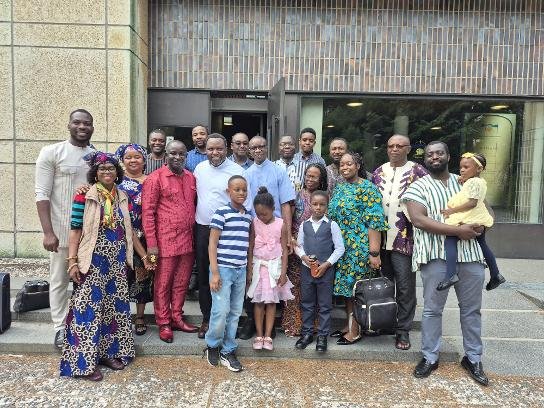
On special occasions, members of the Ghanaian Catholic community, in their gay and colourful kente attire and with adowa dance and music, usually lead the procession into the church. Other communities such as the Cameroonian, Nigerian, Kenyan and Tanzanian as well as Sudanese/South Sudanese groups also put up well-choreographed performances from their cultures.
The African Catholic Chaplaincy in Finland
The African Chaplaincy was founded on June 4, 2017, which was a Pentecost Sunday, in a Pontifical High Mass celebrated by Monsignor Emeritus Sippo S.C.I., the then Bishop of Helsinki, at the St. Mary’s Catholic Parish Church in Helsinki.
The Chaplaincy was created by Bishop Teemu in collaboration with the Diocesan body when they detected a great flocking of African immigrants to Finland, the majority of whom were Catholics. This was to give the immigrants a possibility to integrate into the Finnish society by worshiping as Catholics and in their African cultural identity.
The responsibility of the Chaplaincy was given by Bishop Teemu to Father Dr Leonard Wobilla Shwei, who is thus the first Chaplain and ably led the Chaplaincy. He was succeeded a few years ago by Father Thomas Otieno, who continues to move the Chaplaincy forward. Thank you!
GHANA MATTERS column appears fortnightly. Written in simple, layman’s terms, it concentrates on matters about Ghana and beyond. It focuses on everyday life issues relating to the social, cultural, economic, religious, political, health, sports, youth, gender, etc. It strives to remind us all that Ghana comes first. The column also takes a candid look at the meanings and repercussions of our actions, especially those things we take for granted or even ignore. There are key Ghanaian values we should uphold rather than disregard with impunity. We should not overlook the obvious. We need to search for the hidden or deeply embedded values and try to project them.
With Dr Perpetual Crentsil
SKIP THE QUEUE, TAP THE NEWS

You can now read the Ghanaian Times and The Spectator newspapers from the comfort of your device via TimesNewsPlus.
Join our WhatsApp Channel: https://whatsapp.com/channel/0029VbBElzjInlqHhl1aTU27
She did not find out he was cheating. She found out he was drowning.
It was two weeks after their beautiful wedding. The jollof was still in the fridge. A loan officer called her number-not his-and politely asked, “Madam, please tell your husband to pay his overdue loan. We have been calling him.”
That was how she discovered her new husband had entered their marriage with a hidden debt of over GH¢ 40,000. No cheating. No other woman. Just a financial secret.
And that is how many Ghanaian marriages begin to die. Not with a shout, but with a secret alert on a phone.
We prepare for the wedding. We do not prepare for the wallet.
What is money honesty?
Let me define it simply. Money honesty is not that you both earn the same. It is that you both know the same. It is the ability to sit down and say without fear:
“This is how much I earn.”
“This is how much I owe.”
“This is how I was raised to see money.”
“This is what scares me about money.”
Financial transparency is not about control. It is about clarity. You cannot build trust on top of secrets.
Many couples tell me, “Counsellor, we love each other, love will handle money.” I always answer, “Love is the car, but money honesty is the fuel. Love without honesty cannot move.”
How To Buy Your Marriage Insurance Today – My 5-Step Protocol
If you are engaged, newly married, or even 20 years in marriage, you can still fix this. At Counsellor Prince & Associates Consult—CPAC, this is what I give couples:
Step 1: The 90-Minute Money Naked Session.
No phones, no blame. Each partner writes down on paper: Monthly income, monthly debts, monthly family obligations, savings, and your biggest money fear. Then you exchange papers. Read it. Don’t react for 24 hours. Just absorb.
Step 2: Create OUR Money, YOUR Money, My Money.
You need three pots. OUR money for rent, food, school fees, utilities, properties, and the like— joint contribution. YOUR money and MY money—a small agreed allowance no one questions. This stops the feeling of being controlled.
Step 3: The No-Secret Debt Rule.
Agree from today: No new loan, no new hire purchase, no new family financial commitment above GHS 500 without telling each other first. Not permission, but information.
Step 4: Talk About Your Money Personality.
Are you a Spender or a Saver? Are you Risky or Safe? Most Ghanaian marriages are a Spender married to a Saver. Neither is wrong. But if you don’t understand your partner’s personality, you will call his saving “stinginess” and her spending “wastefulness.”
Step 5: Do a Monthly 30-Minute Money Date
Not an argument date. Light, with tea. “How did we do this month? What worried you? What should we plan for next month?” Couples who do this divorce far less.
My Final Word
Before you say “I Do” at the altar, have pre-marital counselling and also have the money talk on the sofa.
Ask your partner:
“If I lost my job today, how long can we survive?”
“What debt are you bringing into this marriage?”
“How much do you send to your family monthly and will that continue?”
If he or she gets angry that you asked, don’t get married yet. A person who is angry about accountability will be abusive about money.
Marriage insurance is not bought at Star Assurance or Enterprise. It is bought in honest conversations when no one is watching.
The wedding costs one day. The marriage costs a lifetime. Don’t enter a lifetime contract and covenant with hidden costs.
You can still insure your marriage today.
Source:
Counselor Prince Offei, CPAC’s founder, is a leading Mental Health Professional, Marriage Counsellor, Author, ADR Expert/Arbitrator, and Spectator Newspaper Columnist. He writes on relationships, marriage, parenting, special needs support, and their connection to mental health. For therapy, counselling, or enquiries, contact Counselor Prince & Associates Consult (CPAC) in Accra on 0559850604 / 0551428486.
SKIP THE QUEUE, TAP THE NEWS
You can now read the Ghanaian Times and The Spectator newspapers from the comfort of your device via TimesNewsPlus.
Join our WhatsApp Channel: https://whatsapp.com/channel/0029VbBElzjInlqHhl1aTU27