News
President Akufo-Addo cuts sod for reconstruction and dualisation of Adenta-Dodowa road

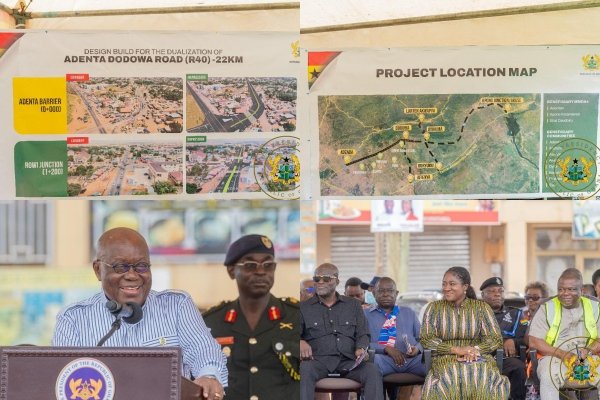
The President of the Republic, Nana Addo Dankwa Akufo-Addo, as part of government’s determined pursuit to transform the road infrastructure of the nation, has on Thursday, August 8, 2024, cut the sod for the dualisation of the 22km Adentan to Dodowa road project.
Originally reconstructed in 1998, this vital inter-regional road, connects Ghana’s capital to the Eastern and Volta regions and beyond, thus forming part of government’s comprehensive strategy to enhance the main trunk roads of the country.
This comprehensive strategy also includes ongoing works on the dualization of other key roads such as the Accra-Kumasi Highway, Accra-Cape Coast road, Tema-Aflao Road and Tema Akosombo road, which are being constructed to reduce travel times, lower vehicle operating costs and significantly improve road safety.
Aside the dualization of the 22km section, the project, being undertaken by Messrs Oswald Investments Limited, an indigenous Ghanaian company, will be managed by the Ministry of Roads and Highways with the Ghana Highway Authority serving as the engineer, also includes the provision of service lanes on both lines of the main carriageway where required, provide adequate drainage structures, walkways and lay-bys along the urbanized sections.
Speaking at the well-attended sod-cutting event, which featured the Chiefs and hundreds of enthusiastic people of the area, President Akufo-Addo said this latest effort will be a welcome addition to the impressive strides by his government in the road network nationwide.
He said, some 12,830 kilometres of road have been completed nationwide.
This includes 2055 kilometres of road and the construction of four interchanges in the Greater Accra Region, in addition to the construction of three bridges in Communities 12 and 19 in Tema, as well as in Taifa.
The President added that “In addition to these completed projects, major road works are ongoing in the greater crowd region, including the dualization of the Achimota-Ofankor road, which will be expanded to a 10 lane facility with 4 interchanges at Amasaman, Pobiman, Medie and Nsawam. The project is 62% complete.”
He also mentioned the construction of the 30km Dome-Kitasi road, currently at 26% complete, the construction of the 64 km Tema Akosombo road, with sections to be dualized to six lanes and with interchanges at Ashaiman roundabout and Asutuare, which is 10% complete, the construction of the Obetsebi Lamptey Interchange Phase II, which is 87% complete, the construction of the Flower Pot Interchange across the motorway, which is 90% complete, and the dualization of the 5.7 km School Junction to Motorway road, which is 98% complete.
President Akufo-Addo also touched on the resumption of work on the construction of the Tema-Aflao road, which provides four interchanges at Kpong, Savannah, Dahwenya and Ningo Junction, the dualization of the 14.6 km Coastal road Phase I, with major bridges across the Kpeshie, Songhor, Ablekeshie street to address perennial flooding and the dualization of the 9.7 km Coastal road Phase II, Nungua to Tema, involving the construction of a 3-tier Nungua Interchange and a railway bridge towards Sakumono, which were suspended due to the debt restructuring exercise.
The President urged the contractor to implement necessary traffic management measures to minimize inconveniences to commuters in pedestriants during the construction period.
Some projects which have been completed include the iconic 4-tier Pokuase Interchange, the first of its kind in Ghana and West Africa, and the second in Africa. This project also included the construction of 12 km of local roads.
The others also include the Tema Motorway Interchange Phase One, and Obetsebi Lamptey Phase One, the dualization of Aviation Road, Otano-School Junction Road and Nana krom road, totalling 12.8km. The partial reconstruction of selected roads in Ga North, Dome-Kwabenya and Ga Central, covering 24km and the partial reconstruction of selected roads in Teshie and Nungua, covering 9 km, as well as, the surfacing of the Bobobokor area roads in Ga West, covering 25 km are all progressing steadily.

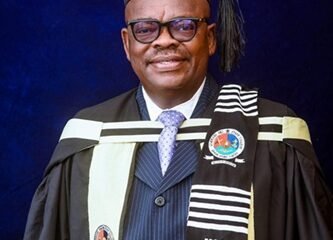





Management and staff of Owass FM have announced the passing of media personality, comedian and politician Seth Kwame Dzokoto following a medical emergency during a live morning show discussion at the station earlier today.
According to the station, Dzokoto was participating in a panel discussion on its morning show “Oman Nkoso” when he suddenly took ill and collapsed.
A statement from the station said its team immediately rushed him to the hospital for medical attention, but he was pronounced dead by the attending medical doctor upon arrival.
“We are deeply saddened by this unfortunate incident, which occurred in the course of our regular programming. Our thoughts and prayers are with his family, loved ones, colleagues, and all those who have been affected by his passing,” the statement said.
Management acknowledged that information about the incident is already circulating in the public domain, but appealed to the public and colleague media houses to respect the privacy of the bereaved family and refrain from circulating unverified information or speculation regarding the circumstances of his death.
Owass FM extended its heartfelt condolences to the family of Seth Kwame Dzokoto.
By Edem Mensah-Tsotorme

The State through the Attorney General (AG) has filed an appeal at the Supreme Court challenging the suspension of the trial in the case of The Republic v Hanan Aludiba and Faiza Seidu.
On Monday, the Court of Appeal suspended the trial in the case. But the prosecution says it has filed an appeal against the suspension order.
According to the update, the law does not allow a criminal trial to be suspended simply because an accused person has complained about some of the charges on the charge sheet, particularly when those complaints were dismissed as meritless.
It argues that if the Court of Appeal’s decision is allowed to stand, no prosecution will ever be possible, since all it would take for a trial to be suspended is an accused person complaining about anything on the charge sheet.
By Edem Mensah-Tsotorme