News
Poor weather and downdraft caused military Helicopter crash – Investigation Report

- /home/u249204778/domains/spectator.com.gh/public_html/wp-content/plugins/mvp-social-buttons/mvp-social-buttons.php on line 27
https://spectator.com.gh/wp-content/uploads/2025/11/WhatsApp-Image-2025-11-11-at-14.48.06-757x600.jpeg&description=Poor weather and downdraft caused military Helicopter crash – Investigation Report', 'pinterestShare', 'width=750,height=350'); return false;" title="Pin This Post">
- Share
- Tweet /home/u249204778/domains/spectator.com.gh/public_html/wp-content/plugins/mvp-social-buttons/mvp-social-buttons.php on line 72
https://spectator.com.gh/wp-content/uploads/2025/11/WhatsApp-Image-2025-11-11-at-14.48.06-757x600.jpeg&description=Poor weather and downdraft caused military Helicopter crash – Investigation Report', 'pinterestShare', 'width=750,height=350'); return false;" title="Pin This Post">
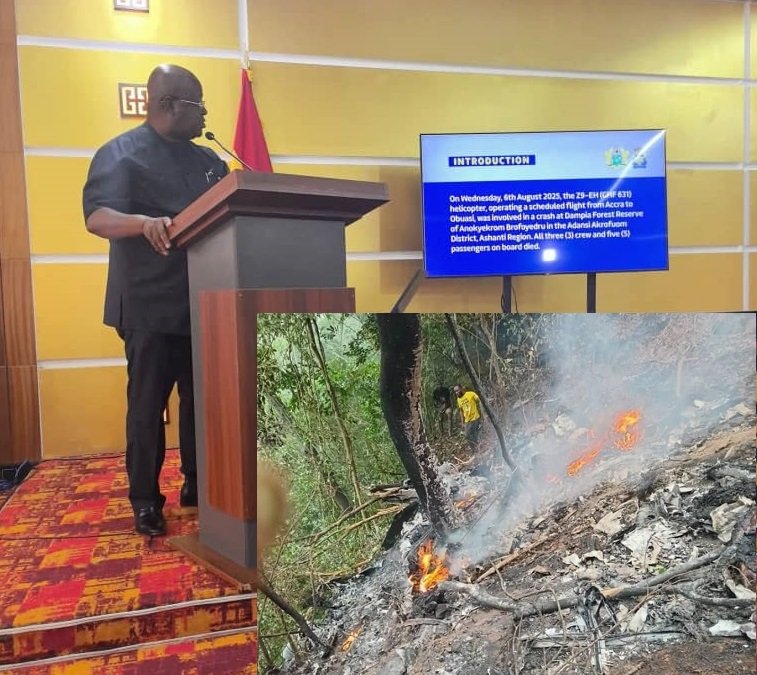
The investigation into the military helicopter crash that killed eight people on August 6, 2025, this year has concluded that the accident was caused by sudden bad weather and a powerful downdraft that forced the aircraft to lose altitude unexpectedly.
According to Captain Paul Fodjour, Head of Investigations at the Aircraft Accident and Incident Investigation and Prevention Bureau (AIB-Ghana), the helicopter encountered severe weather conditions shortly before the crash.
He made this known on Tuesday when he presented the final report of the probe team to the public in Accra.
The helicopter, identified as Z-9EH with tail number GHF 631, was flying from Accra to Obuasi on August 6, 2025, when it crashed in the Ashanti Region.
All three crew members and five passengers on board lost their lives.
Following the tragedy, President John Dramani Mahama directed that a full investigation be conducted to determine the cause of the accident and recommend measures to prevent future occurrences.
The investigation team, led by COP Abdul Razak Osman, National Security Coordinator, included experts from the Ghana Armed Forces, AIB-Ghana, the National Intelligence Bureau, and the U.S. Air Force.
Captain Fodjour explained that the aircraft was airworthy and had passed all necessary safety checks before takeoff.
However, it lacked modern safety systems such as a terrain awareness warning system, autopilot, and advanced navigation features, which could have helped the crew detect and avoid danger.
He revealed that the flight had been delayed earlier due to poor weather, but conditions worsened midair.
“Visibility deteriorated rapidly due to mist and low clouds. The crew tried to climb to clear rising terrain but suddenly lost altitude and crashed about six and a half miles from Obuasi” he said.
According to him, the investigation determined that a downdraft, a sudden downward movement of air caused by changing weather conditions over hilly terrain was the main factor that led to the crash.
“The accident was an unfortunate and sudden weather-related event. The crew were experienced and medically fit, and the aircraft was mechanically sound,” Captain Fodjour stated.
He commended the emergency response teams for their swift reaction.
“Despite the rough terrain, rain, and slippery conditions, rescue teams reached the crash site within two hours. Their effort was remarkable,” he said.
The final report made several safety recommendations aimed at preventing similar accidents in the future.
These include the modernisation of the Ghana Air Force fleet with aircraft equipped with terrain warning and modern navigation systems, the installation of cockpit voice and flight data recorders with audiovisual capability, and investment in flight simulators for pilot training.
The report called for the contracting of certified aviation weather service providers, the establishment of flight data monitoring and real-time tracking systems, and the expansion of navigational aids across the country, especially in remote areas.
Captain Fodjour said implementing these recommendations would help strengthen Ghana’s aviation safety system.
He expressed appreciation to the National Security Secretariat, U.S. and Chinese partners, and the AIB-Ghana team for their technical and logistical support throughout the investigation.
“Our goal is to turn this tragic event into lessons that will make aviation in Ghana safer,” Captain Fodjour said.
By: Jacob Aggrey










Deputy National Women Organiser of the New Patriotic Party (NPP), Mimi Duah, has openly declared her support for Mavis Hawa Koomson as the next National Women’s Organiser of the party.
In a statement endorsing Hawa Koomson’s candidature, Ms Duah outlined four key reasons why she believes the former MP and Minister of State is best placed to lead the party’s women’s wing.
According to her, Hawa Koomson is a motherly figure who rose from the grassroots and is widely noted for her forgiving nature and ability to foster unity.
“She is a true grassroots mother who easily forgives, fosters unity, provides guidance and arbitrates to ensure all aggrieved party women are brought on board to ensure a unified women’s wing,” she stated.
Ms Duah also pointed to Hawa Koomson’s vast experience, having served as a Constituency Women’s Organiser, Member of Parliament and Minister of State, noting that the experience positions her to provide effective leadership as National Women’s Organiser.
She further described Hawa Koomson as capable of making the women’s wing resourceful, through her extensive network and business contacts, to lobby for logistics, training and financial support for women organisers at all levels.
Lastly, she said the NPP as an opposition party needs fearless, bold and assertive leadership at the women’s front to inspire regional, constituency and polling station women organisers as the party reorganises towards the 2028 elections.
“We need a Women’s Organiser who has been tested, who is bold, who understands grassroots women, and who can lead us to victory in 2028. Hon. Mavis Hawa Koomson is that leader,” she stressed.
By Edem Mensah-Tsotorme
News
Tourism, Culture and Creative Arts Minister inaugurates Ghana-Korea Heritage Project Steering Committee
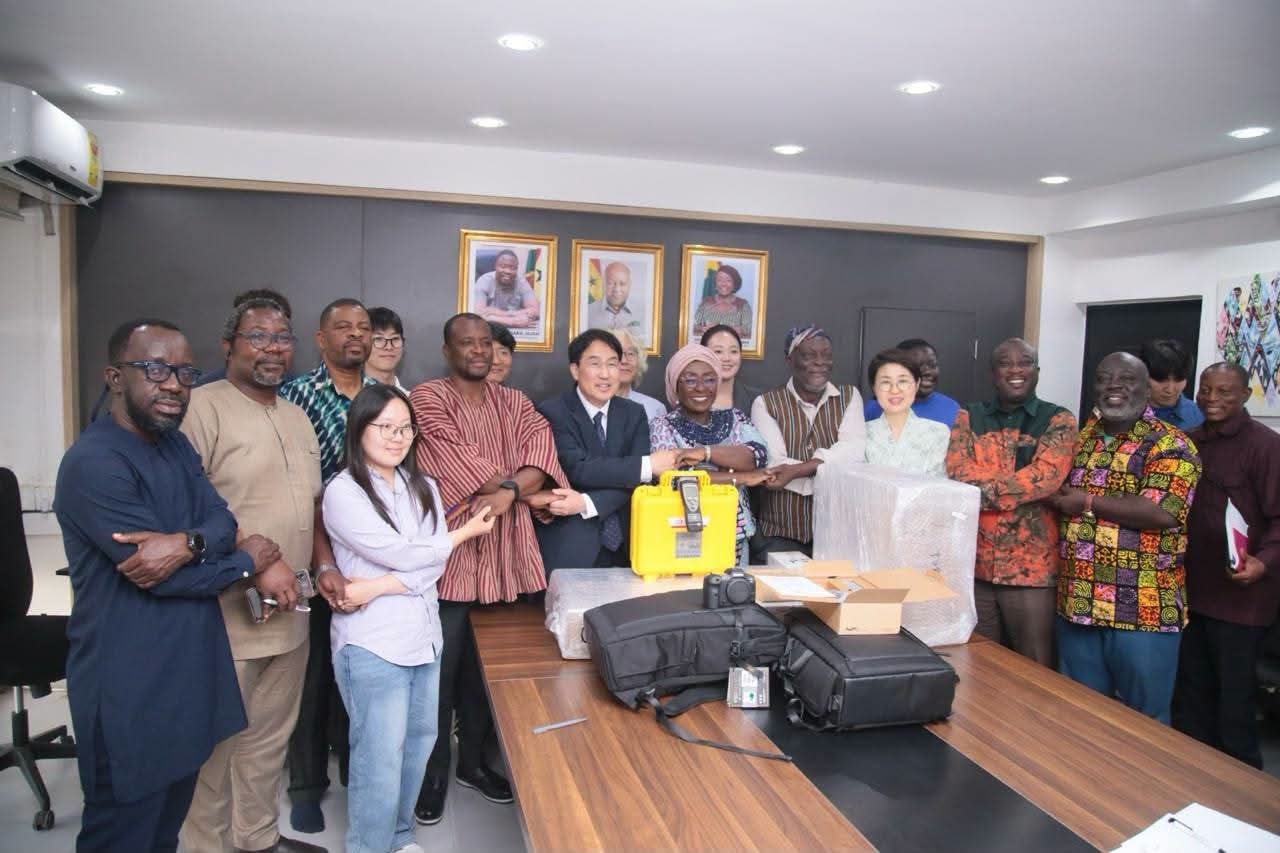
Tourism, Culture and Creative Arts Minister, Abla Dzifa Gomashie, has inaugurated the Ghana-Korea Heritage Project Steering Committee to provide strategic oversight for a five-year programme focused on preserving Ghana’s heritage sites and strengthening their resilience to climate change.
The project will support climate-risk mapping, digital surveying and 3D modelling, joint research, capacity building, community engagement and modern monitoring technologies.
Korea is also providing specialised equipment, including drones, 3D scanners, digital microscopes, thermal imaging cameras and GPS survey instruments, to enhance Ghana’s capacity to scientifically assess, document and conserve heritage structures.
The partnership, which will run through 2030 and beyond, is expected to deepen Ghana-Korea cultural ties while promoting sustainable, technology-driven and climate-adaptive heritage management for future generations.
By Edem Mensah-Tsotorme