News
Ntotroso celebrates annual Apomasu Yam Festival

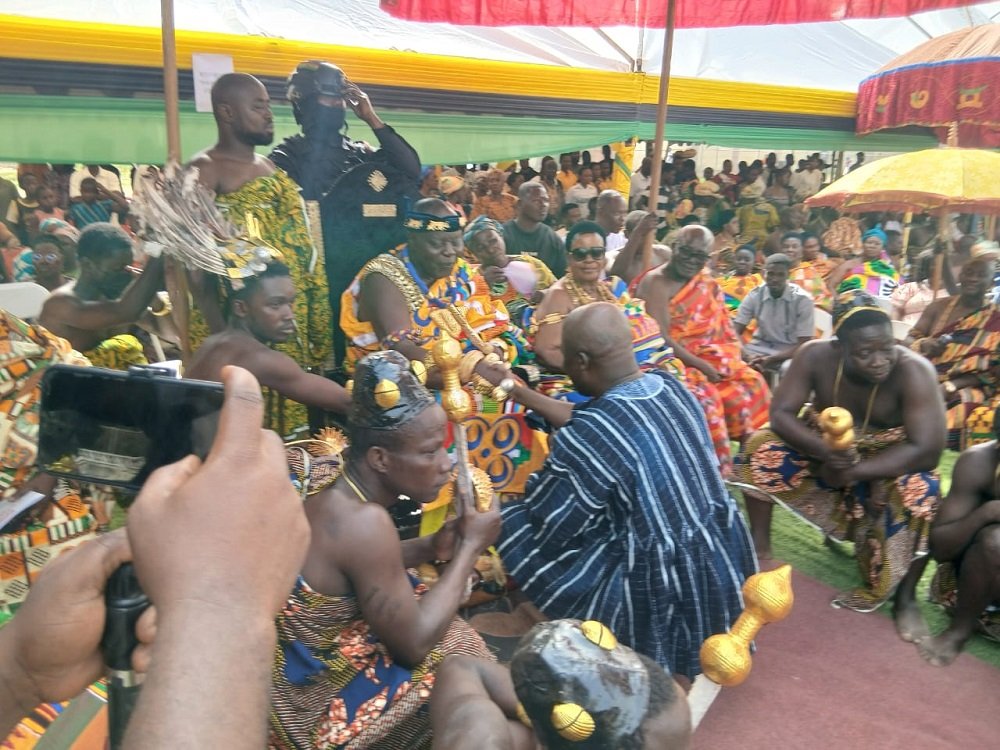
THE chiefs and people of Ntotroso in the Asutifi North District of the Ahafo Region on Saturday celebrated their Apomasu Yam Festival at Ntotroso amidst pomp and pageantry.
The colourful festival, which featured a week-long activities including traditional cultural rites, was held under the Theme: ‘Mining and Tradition: Building Resilient Communities through Sustainable and Responsible Mining.’
It attracted a lot of guests including chiefs, politicians, businessmen and women, foreigners, school children and members of the public amidst drumming and dancing.
The Apomasu Yam Festival, celebrated biennially, honours the Apomasu deity believed to safeguard the community’s wellbeing.
The festival also served as a fundraiser to support ongoing educational infrastructure projects initiated by the Ntotroso Traditional Council.
Addressing the people, Barima Twereku Ampem III, Paramount chief of Ntotroso, said the Apomasu festival was not merely a celebration of harvest, but signifies a spiritual homecoming as well as a moment of thanksgiving to the Almighty God and to the ancestors for protecting the land, blessing the farms, and sustaining them.
The festival, he noted, symbolises renewal of unity, purpose and collective responsibility to protect the land entrusted to us.
Touching on the menace of illegal mining activities, Barima Twereku Ampem, who is also the president of the Ahafo Regional House of Chiefs, pledged the support of the chiefs and people in the area to complement government’s efforts at finding a lasting solution to the problem.
According to him, illegal mining remains a threat not only to our environment but to national security and long-term development of the country.
He, however, urged the government to ensure strict enforcement of the law, in a fair, consistent and transparent manner so as to deal with the menace.
The Minister for Local Government, Chieftaincy and Religious Affairs, Ahmed Ibrahim, who led the government delegation, commended the chiefs and people of Ntotroso for organising a successful festival.
He praised their commitment to be accountable and transparent in their dealings with the people.
“Most leaders finds it difficult to be accountable to their people. What you have shown here is a demonstration of your commitment to honesty and integrity—a virtue that must be emulated by who aspire to lead,” he stated.
He later donated a cash of Gh₵100,000 to support the celebration.
After more than 300 years of existence, Ntotroso has seen a lot of changes both the social and economic fronts.
From a largely subsistence local economy, Ntotroso and other surrounding communities have now been placed on the global map of gold producing areas following the acquisition of mining concession in 2003 by Newmont Ahafo Mines.
From Daniel Dzirasah, Ntotroso
Join our WhatsApp Channel now!
https://whatsapp.com/channel/0029VbBElzjInlqHhl1aTU27







AS Ghana celebrates its 69th Independence Day, the country reflects on the vision of its first President, Kwame Nkrumah. Beyond political freedom, Nkrumah dreamed of building a modern, self-reliant nation.
He launched ambitious projects aimed at industrialisation, job creation, and to position Ghana as a leader in Africa.
Many of these projects were interrupted or abandoned after the 1966 coup that removed him from power. Today, these projects remain reminders of bold ambitions and opportunities for revival.
1. The Black Star Line
One of Nkrumah’s earliest initiatives was the Black Star Line, Ghana’s first national shipping company. Established in 1957, it aimed to boost trade and reduce dependence on foreign vessels. Nkrumah envisioned a fleet of Ghanaian ships transporting goods across Africa and beyond.
The project, however, suffered from poor management, financial challenges, and political instability. After the 1966 coup, the Black Star Line collapsed, leaving a gap in Ghana’s maritime sector. Today, the country still relies heavily on foreign shipping, showing how Nkrumah’s foresight was ahead of its time.
2. Railway expansion
Perhaps Nkrumah’s most enduring domestic dream was a nationwide railway network. He wanted lines connecting northern and southern Ghana, linking agricultural zones to factories, and connecting mines to ports. Railways were to be the backbone of industrialisation, enabling efficient transport of goods and people.
Much of this vision remains unrealised. Expansion stalled after 1966, and the network has suffered decades of neglect.
- Juapong textile factory
- Tomato and fruit processing plants: Designed to add value to agricultural produce, but operations collapsed due to inconsistent supply and lack of technical expertise.
Modernisation efforts by successive governments, including the construction of the Tema–Mpakadan line and rehabilitation of parts of the Western Line, have only partially restored his vision. A fully integrated railway system, particularly linking northern regions, remains a work in progress.
3. Accra–Tema Industrial corridor
The Accra–Tema Motorway, constructed in the early 1960s, was intended to anchor an industrial corridor connecting factories, ports, and residential areas.
The motorway itself was completed and remains a key route, but many industrial zones along the corridor were never built, limiting the economic impact of the project.
4. Defunct factories and industrial ambitions
Through the Ghana Industrial Holding Corporation (GIHOC), Nkrumah established numerous state-owned factories to reduce imports, create jobs, and industrialise the country. Many of these factories, however, became defunct due to poor management, political changes, and economic challenges.
Some notable examples include:
- Textile factories: Aimed at making Ghana self-reliant in clothing production, but most shut down after Nkrumah’s overthrow.
- Brick, tile, and cement factories: Intended to supply building materials for rapid urbanisation; many closed or underperformed.
- Sugar and meat processing plants: Built to supply local demand and reduce imports, yet most never reached full capacity.
These defunct factories are a testament to the challenges of maintaining large-scale industrial projects in a changing political and economic environment. They also illustrate the potential that existed to make Ghana self-sufficient in manufacturing.
Meridian Hotel
The Meridian Hotel in Tema. Built in 1960 by Ghana’s first President, Osagyefo Dr. Kwame Nkrumah. One of the most sought-after hotels at the time, it was a popular location for dignitaries and tourists. The iconic hotel was so popular it inspired the famous Wulomei song Meridian.
Sadly, it has been abandoned for over two decades after it was closed down in the late 1990s. Meanwhile, residents in the area have called on the government to demolish the building if there are no plans to revamp it.
Lessons and way forward
These abandoned projects and defunct factories are not just stories of failure. They highlight Nkrumah’s bold vision and the importance of continuity in national development. Independence brought freedom, but building a self-reliant, industrialised Ghana requires sustained planning, political stability, and investment in infrastructure and human capital.
As Ghana marks its 69th Independence Day, revisiting these projects is both a reflection on history and a call to action. Reviving or modernising parts of these initiatives could strengthen infrastructure, create jobs, and make the country more competitive in the regional and global economy.
Nkrumah’s projects were not merely monuments of ambitions but blueprints for economic sovereignty. As Ghanaians, it is not just enough to remember past events leading to independence but completing and reviving works that began in 1957.
It reminds us that true nation-building—connecting the country, industrialising the economy, and asserting Ghana’s role in Africa—is an ongoing journey.
By Esinam Jemima Kuatsinu
Join our WhatsApp Channel now!
https://whatsapp.com/channel/0029VbBElzjInlqHhl1aTU27

THE A1 Bread Factory last Thursday held a breakfast engagement with staff of the New Times Corporation (NTC) as part of the company’s ‘Share Happiness’ community outreach.
Close to 60 members of staff enjoyed the breakfast package of special loaves with fillers and with cocoa drinks.
“For us, it is a moment to give back to the people and build goodwill,” says Mr Isaac Dazie, Head of Sales IN in an interview with The Spectator.
“Through such activations, we hope to reach out to a lot more people and in the process strengthen our bonds with the communities around,” he said.
Mr Dazie said A1 Bread provides corporate breakfast orders and hope that such activities would lead to full partnerships in future.
He encouraged staff of NTC to patronise the brand, noting that the company planned to keep supporting communities in similar ways.
Mrs Georgina Naa-Marku Quaittoo thanked the team on behalf of staff and Management for this guesture.
By Agnes Owusu
Join our WhatsApp Channel now!
https://whatsapp.com/channel/0029VbBElzjInlqHhl1aTU27