News
NPP criticises government’s flood response, demands stronger action

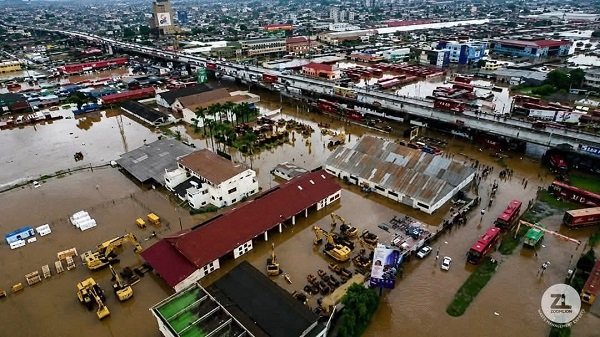
The New Patriotic Party (NPP) has criticised the government’s handling of the flooding that hit parts of Accra and surrounding communities on Monday, urging it to move beyond what it described as public relations activities and take decisive action to address the country’s flood challenges.
In a press release issued on June 29, the party expressed sympathy to thousands of people affected by the floods but maintained that the government had failed to respond effectively to the recurring disaster.
The NPP noted that communities including the N1 Highway, Apenkwa, Achimota, Kaneshie, Weija, Spintex, Darkuman Junction and the Kwame Nkrumah Interchange were flooded after heavy rains.
According to the party, these communities have experienced flooding repeatedly over the years, making it necessary for government to adopt long term solutions.
The NPP argued that the current administration had created confusion by splitting responsibility for flood management between the Ministry of Local Government and the Ministry of Works, Housing and Water Resources.
It claimed that the arrangement had resulted in poor coordination, with the two ministries competing over responsibilities instead of working together to address the problem.
The party questioned the decision to place Deputy Chief of Staff Stan Dogbe in charge of coordinating flood response efforts.
According to the NPP, he does not have the authority to direct ministers, making the current command structure ineffective.
The opposition party further alleged that some anti flood measures announced by the government had either not been implemented or had been poorly executed.
It claimed that delays in the release of funds for flood mitigation programmes had affected ongoing interventions.
The NPP rejected recent comments by President John Dramani Mahama that flooding was partly caused by poor environmental practices and indiscipline among some citizens.
It argued that while public cooperation was important, the government should take responsibility for designing and implementing effective flood management policies.
The party called on the President to place flood management under one ministry, appoint a single minister to lead the response, and provide a public account of the work and spending of the Anti Flood Task Force.
It also urged the government to work closely with Metropolitan, Municipal and District Assemblies and technical experts to improve land use planning, sanitation management and drainage infrastructure.
The statement, signed by the NPP General Secretary, Justin Kodua Frimpong, stressed that the party would continue to hold the government accountable while standing with families affected by the floods.
By: Jacob Aggrey






News
GES directs Ashanti Regional, Obuasi Municipal Education Directors to step aside over Obuasi SHTS scandal

The Management of the Ghana Education Service (GES) has directed the Ashanti Regional Director of Education, Dr. William Amankrah Appiah, and the Obuasi Municipal Director of Education, Mr. Kwamena Owusu-Nketiah, to step aside with immediate effect.
The directive forms part of ongoing investigations into allegations of sexual misconduct involving the headmaster of Obuasi Senior High Technical School (SHTS), Mr. Zakaria Abdulai.
According to GES, the decision is intended to ensure that the investigations proceed without potential interference, nor the perception of it.
The two directors are to hand over their offices and all state property in their possession to the Deputy Ashanti Regional Director of Education, Mr. Thomas Kwame Boateng.
Management added that the headmaster, Mr. Zakaria Abdulai, also remains interdicted and therefore urged the public to ignore any news circulating that he has been cleared.
Management is calling for calm, support and cooperation as thorough investigations into the matter continue.
By Edem Mensah-Tsotorme
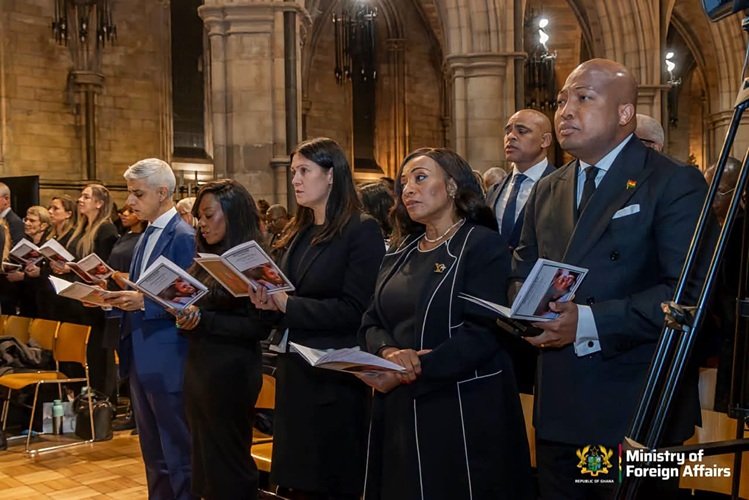
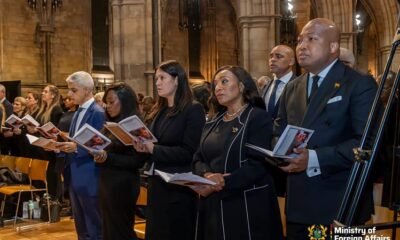
The Minister for Foreign Affairs, Samuel Okudzeto Ablakwa, has joined the family of the late Professor Jason Atta Kwei Arday, the Ghanaian community in the UK, and other dignitaries for a memorial service in Southwark, UK.
In a post, Mr. Ablakwa described the service as deeply moving and unforgettable, held in honour of the late professor’s memory.
According to him, in keeping with the government’s pledge, he joined the family, Ghana’s High Commissioner to London, British MPs, Ministers, the Mayor of London, Cambridge scholars, Prof. Arday’s students and loved ones to pay respects and honour his inspiring legacy.
Mr. Ablakwa noted that Prof. Arday’s accomplishments as the youngest Black professor appointed at the University of Cambridge and his widely appreciated charitable contributions will continue to inspire generations.
“The Government and People of Ghana will continue to stand by our compatriots everywhere they are in the world. As we do so, we profess our commitment to justice, equality and the creation of a new world,” he said.
He prayed for fortitude for the family in what he described as an extraordinarily difficult time.
“We shall always remember Prof. Arday for his response when asked what he will wish to do to change the world: ‘I would take a thread and a needle, and I’d interweave love into our society’,” Mr. Ablakwa added.
By Edem Mensah-Tsotorme