Fruitful Living
National Chief Imam blesses Muslim Youth in Agriculture project

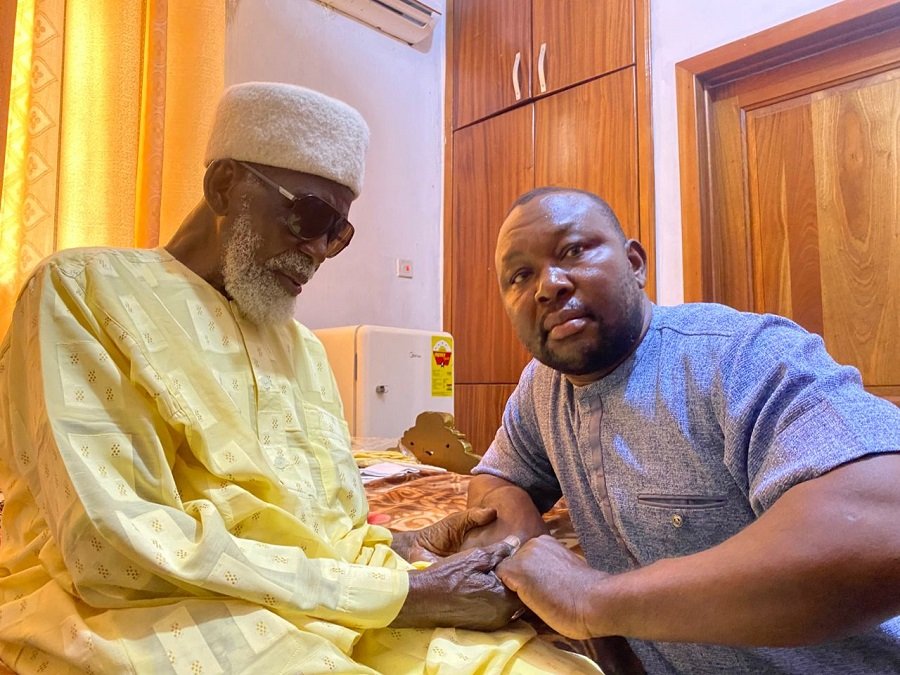
The National Chief Imam with Mr Mensah at his residence at Fadama
The National Chief Imam, Sheikh (Dr) Osman Nuhu Sharubutu, has urged Ghanaian Muslims to venture into agriculture in order to enhanced food security in the country.
The Chief Imam said this when the Managing Director of Sky Dolphin Limited, Wisdom Mensah, paid a courtesy call on him at his residence at Fadama, a suburb of Accra on Monday.
Mr Mensah presented a gift to the National Chief Imam in support of his planned anniversary of the birth of Prophet Muhammad (Maulid) which comes off today October 5 at Fadama.
The National Chief Imam asked for Allah’s blessing for the success of the Muslim Youth in Agriculture project.
Mr Mensah is supervising the Muslim Youth in Agriculture project, a partnership between the Muslim community and the Sky Dolphin Limited, which involves novel aquaponics project, a mixture of fish farming and crop farming, aimed at creating jobs for the teeming unemployed Muslim youth as well as vulnerable rural Muslim women.
The representatives of the Islamic Community on the Muslim Youth in Agriculture, aquaponics projects are Sheikh Mustapha Ibrahim, the founder and chairman of the Islamic Council for Development and Humanitarian Services in Ghana (ICODEHS) and Special Advisor to the National Chief Imam, Imam Mohammed Awal Alhassan, the Metropolitan Chief Imam of Takoradi and Greater Accra Chief Imam of the Dagomba Community, Sheikh Yusuf Farouk Alhassan Umar Yussifiya, the Imam of Yussifiya Mosque in Kumasi and Acting Chairman of the National Hilal Committee of Ghana and Alhaji Khuzaima Mohammed Osman, Eminent Member and Chairman of the Greater Accra Regional Peace Council of the National Peace Council of Ghana and Executive Secretary of the Tijjaniya
By Spectator Reporter

Satan tempts Jesus with the offer of rulership over all the kingdoms of the world, a proposal that Jesus rejects. This could be viewed as an appeal for material wealth, possessions and power.
Jesus’ kingdom in this age is not a worldly kingdom. Throughout His ministry, Jesus would refuse to seek a kingdom for Himself by the worldly methods of compromise, earthly power, political maneuvering, external violence or personal popularity.
Jesus’ kingdom is a spiritual one, established in the hearts of His people, who have also refused to follow the ungodly ways of the world. As a heavenly kingdom,
- It is gained through suffering, self – denial, humility and meekness – the opposite of how worldly people pursue power;
- It requires surrendering ourselves as living and holy sacrifices completely devoted and obedient to God and His purposes; Romans 12:1 – Therefore, I urge you, brothers and sisters, in view of God’s mercy, to offer your bodies as a living sacrifice, holy and pleasing to God—this is your true and proper worship.
- It involves a battle against Satan, sin, temptation and evil using spiritual weapons. Finally, be strong in the Lord and in his mighty power. Put on the full armor of God, so that you can take your stand against the devil’s schemes. For our struggle is not against flesh and blood, but against the rulers, against the authorities, against the powers of this dark world and against the spiritual forces of evil in the heavenly realms. Therefore, put on the full armor of God, so that when the day of evil comes, you may be able to stand your ground, and after you have done everything, to stand. Stand firm then, with the belt of truth buckled around your waist, with the breastplate of righteousness in place, and with your feet fitted with the readiness that comes from the gospel of peace. In addition to all this, take up the shield of faith, with which you can extinguish all the flaming arrows of the evil one. Take the helmet of salvation and the sword of the Spirit, which is the word of God. And pray in the Spirit on all occasions with all kinds of prayers and requests. With this in mind, be alert and always keep on praying for all the Lord’s people. – Ephesians 6:10-20.
- It means resisting conformity to the beliefs, behaviours and lifestyles that are common in the world. Do not love the world or anything in the world. If anyone loves the world, love for the Father is not in them. For everything in the world—the lust of the flesh, the lust of the eyes, and the pride of life—comes not from the Father but from the world. The world and its desires pass away, but whoever does the will of God lives forever. – 1 John 2:15-17
Satan’s appeal to worship Him was an attempt to get Jesus to take a quick route to a world domination – to avoid the humility and sufferings that would lead to Jesus’ death on the cross. This is to say, the devil was trying to get Jesus to lay aside His entire purpose for coming to earth. Christ’s willingness to face all the difficulties that lay ahead is an example to all believers. He taught us that there are no shortcuts to fulfilling God’s perfect purposes for our lives, no matter how tempting the options may seem.
Stay Blessed!
By Rev. Dr Joyce Aryee
Join our WhatsApp Channel now!
https://whatsapp.com/channel/0029VbBElzjInlqHhl1aTU27

Preparing for Ramadan through the month of Sha‘ban
THE month of Sha‘ban, which precedes Ramadan, serves as a spiritual training ground. The Prophet (s.a.w.) devoted significant attention to this month, fasting frequently and encouraging heightened acts of worship. ‘Aishah (r.a.) narrated:
“I did not see the Messenger of Allah complete fasting in any month except Ramadan, and I did not see him fast more in any month than in Sha‘ban.” (Ṣaḥīḥ al-Bukhārī; Ṣaḥīḥ Muslim)
During Sha‘ban, Muslims are encouraged to:
• Observe optional fasts,
• Increase Qur’anic recitation,
• Engage in charitable deeds (ṣadaqah),
• Strengthen community bonds and service.
These acts gradually condition both the body and soul for the rigours and blessings of Ramadan.
Scholarly guidance and community sensitisation
Across Muslim communities, scholars and religious leaders organise lectures, workshops, sermons, and media engagements to educate the Ummah about Ramadan. These initiatives address:
• The jurisprudence (fiqh) of fasting,
• The obligation to make up missed fasts from previous years,
• The ethical conduct expected during Ramadan,
• The spiritual, social, and health benefits of fasting.
Modern studies have also affirmed that fasting, when properly observed, contributes to improved self-discipline, metabolic balance, and emotional regulation—findings that align with Islamic teachings on moderation and self-control.
The role of parents and families in Ramadan preparation
Preparation begins at home. Parents play a vital role in nurturing a Ramadan-conscious environment by:
• Encouraging children and young adults to try voluntary fasts,
• Training family members to wake up for Tahajjud (night prayers),
• Establishing regular family supplications and Qur’an reading sessions.
Such practices help instill lifelong spiritual habits and strengthen family unity through shared worship.
By Imam Alhaji Saeed Abdulai