Hot!
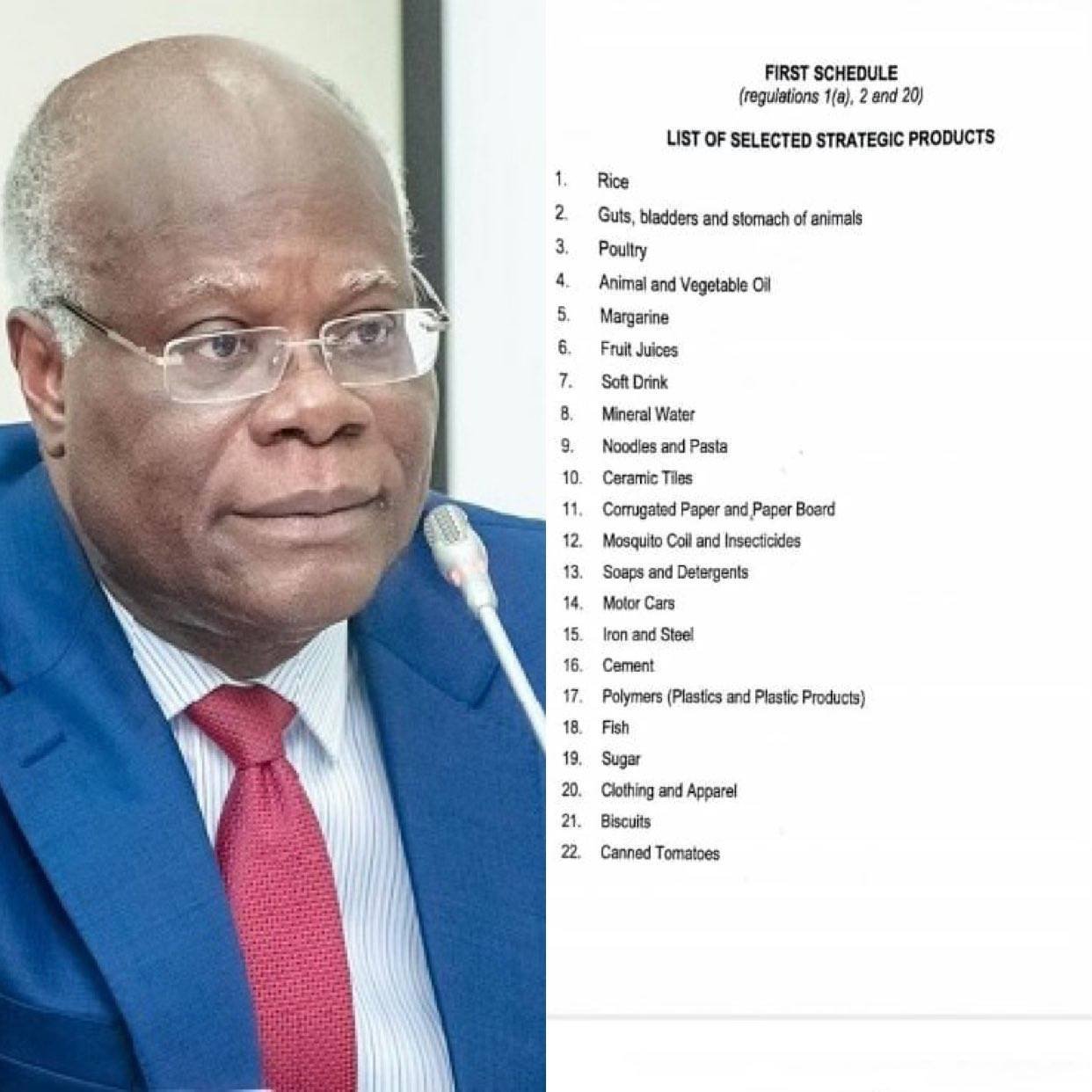
KT Hammond justifies import restrictions bill, says it’ll boost local production

- /home/u249204778/domains/spectator.com.gh/public_html/wp-content/plugins/mvp-social-buttons/mvp-social-buttons.php on line 27
https://spectator.com.gh/wp-content/uploads/2023/11/d8f9cae4-0779-4c5e-a9cc-5bd67a2b7789.jpeg&description=KT Hammond justifies import restrictions bill, says it’ll boost local production', 'pinterestShare', 'width=750,height=350'); return false;" title="Pin This Post">
- Share
- Tweet /home/u249204778/domains/spectator.com.gh/public_html/wp-content/plugins/mvp-social-buttons/mvp-social-buttons.php on line 72
https://spectator.com.gh/wp-content/uploads/2023/11/d8f9cae4-0779-4c5e-a9cc-5bd67a2b7789.jpeg&description=KT Hammond justifies import restrictions bill, says it’ll boost local production', 'pinterestShare', 'width=750,height=350'); return false;" title="Pin This Post">
The Minister of Trade and Industry, KT Hammond, has clarified that the government’s proposed import restrictions bill on 22 commodities is not intended to create food shortages but rather to encourage local production and consumption.
In a press briefing, KT Hammond outlined the government’s plan to impose import restrictions on a range of products, including poultry, animal and vegetable oils, margarine, fruit drinks, soft drinks, mineral water, noodles and pasta, and ceramic tiles.
He emphasized that this measure is not a ban, but rather a strategic initiative to promote domestic production and reduce reliance on imports.
KT Hammond acknowledged concerns from stakeholders regarding potential food shortages, but he assured the public that the proposed restrictions are designed to encourage local producers to step up and meet the country’s needs.
Giving further details on the Legislative Instrument on Eyewitness News, he further explained that the import restrictions may not be implemented until 2024, providing ample time for businesses and consumers to adjust.
“You know, by its nature, when you put an L.I. before Parliament, it takes 21 days to mature. And so by 21 days, all that traders would want to import, they can import. Because by the time the L.I. kicks in, they would have imported everything. So I am not anxious that it is going to lead to a shortage of anything going to Christmas. Hopefully, it will kick in 2024. But even that, as I said, it is not a ban.”
The Trade Minister encouraged Ghanaians to embrace this initiative and support local farmers by purchasing domestically produced goods.
He also mentioned that private businesses seeking to import restricted products would need to apply for permits.
“So we are not banning, but it will require some sort of assurance that there is the need for these particular items to be imported in the country, but definitely nothing like banning, but we will be monitoring.”
He said, “The Agric ministry is on board and the committee would want to ascertain how much quantity is it that the country can import. What is the gap between production and consumption and depending on that you would import.”
The government’s proposed import restrictions aim to strike a balance between protecting domestic industries and ensuring adequate supply of essential goods. By encouraging local production and consumption, the government hopes to strengthen the economy and reduce reliance on external resources.
Source: Citinewsroom.com


General Secretary of the New Patriotic Party (NPP), Justin Kodua Frimpong, has filed his nomination to contest the position of General Secretary again as the party begins its rebuilding efforts ahead of the 2028 general elections.
He was accompanied by party stalwarts and supporters who were in high spirits, expressing confidence that he is the right person to hold the position.
Speaking after filing his nomination, Mr Kodua Frimpong assured the rank and file of the party that he would not disappoint them.
“I can assure you that the faith the rank and file of the party have had in me, I will never disappoint them,” he said.
He also pledged to run a clean campaign devoid of personal attacks.
“I can assure you that our internal campaign will be devoid of personal attacks,” he told his fellow contestants and the rank and file of the party as he seeks to retain his position.
His tenure has seen the party through the 2024 general elections, where the NPP lost power to the National Democratic Congress (NDC) after eight years in government.
The party is currently in a rebuilding phase, with internal elections scheduled to elect new national executives to lead its reorganization towards the 2028 polls.
The General Secretary position is considered one of the most influential in the party’s administrative structure, responsible for the day-to-day running of the party secretariat and implementation of party decisions.
By Edem Mensah-Tsotorme

The University of Ghana Medical Centre (UGMC) has disputed claims made on social media by comedian Michael Blackson concerning the treatment given to his late mother, saying a review found that the allegations did not accurately reflect what happened during her stay at the hospital.
In a statement issued in Accra on August 5, 2026, the management of UGMC expressed condolences to Mr. Blackson and his family over the death of his 83-year-old mother, who died at the facility on July 16, 2026.
The hospital said it had taken the concerns raised by Mr. Blackson seriously and conducted a thorough review in line with its clinical and administrative procedures.
According to the statement, the facts presented by Mr. Blackson on social media contained “numerous inaccuracies” and did not accurately reflect the medical care provided to his mother.
UGMC explained that she was referred to the facility from another hospital and received treatment there from May 27 to July 16, 2026, a period of about eight weeks.
The hospital stated that it would not release details of her diagnosis, treatment, medical records or other aspects of her care because it had a duty to protect patient confidentiality, even after death.
It said the decision was intended to respect the dignity of the deceased and the privacy of her family.
UGMC further stated that all clinical decisions at the facility are made by qualified healthcare professionals based on medical judgment, established standards of care and the best interests of the patient.
The statement added that such decisions are made in consultation with authorised family representatives where necessary and that billing and financial procedures are governed by institutional policies and are separate from clinical decision-making.
The hospital noted that it values feedback from patients and their families and considers both positive and negative comments important for improving the quality of care.
Mr. Blackson had earlier used social media to criticise the care his mother received at UGMC, prompting the hospital’s response.
By: Jacob Aggrey