Hot!
Kim Jong-un cries as he begs North Korean women to help halt a decline in country’s birth rate

- /home/u249204778/domains/spectator.com.gh/public_html/wp-content/plugins/mvp-social-buttons/mvp-social-buttons.php on line 27
https://spectator.com.gh/wp-content/uploads/2023/12/Kim-Jong-Un-CRIES-in-front-of-thousands-of-women-as-he-calls-on-them-to-have-more-children.webp&description=Kim Jong-un cries as he begs North Korean women to help halt a decline in country’s birth rate', 'pinterestShare', 'width=750,height=350'); return false;" title="Pin This Post">
- Share
- Tweet /home/u249204778/domains/spectator.com.gh/public_html/wp-content/plugins/mvp-social-buttons/mvp-social-buttons.php on line 72
https://spectator.com.gh/wp-content/uploads/2023/12/Kim-Jong-Un-CRIES-in-front-of-thousands-of-women-as-he-calls-on-them-to-have-more-children.webp&description=Kim Jong-un cries as he begs North Korean women to help halt a decline in country’s birth rate', 'pinterestShare', 'width=750,height=350'); return false;" title="Pin This Post">
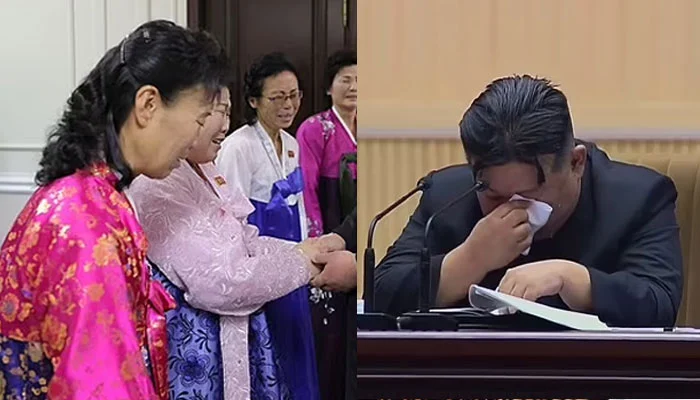
Kim Jong-un burst into tears in front of thousands of North Korean “mothers” as he begged them to have more babies and stop the decline in the communist country’s birth rate.
The dictator was seen dabbing his eyes with a handkerchief in a highly choreographed plea to women gathered at a National Mothers’ Meeting in Pyongyang on Sunday.
Addressing the audience as “Dear Mothers” he told them: “Preventing a decline in birth rates and good childcare are all of our housekeeping duties we need to handle while working with mothers.”
He added his country was being confronted with a host of “social tasks that our mothers should join to tackle.”
“These tasks include bringing up their children so that they will steadfastly carry forward our revolution, eliminating the recently-increasing non-socialist practices, promoting family harmony and social unity, establishing a sound way of cultural and moral life, making the communist virtues and traits of helping and leading one another forward prevail over our society, stopping the declining birth rate, and taking good care of children and educating them effectively.
“These belong to our common family affairs, which we need to deal with by joining hands with our mothers.”
The United Nations Population Fund estimates that as of 2023 the fertility rate, or the average number of children being born to a woman in North Korea, stood at 1.8, amid an extended fall in the rate during recent decades.
The fertility rate remains higher than in some of North Korea’s neighbours, which have been grappling with a similar downward trend.
South Korea saw its fertility rate drop to a record low of 0.78 last year, while Japan saw its figure drop to 1.26.
The dwindling birth rates in South Korea have caused a shortage of pediatricians, while one city is hosting matchmaking events to boost birth rates.
North Korea, which has a population of about 25 million people, has in recent decades also had to contend with serious food shortages, including deadly famine in the 1990s, often a result of natural disasters such as floods damaging harvests.
North Korea implemented birth control programs in the 1970-80s to slow a postwar population growth. The country’s fertility rate recorded a major decline following a famine in the mid-1990s that was estimated to have killed hundreds of thousands of people, the Seoul-based Hyundai Research Institute said in a report in August.
“Given North Korea lacks resources and technological advancements, it could face difficulties to revive and develop its manufacturing industry if sufficient labor forces are not provided,” the institute report said.
Source: independent.co.uk


The University of Ghana Medical Centre (UGMC) has disputed claims made on social media by comedian Michael Blackson concerning the treatment given to his late mother, saying a review found that the allegations did not accurately reflect what happened during her stay at the hospital.
In a statement issued in Accra on August 5, 2026, the management of UGMC expressed condolences to Mr. Blackson and his family over the death of his 83-year-old mother, who died at the facility on July 16, 2026.
The hospital said it had taken the concerns raised by Mr. Blackson seriously and conducted a thorough review in line with its clinical and administrative procedures.
According to the statement, the facts presented by Mr. Blackson on social media contained “numerous inaccuracies” and did not accurately reflect the medical care provided to his mother.
UGMC explained that she was referred to the facility from another hospital and received treatment there from May 27 to July 16, 2026, a period of about eight weeks.
The hospital stated that it would not release details of her diagnosis, treatment, medical records or other aspects of her care because it had a duty to protect patient confidentiality, even after death.
It said the decision was intended to respect the dignity of the deceased and the privacy of her family.
UGMC further stated that all clinical decisions at the facility are made by qualified healthcare professionals based on medical judgment, established standards of care and the best interests of the patient.
The statement added that such decisions are made in consultation with authorised family representatives where necessary and that billing and financial procedures are governed by institutional policies and are separate from clinical decision-making.
The hospital noted that it values feedback from patients and their families and considers both positive and negative comments important for improving the quality of care.
Mr. Blackson had earlier used social media to criticise the care his mother received at UGMC, prompting the hospital’s response.
By: Jacob Aggrey

The New Patriotic Party (NPP) has directed all aspirants campaigning in the Greater Accra Region to suspend their campaign activities on August 5 and 6 and instead mobilise supporters for the party’s planned “Democracy Under Attack” demonstration.
The directive was issued by the party’s National Steering Committee in a statement signed by the NPP General Secretary, Justin Kodua Frimpong, on Tuesday.
According to the statement, the decision forms part of efforts to ensure a strong turnout for the demonstration, which is scheduled for Thursday, August 6, 2026.
The party said the protest would begin at 5:00 a.m., with participants expected to gather at the Supreme Court in Accra.
It further directed Regional, Constituency and Polling Station Executives in Greater Accra to work closely to mobilise members and supporters for the event.
“The National Steering Committee is calling on all aspirants currently campaigning across the Greater Accra Region to temporarily suspend their campaign activities on the 5th and 6th of August and join in mobilising support for the upcoming demonstration,” the statement noted.
The NPP appealed to party members and supporters to remain peaceful, disciplined and orderly throughout the protest.
The demonstration forms part of the party’s response to concerns it has raised over issues relating to Ghana’s democratic governance and the justice system.
The NPP leadership expressed confidence that party members would cooperate fully to ensure a successful and peaceful event.
By: Jacob Aggrey

 News1 week ago
Prof. Kwabena Twerefou holds inaugural lecture; calls for better stewardship of Ghana’s natural resources
- News1 week ago
Prez Mahama to visit Jamaica to strengthen ties and advance reparations agenda
- News1 week ago
Ahanta Heritage Month: Diplomats, youth tour forts, Cape Three Points and historic sites