Features
Humour in Ghana journalism

- /home/u249204778/domains/spectator.com.gh/public_html/wp-content/plugins/mvp-social-buttons/mvp-social-buttons.php on line 27
https://spectator.com.gh/wp-content/uploads/2026/10/Kwame-Sefa-Kayi.jpg&description=Humour in Ghana journalism', 'pinterestShare', 'width=750,height=350'); return false;" title="Pin This Post">
- Share
- Tweet /home/u249204778/domains/spectator.com.gh/public_html/wp-content/plugins/mvp-social-buttons/mvp-social-buttons.php on line 72
https://spectator.com.gh/wp-content/uploads/2026/10/Kwame-Sefa-Kayi.jpg&description=Humour in Ghana journalism', 'pinterestShare', 'width=750,height=350'); return false;" title="Pin This Post">
CECIL, alias Lee of Community 3, Tema, and formerly of Vibe FM, has said he would recommend the Sikaman Palava’ column to hypertensives, that is, those suffering from high blood pressure. According to him, the column is a medical therapy and a perfect prescription for the afflicted.
Well, Lee might be right, because mails I receive from all over the world, courtesy of the Internet have also alluded to a calming effect of the column. Emails pour in from as far as the Philipines, are oiling my knuckles. I feel flattered.
I get mails from the Middle East, Canada, United States and some African countries. I often get amazed that playing with words on paper elicits such profound interest in my readers. I thank my readers for the recognition and acknowledgement.
However, I am not alone in this game of humour peddling. Oldboy Professor Kwesi Yankah who has been a great inspiration is one personality whose word juggling has illuminated the pages of newspapers, right from the Abonsam Fireman days. His pen is still dripping of humour.
Where is Ivan Dornu Adjokatcher, the ex-darling of THE MIRROR? Full of wit, he ran a column that had quite a following. One day he met me and I told him he was crazy if not, then he was downright mad.
Ivan went and edited a private newspaper and had a brush with the owner. He left. He sent me a postcard from the United States. Very good pals we’ve always been. He needs to return to the fold.
Now, Ghana journalism would have been tasteless without writers of humour, those who see the interesting side of serious issues.
Nigerian humorists are great and some of their writers have really made all the difference in the newspaper industry, with their amazing paper industry sense of humour.
Many of them studied journalism in Ghana with our folks here and went on to carve niches for themselves. Nigerians have a good sense of humour and this is exemplified in their drama and writings.
Read Chukwemeka Ike and Elechi Amadi and you’ll be getting the drift. Even Wole Soyinka (Nobel prize winner for literature) whom I sometimes consider overly stiff and pedantic, exudes a unique kind of humour in his plays.
In Ghana, aside Amu Djokoto’s “The Strange Man’ which spots many faces of humour and Atukwel Okai whose poetry induces some mirth, the literati have generally gone dry of humour.
Any good piece of writing must either be poetry or prose must either be highly intellectual, controversial or humorous. Ghanaian writers should take up the challenge and publishers should offer the platform for the expression of various genres of penmanship.
Every publisher in Ghana is doing only school books. Is all that publishing is about? Only a few like Woeli and Holiano are doing something else.
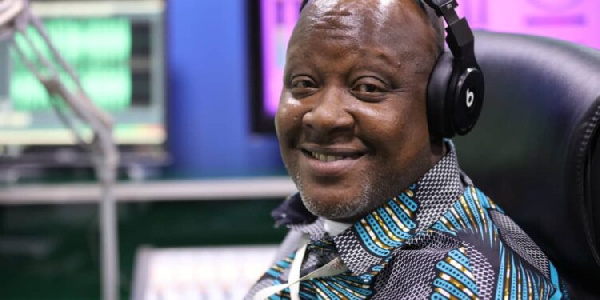
In Ghana broadcasting, there are great touches of humour worth reading. Foremost is Kwame Sefa Kayi who gave Radio Gold a great and left to pitch camp with Peace FM.
He hosts a very explosive morning Kokrokoo programme that could blow through the roof tops if it is not tempered with humour. When you have guys like Kwaku Baako Junior, Kwesi Pratt (also Junior?), Baby Ansaba and boxing supremo NDC titan, Ama Benyiwa-Doe, on the show, only a sense of humour can avert mayhem.
They are all nice fellows but when it comes to politics, I fear for Kwame’s jaws. I wonder how he survives day after day.
Kwame’s spontaneous burst of humour once in a while does the programme a lot of good. No wonder his programme was last year adjudged Best CIMG Radio Programme.
Let’s not forget JOY FM’s Ato-Kwamena and of course Bola Ray also of Joy and “Music Music fame. They know what it takes to make others laugh. I hate to miss Ato during the newspaper review on Joy. I always have something to laugh about.
At least, you can laugh in Ghana even if you are not permitted to sneeze on Sundays and public holidays.
This article was first published on Saturday August 19, 2006
SKIP THE QUEUE, TAP THE NEWS
You can now read the Ghanaian Times and The Spectator newspapers from the comfort of your device via TimesNewsPlus.
Join our WhatsApp Channel: https://whatsapp.com/channel/0029VbBElzjInlqHhl1aTU27

There is a culture that permeates all aspects of leadership in the advanced countries which I believe has contributed to the success in all aspects of their national lives. Citizens strive to excel so that they will not find themselves in a situation where they would have failed, to necessitate a decision to resign.
Countries where failure is frowned upon, it pushes the citizens to strive for success. In our part of the world, failure and mediocrity has become an accepted norm and therefore, there is no shame in failing in a particular position of leadership.
A head of an organisation mismanages the place and he does not see the need for him to resign. The appointing authority does not also see the need to sack him and so the merry go round continues.
It becomes friends and family as usual and if care is not taken, the rest of the world will leave us far, far behind.
The practice of resignation in parts of the world for failure in some parts of the world has to be institutionalised in our country too. It encourages the principle of accountability which is good for any organisation, sector of an economy or a country.
It promotes good governance, a necessary ingredient in the growth of the economy of any country.
When this practice becomes a culture, every individual, privileged to hold a position of trust, gives his or her full attention to the job assigned him or her, to ensure that objectives are achieved.
This trickles down to every individual down the chain of command and there are no rooms for errors.
That is how efficient systems are built over time and this is the difference between advanced nations and third world countries.
Where systems are designed such that people take responsibility for things that go wrong under their supervision or ultimate responsibility, there is evidence of development.
There are a few people that I admire in Ghana as far as this culture of resignation based on principled stance. One of them is the late Mrs Emma Mitchell. She was a cabinet member but chose to resign after the confrontation between late President Jerry Rawlings and late Vice President Kow Akaah.
She was not prepared to be part of a cabinet which was lying to the general public that Rawlings did not assault Akaah.
She was of the conviction that telling the truth is more honourable than telling lies and that if she was bound by confidentiality oaths to tell a lie, then she would resign and she did exactly that.
That is how we build a culture of truth and accountability. We have people in positions who have not lived up to expectation but are still holding on to their positions not prepared to let go of it.
This is a clear case of display of selfishness, trying to be a Boss instead of a Servant to serve the people, which leadership is all about.
The ineffectiveness of some leaders, often result in waste of resources which could have been channeled to other sectors of the economy which could have been more productive. A culture of voluntary resignation must be advocated for by all stakeholders, especially the CSOs, traditional leaders and the clergy.
This is the only way the needed growth in every sector of our national life would manifest.
Presidents, Prime Ministers, heads of reputable organisations have voluntarily resigned by taking ultimate responsibility and it is about time, we started seeing it manifest in our country.
The people in charge of our sports especially our soccer, can initiate this long desired culture and resign in view of the embarrassment witnessed from the defeat of the Black Stars by Gambia. God bless.
BY LAUD KISS-MENSAH
SKIP THE QUEUE, TAP THE NEWS
You can now read the Ghanaian Times and The Spectator newspapers from the comfort of your device via TimesNewsPlus.
Join our WhatsApp Channel: https://whatsapp.com/channel/0029VbBElzjInlqHhl1aTU27
THE QUR’AN FORBIDS RELIGIOUS PROVOCATION
There is a remarkable verse in the Qur’an which every Muslim preacher should memorise.
Allah says:
“And do not insult those they invoke besides Allah, lest they insult Allah in hostility without knowledge.” (Qur’an 6:108).
Think about this carefully.
Allah knows that the unbelievers worship false gods.
Yet Allah tells Muslims: Do not insult their objects of worship.
Why?
Because your speech may provoke an even greater offence.
This establishes a profound principle:
A Muslim must not fight religious provocation with religious provocation.
If someone insults what we hold sacred, we do not respond by insulting what they hold sacred.
If someone attacks Islam, we defend Islam with knowledge.
If someone misrepresents Muhammad (pbuh), we explain who is Muhammad to him.
If someone lies about Islam, we answer with truth and knowledge.
We do not allow another person’s bad behaviour to dictate our own morality.
LOOK AT MUHAMMAD (PBUH) — HE WAS INSULTED BEFORE WE WERE
Servant of Allah,
Sometimes we speak as though the Prophet (pbuh) lived in a world where everyone respected him.
No.
He was mocked and insulted. Quran 37:36, Quran 15:6
He was called a liar, magician, and a mad man. Quran 51:52, Quran 17:47
He was ridiculed. Quran 6:10
His followers were tortured, and some were killed. Quran 85:8-10
He himself was persecuted, leading to his migration to Madina.
Yet he remained the Messenger of Allah.
Allah said:
“Indeed, we know that your heart is distressed by what they say.” (Qur’an 15:97)
Allah acknowledged the Prophet’s pain.
Islam does not say that insults do not hurt. They hurt.
But the question is: What do you do with the pain?
THE DAY OF TA’IF: WHEN THE PROPHET (PBUH) COULD HAVE CHOSEN
REVENGE
One of the most powerful examples is the journey of the Prophet (pbuh) to Ta’if.
He went seeking support for his message.
Instead, the people rejected him and incited their children and others against him.
He was chased.
He was insulted.
He was struck with stones until his feet bled.
He was physically and emotionally exhausted.
Then the Angel of the Mountains came to him.
The two angels offered to crush the people of Ta’if between the mountains.
The Prophet (pbuh) could have said: “Do it.”
But he did not.
Instead, he hoped that Allah would bring from their descendants people who would worship Him.
This account is recorded in the authentic hadith literature, including Sahih Muslim (Muslim, 1795).
What a lesson!
The Prophet (pbuh) had suffered injustice.
But he did not turn his pain into indiscriminate revenge.
He saw beyond the offender.
He saw the possibility of tomorrow.
And this is one of the greatest characteristics of prophetic leadership:
The Prophet (pbuh) did not merely ask, “What punishment does this person deserve?”
He also asked, in effect: “What can this person become?”
THE PROPHET IN MADINAH: LEADER OF A DIVERSE SOCIETY
When Muhammad (pbuh) migrated to Madinah, he did not enter an empty city.
Madinah contained different communities, including Muslims and Jews, and there were also Christians who interacted with the Muslim community.
The Prophet became the political and communal leader of Madinah.
The Sahifah (A Covenant) of Madinah, preserved in the early sīrah (Prophet’s biography) tradition, established arrangements concerning mutual obligations, security, justice and relations among the communities of the city.
This is important:
The Prophet did not build Madinah by teaching Muslims to hate everyone who was not Muslim.
He built a society governed by covenant, responsibility and justice.
Allah says:
“Allah does not forbid you from being kind and just to those who have neither fought you because of your religion nor driven you from your homes. Indeed, Allah loves those who act justly.” (Qur’an 60:8)
This is not weakness.
This is Islam.
THE PROPHET DEALT WITH JEWS IN MADINAH
‘A’ishah (Wife of the Prophet) narrated that the Prophet (pbuh) bought food from a Jewish man on credit and gave him his iron armour as collateral.
“The Prophet purchased food from a Jew on credit and mortgaged his iron armour to him.” (Sahih al-Bukhari, 2068)
Think about it.
This was Muhammad.
The Messenger of Allah.
Yet he conducted lawful commercial dealings with a Jewish citizen.
He did not say: “He is not a Muslim, therefore I cannot deal with him.”
No.
Islam gave him a relationship governed by justice and trust.
Jabir رضيهللاعنه narrated:
“A funeral procession passed before us and the Prophet (pbuh) stood up, and we stood with him. We said, ‘O Messenger of Allah, it is the funeral of a Jew.’ He said: ‘When you see a funeral procession, stand.’” (Sahih al-Bukhari, 1311)
Another narration records his response: “Is it not a soul?” (Sahih al-Bukhari, 1312–1313)
What kind of heart did Muhammad (pbuh) possess?
A heart that recognised human dignity even in death.
THE PROPHET AND THE CHRISTIANS OF NAJRAN
The Prophet also received the Christian delegation of Najran.
They disagreed with him theologically.
Yet when they requested a trustworthy person, he did not choose someone because of hatred.
He selected Abu ‘Ubaydah ibn al-Jarrah.
The Prophet said:
“I shall send with you a man who is truly trustworthy.”
He then appointed Abu ‘Ubaydah.
This is authentically reported in Sahih al-Bukhari 4380–4381.
Notice something profound:
The Prophet could disagree with people without becoming dishonest toward them.
That is the standard we need today.
The author is the chief Imam of Katamanso Municipal and Certified Counsellor and Governance Expert.