Hot!
Honouring young business leaders …some Ghanaians decorated at ‘Forty under 40 Africa’ awards


The Forty under 40 Africa awards were held recently to honour the continent’s most influential and accomplished business leaders, under the age of 40, from a wider range of sectors.
Young people from 16 African countries were nominated with the most outstanding personalities taking home the ultimate prizes in their respective categories.
Here is a summary profile of four Ghanaians who were decorated for excellence in their chosen professions. They are Rosebird Ama Dadzie (Theatre and Arts female category), Ronald Tagoe,(Science & Technology) Nelson Amo (Investment) and Dr. Kofi Amoa-Abban (Oil & Gas).
Rosebird Ama Dadzie
The realistic pencil artist started drawing at an early age and developed her talent further as her drawings were being complimented by teachers and classmates in school.

Later in life, she studied Painting and Decorating at Takoradi Technical University, and started building a portfolio as her passion for ‘hype-realistic figurative art’ grew and participated in many art and craft exhibition.
She began drawing African celebrities and sometimes spent weeks and months to produce art pieces with strong emotions to connect with her audience. She captures details of her artwork using charcoal, graphite, colour pencil and paint.
Describing her craft as rewarding, she says her artworks are made from “determination and love purposely to groom and educate people,” as she encourages young ladies especially to be self-reliant, have positive self-esteem, as well as gain confidence to face and overcome life’s challenges.
Ronald Tagoe
Ronald attended Presbyterian Boys Secondary School (PRESEC) and continued at Kwame Nkrumah University of Science and Technology (KNUST), where he studied Computer Science and graduated in 2013.

In 2021, he completed his Master’s programme in Advanced Computer Science from the University of Leicester (UK) and passed with distinction. While at KNUST, he co-founded mNotify, a telecommunications company (SMS and Voice Technologies) with the objective of improving information dissemination within corporate organisations and religious bodies.
The company, under his leadership over the past nine years, became one of the giants in the Communications cloud service space with its products spanning across SMS, Voice Technologies, and the USSD infrastructure. mNotify currently has over 20,000 clients across many industries and makes an average annual revenue of USD 350,000.
He is passionate about Artificial Intelligence and considers social commerce as the future of commerce in Africa. This passion led him to start Chatbots Africa to empower African Small and Medium Scale Enterprises (SMEs) to increase their revenue and enhance their customer engagement using Artificial Intelligence and Chatbots (Conversational Commerce).
Chatbots Africa is currently registered in Ghana and in Kenya. Another application he developed is the Sario App, a music-oriented crowdfunding platform in Ghana which won the Lifestyle App Category at the 2018 MTN Apps Challenge.
Nelson Amo
Nelson is experienced in Business Development, Grant Management, Business Model Innovation, Growth Planning, and Project Management in the profit and non-profit sectors.

He is an alumnus of the Oxford Social Finance Programme from the Oxford University of Business School. He has a Master of Science (MSc) in Development Studies from London School of Economic (LSE) with special interest in Business Model Innovation.
In addition to other certificate courses in Finance, he is the Grant Manager/Programme Lead for ‘mLab Ghana’ a project under the Ministry of Communications with funding from the World Bank. The programme aims to promote the development of digital start-ups, and support them to develop and launch their prototypes on the market.
Mr. Amo had previously designed and led enterprise support programmes such as the Innohub Accelerator Programme, Solidaridad West Africa’s Accelerator for Responsible Gold, fLab Incubator for females in tech, the British Council’s ReadyToWork incubator programme, among others.
He has led consulting projects across several industries including health, renewable energy, agribusiness, green housing. He is a Harambe Entrepreneur Alliance Fellow and a Coach of the Africa Entrepreneurship Awards, hosted by the BMCE Bank of Africa in Morocco.
Dr. Kofi Amoa-Abban
Best known as the Founder and Chief Executive Officer (CEO) of Rigworld Group, he is an indigenous upstream Oil and Gas entrepreneur and a philanthropist.
The company has operations across West Africa and beyond, and has, over the years, proven its international acceptance as a top-quality service provider.
Dr. Amoa-Abban’s exemplary professional competencies have been pivotal in making local content and participation regulations feasible in the upstream oil and gas industry.
Some of his accomplishments as the CEO of Rigworld Group include securing long-term working relationships with global oil and gas giants like Maersk Drilling, Tullow oil, Modec, Eni, Score (Europe) Ltd.
He holds a degree in Psychology from the University of Ghana and a master’s degree from Oslo University, where his interest in the oil industry was piqued following the discovery of oil in Ghana in 2007.
Prior to establishing Rigworld, he had served as a drill crew member with Atwood Hunter and Banda Wells. His contribution and dedication to the oil and gas sector has earned him several awards, apart from the recent recognition at the Africa 40under40 awards.
By Spectator Reporter


The professor who spends his days exploring the intricacies of African languages found himself at the centre of a different kind of lesson on Friday, October 2, 2026. 
This time, there were no lecture notes, academic arguments or university classrooms. Instead, there was the weight of tradition, the rhythm of a community celebration and the solemnity of an oath at a royal palace.
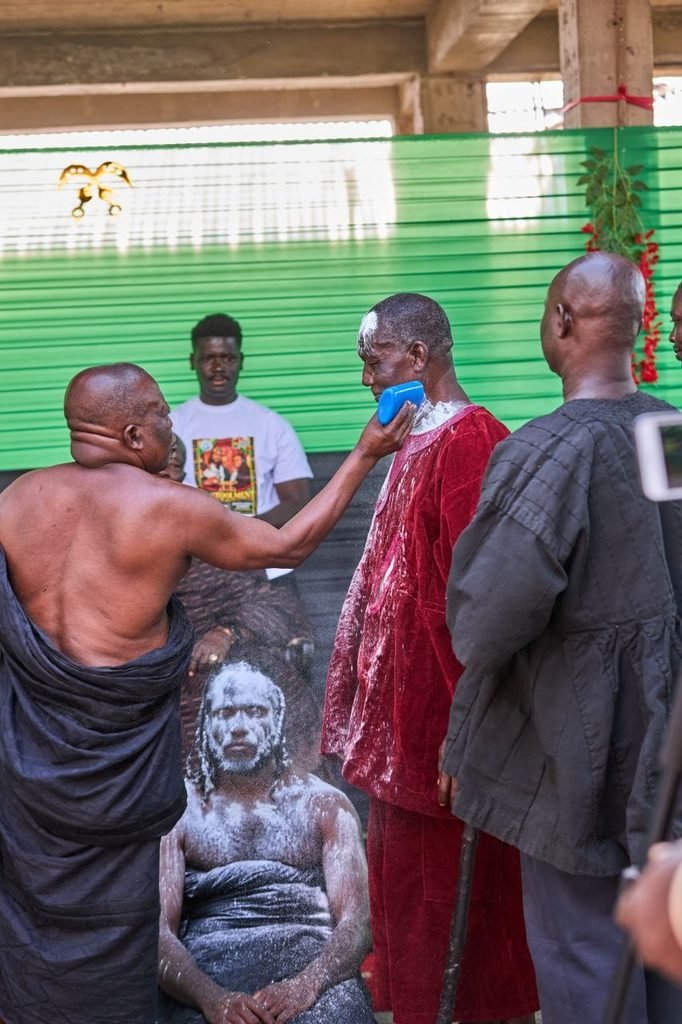
Professor Ọbádélé Kambon, a full Professor of African Linguistics at the University of Ghana, was enstooled as Apagyahene and Sunsum Ɔsahene of Akuapem Mampong in the Eastern Region in a ceremony that brought academia and traditional authority together.
For the professor, the occasion was more than a new title. It was a moment that connected his academic interests in African languages and indigenous knowledge with the living traditions of an Akan community.
The day’s events unfolded through a series of customary observances. Kambon was first taken to the compounds of the Ɔkyeamehene and Gyasehene, where the preparations for his installation continued.
Then came the application of hyire, the white kaolin powder associated with traditional rites.
With the customary proceedings underway, the new chief was lifted onto the shoulders of celebrants and carried along the main thoroughfare of Akuapem Mampong.
The procession transformed the streets into a public stage for a ceremony rooted in the community’s traditional institutions.
There was something striking about the image, a university professor, accustomed to the measured language of academic discourse, being carried through the town in a display of traditional recognition.
Yet the celebration was not complete with the procession.
A ram was sacrificed at the Mamponghene’s compound before Kambon was taken to the palace, to swear the oath associated with his new offices.

The ceremony brought him formally into his roles as Apagyahene and Sunsum Ɔsahene.
Beyond the colourful proceedings, the titles themselves carry layers of historical meaning.
Kambon in his research explores the historical connections between Apagya and Akan political and military organisation.
Accounts cited in his work linked Apagya to an asafo, or military company, while historical writing traces an Apagya stool in Asante to the reign of Opoku Ware I in the eighteenth century.
These historical associations offer a glimpse into the institutions that have shaped Akan society over generations, although they do not automatically define the precise responsibilities of the office in Akuapem Mampong.
Kambon’s own professional life reflects a similar interest in preserving and examining African knowledge.
His work encompasses Akan language structure, naming practices across the Black world, proverbs and indigenous intellectual traditions.
Through Abibitumi, the platform he founded, he also promotes language learning, scholarship and cultural engagement.
But tradition was only one part of the story that day.
When the formal ceremony gave way to a reception, the occasion expanded into a celebration of three milestones: Kambon’s enstoolment, his promotion to full professor and his daughter Ama’s admission to the University of Ghana.
The gathering therefore carried a personal significance that went beyond the honours bestowed on one man. 
It celebrated professional advancement, the continuation of family aspirations and a connection to cultural heritage.
For a father, seeing a daughter gain admission to the same university where he holds a distinguished academic position offered another reason to celebrate.

For the professor, the moment placed family achievement alongside his own professional and traditional milestones.
Kambon had already established a place in the traditional life of Akuapem Mampɔn through an earlier installation as Banmuhene Kyidɔmhene, recorded in 2017.
His latest enstoolment adds another chapter to that relationship.
In Akuapem Mampɔn, the day brought together the university, the palace and the family table in one celebration. And for Kambon, the journey from the lecture room to the traditional procession showed how scholarship, cultural responsibility and family achievement could converge in a single memorable occasion.
By Enoch Ntiamoah Siaw
SKIP THE QUEUE, TAP THE NEWS
You can now read the Ghanaian Times and The Spectator newspapers from the comfort of your device via TimesNewsPlus.
Join our WhatsApp Channel: https://whatsapp.com/channel/0029VbBElzjInlqHhl1aTU27

Intercity STC Coaches Limited has interdicted a driver captured in a viral video allegedly hitting a Sprinter bus during an overtaking manoeuvre at Pokuase before driving away from the scene.
In a public notice, the company described the driver’s conduct as unacceptable, stressing that it did not reflect the safety standards and professionalism it upholds.
Management said it had commenced an immediate investigation into the incident and identified the driver, who has been interdicted pending the outcome of the disciplinary process.
The company added that it was awaiting an official report from the Pokuase Police Command to help establish the facts surrounding the incident.
STC reaffirmed its commitment to passenger safety and responsible road use, while thanking members of the public for bringing the incident to its attention.
Management assured the public that appropriate action would be taken following the investigation.
By: Jacob Aggrey