Hot!
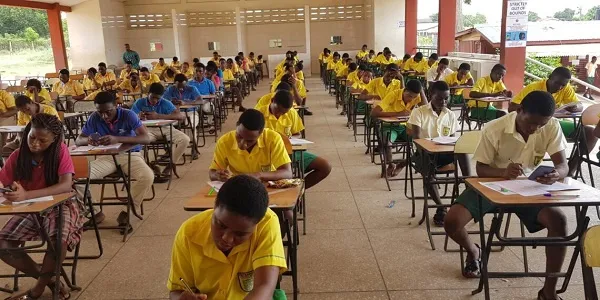
Ghana to write 2022 WASSCE alone

- /home/u249204778/domains/spectator.com.gh/public_html/wp-content/plugins/mvp-social-buttons/mvp-social-buttons.php on line 27
https://spectator.com.gh/wp-content/uploads/2022/07/Students-writing-WASSCE.webp&description=Ghana to write 2022 WASSCE alone', 'pinterestShare', 'width=750,height=350'); return false;" title="Pin This Post">
- Share
- Tweet /home/u249204778/domains/spectator.com.gh/public_html/wp-content/plugins/mvp-social-buttons/mvp-social-buttons.php on line 72
https://spectator.com.gh/wp-content/uploads/2022/07/Students-writing-WASSCE.webp&description=Ghana to write 2022 WASSCE alone', 'pinterestShare', 'width=750,height=350'); return false;" title="Pin This Post">
Only Ghanaian candidates are left to write the West African Senior High School Certificate Examination (WASSCE), scheduled from August 1 to September 27, 2022.
This is because the other four-member countries of the West African Examinations Council (WAEC) — Nigeria, Liberia, Sierra Leone and The Gambia have returned to the May/June calendar and had administered the WASSCE for their school candidates from May 9 to June 24, this year.
The four countries have had their academic calendars streamlined to enable them to write the examination in May/June, as Ghana sticks to the ‘new normal’ calendar occasioned by the COVID-19 pandemic in 2020.
Notwithstanding the late sitting, Ghanaian candidates will still compete for the National Distinction Award and the WAEC Excellence Award with candidates from those countries.
“Our candidates will still compete for the National Distinction Award and the WAEC Excellence Award, which is normally competed for by all candidates in the five-member countries,” the Head of the Ghana National Office of WAEC, Wendy Enyonam Addy-Lamptey, said.
Semester system
In an exclusive interview with the Daily Graphic, Mrs Addy-Lamptey explained that because candidates in the country started their academic year on February 7, this year, as a result of the new semester system, they were unable to subscribe to the examination.
She explained that considering the beginning of the 2022 academic year, the time was too short for the candidates to write the WASSCE in May/June.
“The time was too short and the candidates would not have adequately prepared for the examination and so the Ministry of Education requested that it be conducted for them in August and September 2022.
“Following from that, Ghanaian candidates will write a Ghana-only version of the WASSCE for School Candidates, starting from August 1 and ending on September 27,” she explained.
Caution
Mrs Addy-Lamptey observed that rogue website operators and scammers had already obtained snapshots of past question papers for WASSCE 2022 administered in the other member countries and were using those snapshots to advertise their websites.
“Some have requested candidates to register by paying a fee. We want to inform our publics that the examination being conducted has totally different questions/parallel questions from the papers written in the other member countries,” she emphasised.
The Head of the National Office of WAEC, however, added that the questions would certainly be of the same difficulty level and gave an assurance that “all post-examination arrangements will be handled internationally”.
“For example, the Standard Fixing and Grading Awards meetings will have representatives from the five member countries,” she explained.
Preparation
A total of 422,883 candidates from 977 schools registered for the WASSCE after the extended closing date of April 8, 2022.
The entry figure included 72 candidates with visual impairment, made up of 39 males and 33 females, as well as 14 candidates with hearing impairment.
Mrs Addy-Lamptey explained that 60 subjects, comprising four core and 56 electives, would be administered to prospective candidates.
“In addition to the four core subjects that all candidates write, candidates have the option to select up to a maximum of four elective subjects from the seven programmes offered in senior high schools,” she further explained.
Depots
She explained that the council utilised dedicated facilities (depots) for the storage of confidential materials in the various communities, and gave an assurance that “such facilities have been inspected and the necessary fortification and refurbishment works are being done to ensure that they meet the security requirements”.
“This year, the number of depots has been increased to reduce the time taken in moving the question papers from the depots to the examination centres, pushing the depots closer to the examination centres,” she said.
Source: Graphic.com.gh


General Secretary of the New Patriotic Party (NPP), Justin Kodua Frimpong, has filed his nomination to contest the position of General Secretary again as the party begins its rebuilding efforts ahead of the 2028 general elections.
He was accompanied by party stalwarts and supporters who were in high spirits, expressing confidence that he is the right person to hold the position.
Speaking after filing his nomination, Mr Kodua Frimpong assured the rank and file of the party that he would not disappoint them.
“I can assure you that the faith the rank and file of the party have had in me, I will never disappoint them,” he said.
He also pledged to run a clean campaign devoid of personal attacks.
“I can assure you that our internal campaign will be devoid of personal attacks,” he told his fellow contestants and the rank and file of the party as he seeks to retain his position.
His tenure has seen the party through the 2024 general elections, where the NPP lost power to the National Democratic Congress (NDC) after eight years in government.
The party is currently in a rebuilding phase, with internal elections scheduled to elect new national executives to lead its reorganization towards the 2028 polls.
The General Secretary position is considered one of the most influential in the party’s administrative structure, responsible for the day-to-day running of the party secretariat and implementation of party decisions.
By Edem Mensah-Tsotorme

The University of Ghana Medical Centre (UGMC) has disputed claims made on social media by comedian Michael Blackson concerning the treatment given to his late mother, saying a review found that the allegations did not accurately reflect what happened during her stay at the hospital.
In a statement issued in Accra on August 5, 2026, the management of UGMC expressed condolences to Mr. Blackson and his family over the death of his 83-year-old mother, who died at the facility on July 16, 2026.
The hospital said it had taken the concerns raised by Mr. Blackson seriously and conducted a thorough review in line with its clinical and administrative procedures.
According to the statement, the facts presented by Mr. Blackson on social media contained “numerous inaccuracies” and did not accurately reflect the medical care provided to his mother.
UGMC explained that she was referred to the facility from another hospital and received treatment there from May 27 to July 16, 2026, a period of about eight weeks.
The hospital stated that it would not release details of her diagnosis, treatment, medical records or other aspects of her care because it had a duty to protect patient confidentiality, even after death.
It said the decision was intended to respect the dignity of the deceased and the privacy of her family.
UGMC further stated that all clinical decisions at the facility are made by qualified healthcare professionals based on medical judgment, established standards of care and the best interests of the patient.
The statement added that such decisions are made in consultation with authorised family representatives where necessary and that billing and financial procedures are governed by institutional policies and are separate from clinical decision-making.
The hospital noted that it values feedback from patients and their families and considers both positive and negative comments important for improving the quality of care.
Mr. Blackson had earlier used social media to criticise the care his mother received at UGMC, prompting the hospital’s response.
By: Jacob Aggrey