News
Gender equality in the financial sector…give women the opportunity to thrive


- /home/u249204778/domains/spectator.com.gh/public_html/wp-content/plugins/mvp-social-buttons/mvp-social-buttons.php on line 27
https://spectator.com.gh/wp-content/uploads/2024/01/PHOTO-2024-01-23-12-32-08.jpg&description=Gender equality in the financial sector…give women the opportunity to thrive', 'pinterestShare', 'width=750,height=350'); return false;" title="Pin This Post">
- Share
- Tweet /home/u249204778/domains/spectator.com.gh/public_html/wp-content/plugins/mvp-social-buttons/mvp-social-buttons.php on line 72
https://spectator.com.gh/wp-content/uploads/2024/01/PHOTO-2024-01-23-12-32-08.jpg&description=Gender equality in the financial sector…give women the opportunity to thrive', 'pinterestShare', 'width=750,height=350'); return false;" title="Pin This Post">
Over time, the finance industry has evolved and become more complex, requiring skills beyond physical labor.
However, the perception that finance is a male-dominated field still persists, leading to biases and barriers for women.
One major challenge faced by women in finance is the lack of representation in leadership positions.
Despite the increasing number of women entering the industry, they are often underrepresented in senior roles such as CEOs, board members, and investment managers.
This lack of representation not only limits career advancement opportunities for women but also perpetuates the notion that finance is a male domain.
Another challenge is the gender pay gap. Studies have consistently shown that women in finance earn less than their male counterparts, even in education and experience.
This pay disparity not only affects women’s financial well-being but also contributes to the overall gender wealth gap.
Additionally, women in finance often face biases and stereotypes that can hinder their professional growth.
They may be perceived as less competent or less committed to their careers due to societal expectations around caregiving and family responsibilities. These biases can result in missed opportunities for promotions, mentorship, and networking, further limiting women’s progress in the industry.
The finance industry for centuries has a reputation for long working hours and a demanding work culture. This can create challenges for women who may face additional responsibilities outside of work, such as childcare or eldercare. The lack of flexibility and support in balancing work and personal life can make it difficult for women to thrive in finance.
As highlighted by the World Economic Forum’s Global Gender Gap Report, despite the banking and financial sector experiencing significant growth, women continue to be an underutilised resource.
Unlike their male counterparts, women often encounter unique circumstances, such as maternity leave, which may necessitate a temporary break in their careers. Surprisingly, certain employers overlook the valuable contributions that women can make in finance.
Interestingly, some employers, particularly men uses this as a point to disadvantage a woman for occupying the top spot in some working places.
Another study by The Forté Foundation, a non-profit consortium of top business schools, shows that although gender equality is increasing in business schools, the number of MBA applications is not increasing at the same rate.
The study found that the number of women enrolled in business schools has increased by over 60 per cent for the past five years, yet female MBAs seem to be decreasing every year. For instance, in 2018, they fell by 7per cent, while in 2019, they decreased by 9 per cent.
To address these challenges, efforts are being made to promote gender diversity and inclusion in the finance industry.
Companies are implementing policies and initiatives to support women’s career development, such as mentorship programmes, flexible work arrangements, and diversity training.
Additionally, organisations and industry associations are advocating for equal pay and promoting women’s leadership in finance.
Despite all the challenges women face in the financial sector, a few have overcome the obstacles to show society that women are capable of achieving greater heights when given the opportunity and not discriminated. Until recently, the CEO of banks were dominantly males.
It was very encouraging when the former CEO of UBA Ghana, Abiola Bawua assumed the position. It was even more refreshing when Patience Akyianu was announced CEO of former Barclays Bank Ghana until she left.
Currently, the financial sector can boast of Mansa Nettey, CEO of Standard Chartered Ghana; Abena Osei-Poku, CEO of Absa Bank Ghana. More refreshing, the financial sector has seen hardworking women occupying key positions such as the Deputy Managing Director of the Ghana Stock Exchange, Abena Amoah; and Rev. Mrs. Patricia Sappor, the President of the Chartered Institute of Bankers (CIB), to name a few.
In an interview with the Regional Lead, Policy and Insights- India & Africa at the Association of Chartered Certified Accountants (ACCA) Evelyn Isioye, she urged female leaders to provide opportunity for younger women to occupy key roles in the financial sector.
“Perhaps, successful women in the banking and financial sector should mentor young females in the sector to boost their confidence in order to change the narrative.
“To make this work, we must begin to unlearn the old traditional views that suggest that women do not have a place in the world of finances. We need to understand and relearn the fact that women have a better place in the financial ecosystem system hence must be given the opportunity to be mentored” she stated.
That according to her would not just empower them but create a collective strength that can help overcome barriers such as balance work and family Life, as well as promote gender equality.
Recounting her journey in the Financial and Accounting Profession sector, Madam Isioye stated that she had always liked numbers and initially wanted to become an engineer but later veered into accounting out of curiosity.
“I enrolled for a diploma course in accounting to keep me busy while I sought admission into an engineering programme at the university. I was only halfway through the programme at the University of Abuja, when I decided I was going to pursue accounting full time. So for the first time in 2018, I applied and sat for both the joint matriculation and university aptitude exams to enroll for an accounting degree at Covenant University. I went on to get chartered in 2012 and became a fellow of the Institute of Chartered Accountants of Nigeria in 2022” she stated.
Ms Isioye said she was fortunate to have started early in career in order to make way for some of the barriers however showing appreciation to ACCA for the incredible opportunity offered her to contribute to the development of the accountancy profession across Africa and beyond.
She said Africa Member Convention(AMC) organised by her outfit was around empowering finance professionals for sustainable development and one of the key areas of focus under this, was how finance professionals can lead organisations towards diversity & inclusion, achieving gender equity and equal opportunity.
She said her role as regional lead of policy and insights for India & Africa, gives her the opportunity of developing and applying ACCA’s wealth of research insights, in contributing to the development of the accountancy profession across these regions.
“Also, it gives me the opportunity to interact with colleagues and key stakeholders in the region including governments, educational institutions, and professional accountancy organisations, to build the capacity of professionals through research insights, consult on topical policy issues in the industry and manage the contribution of regional insights to global research development” she added.
She advised, women in the financial space to be bold and also avail themselves to successful females in the sector to guide and mentor them saying having more women in the drive for financial inclusion will be a great catalyst to encourage them climb up the financial ladder.
“As we mark International Women’s Day soon, let us make it an important day of encouraging women to explore the banking and the financial space. Women have made significant progress in the labor market over the past few decades, however, they are still woefully underrepresented in finance” she stated.
Ms Isioye recommended that to increase the number of women in finance, organisations must create a welcoming, friendly and supportive environment for women adding that they also need to develop programmes that would help women advance their careers.
‘While women in finance continue to face challenges, progress is being made towards achieving gender equality in the industry by addressing gender bias, promoting diversity and inclusion, and providing support and opportunities for women’s advancement, finance firms can create an environment that empowers women to thrive.
It is crucial for industry as a whole to recognise the immense value that women bring to financial sector and work towards breaking down barriers, ensuring equal opportunities for all” she added.
BY BENEDICTA GYIMAAH FOLLEY


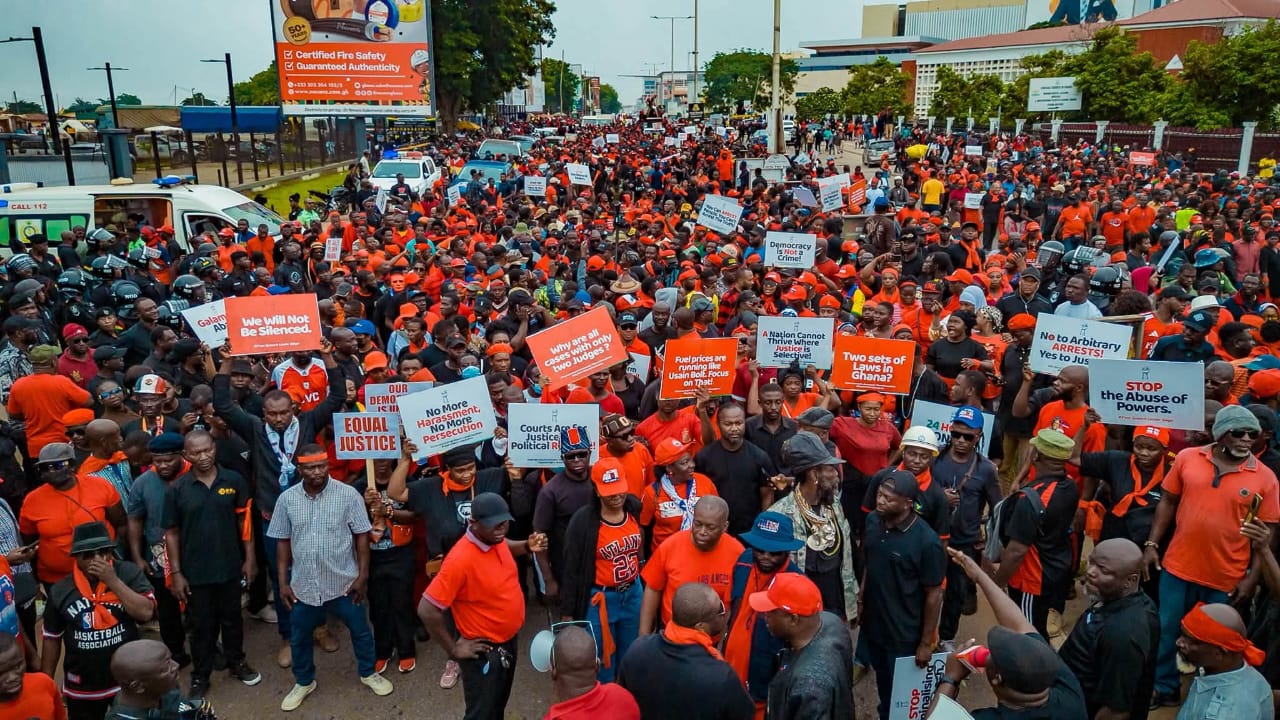
The New Patriotic Party (NPP) on Wednesday, August 6, 2026, staged a massive nationwide protest in Accra dubbed “Democracy Under Attack” to register its displeasure over what it describes as threats to Ghana’s democratic governance and justice system.
The demonstration commenced at 5:00 a.m., with hundreds of party supporters, executives and sympathizers gathering at the forecourt of the Supreme Court before marching through principal streets of the capital.
Ahead of the protest, the NPP National Steering Committee directed Regional, Constituency and Polling Station Executives in Greater Accra to work closely to mobilize members and supporters for the event.
Led by General Secretary Justin Kodua Frimpong, the protesters presented their first petition at the Supreme Court.
The five-page petition was received by Judicial Secretary, Musah Ahmed, on behalf of the Chief Justice.
He assured the party leadership that the document would be delivered to the Chief Justice.
At the Jubilee House, Presidential Staffer Nana Yaa Jantuah received the second petition on behalf of the President.
However, the gesture did not sit well with some party leaders.
Majority Leader, Alexander Afenyo-Markin, who also presented a petition, expressed disappointment at the government’s representation.
“Electing only Nana Yaa Jantuah to receive the petition on behalf of the government was an insult and did not show respect,” he said.
According to him, “It meant government did not place premium on the Democracy Under Attack demonstration.”
Speeches and Concerns Raised
Addressing the crowd, MP for Akuapem North, Sammy Awuku criticized what he called the criminalization of free speech.
“Arresting citizens for just insults doesn’t strengthen Ghana’s democracy,” he stated.
Dennis Miracles Aboagye, an embattled National Communications Director hopeful, also spoke about the climate of fear.
“Democracy under attack demo: I love to speak but right now I am afraid,” he told journalists.
One protester, a local trader, shared her frustration about the state of Ghana’s economy as she joined the march. She said the rising cost of living and governance issues compelled her to hit the streets.
The NPP leadership expressed appreciation to its members, civil society organizations and other political parties for cooperating fully to ensure a successful and peaceful event.
The “Democracy Under Attack” demonstration forms part of the party’s response to concerns it has raised over issues relating to Ghana’s democratic governance, rule of law and the justice system.
Security was tight but calm throughout the march, with no major incidents reported.
By Edem Mensah-Tsotorme

The Ghana Airports Company Limited (GACL) has announced new measures to stop extortion and begging by airport personnel at airports under its management.
The decision was taken at a high-level stakeholder facilitation meeting held in Accra on Wednesday, August 5, 2026.
In a press statement issued after the meeting, GACL said stakeholders agreed to introduce a “mystery shopping” system in which individuals would secretly assess the conduct of airport personnel.
According to the statement, workers found engaging in extortion would be publicly identified through appropriate media channels as part of a “name and shame” campaign aimed at discouraging the practice and promoting accountability.
GACL said staff found guilty would face disciplinary action and would no longer be allowed to work at any airport or within its surroundings.
The company also announced a dedicated hotline, 0542175636, through which passengers can report extortion by airport officials and service providers by phone call, WhatsApp or SMS.
The statement said reports should include the date and time of the incident, the name of the officer, the agency involved and the location where the incident occurred.
GACL said the hotline covers personnel from several agencies and companies operating at the airports, including the Ghana Immigration Service, Customs, the Ghana Civil Aviation Authority, the Ghana Police Service, National Security, airlines, ground handling companies, private security firms and airport concessionaires such as shops and restaurants.
The company reminded passengers that they have the right to ask any airport official to show an Airport Identification Card before dealing with them.
It advised travellers to request receipts for all payments made at the airport and to report any suspicious transaction through the hotline.
GACL said it was working together with airport stakeholders to improve standards at the airports and protect Ghana’s image.
The company added that public cooperation in reporting unacceptable conduct would help strengthen confidence in the country’s airports and support efforts to position Ghana as a
leading aviation hub in West Africa.
By: Jacob Aggrey