Features
Farewell to a stalwart: The life story of a great student leader and activist Kenneth Yirenkyi Darko (Ojukwu)

Introduction
IN the annals of Ghana’s history, there are individuals whose contributions shape the nation’s trajectory, often without seeking the limelight. Kenneth Yirenkyi Darko, affectionately known as Ojukwu, was one such unsung hero whose deep desire for a just and equitable democratic society propelled him into heroic leadership, a journey that nearly cost him his life at the University of Ghana campus in early 1978. Born on September 24, 1950, to a renowned Educationist and author, Mr Daniel Offei Darko and Madam Comfort Ama Adubea Akoto, a Baker, in Aye-Kokooso near Suhum, Kenneth became a leader in the University of Ghana’s student community and a prominent figure in Ghanaian student activism. He and his contemporaries played significant roles in shaping students’ governance and activism in Ghana in the mid 1970’s. Kenneth’s life was a testament to his unwavering commitment to justice, equality, and education.
Secondary, Teacher
training education and
early career as a teacher
Kenneth’s academic journey began at Osino Presbyterian Primary School in 1956, where his exceptional command of English, fostered by his father’s private tutoring, set him apart from his peers. He later attended the Presbyterian Training College Demonstration Primary school at Akropong-Akuapem and had his Middle school education at Awisa Presbyterian Middle Boys Boarding School, where he excelled academically and developed a passion for sports. His academic prowess earned him admission to the prestigious Presbyterian Boys’ Secondary School (PRESEC) in Odumase-Krobo in 1963.
At PRESEC, Kenneth’s charisma and oratory skills began to shine. He was an independent thinker, unafraid to challenge the status quo, and his exceptional performance during a school gathering, where he recited a poem entitled “Death, Thou Shall Die,” left a lasting impression on his schoolmates. He completed his ‘O’ Level in General Arts in 1968 with distinction. He was a proud member of Odadee 1968.
Following in his father’s footsteps, he trained as a teacher at the Presbyterian Training College at Akropong-Akuapem from 1968 to 1970. After graduating as a Certificate ‘A’ Post-Secondary teacher, he was posted to his alma mater, Awisa Presbyterian Middle Boys School in September 1970.
He was assigned as the Middle Form 4 Teacher. He worked very hard as a class teacher and his students passed the Form 4 final examinations with Distinction. In 1972, having heard of Kenneth’s teaching prowess, one of his mentors, the late revered Headmaster of Adonten Secondary School, Mr. Primrose Victor Akoto, requested Kwasi’s transfer to teach English, Twi, and Economics at Adonten Secondary school. During this period, he studied and passed his ‘A’ Level exams as a private candidate, gaining admission to the University of Ghana, Legon, to study English Language, Linguistics, and Kiswahili in 1973/74 academic year. From 1976/77 academic year to 1978/79 academic year, there were several students’ riots which led to the closure of universities in Ghana. Whilst at home, he applied for a teaching position at the Presbyterian Training College, Akropong-Akuapem and was assigned to teach English language in June 1977.
Student activism
and leadership
Kenneth’s university days at the University of Ghana, Legon, marked the beginning of his journey as a student activist and leader. He evolved into one of the most charismatic and revolutionary student leaders in Ghana’s history.
He became known for his fiery speeches, insightful analysis, and galvanising presence. As a leader of the ‘Students Action Group’, he mobilised students to push back against government mismanagement and advocate for reforms.
Some of the notable students’ riots he and his team championed had positive outcomes such as the transition from students’ allowance dubbed: ‘Millions’ to the Pay As You Eat’ (PAYE),’ which later evolved into the Students’ Loan scheme.
Some of his contemporaries were Kofi Totobi Quakyi, The Ahwoi brothers, D.K. Osei, Addo Kuffour, Akwasi Sarpong, Akrasi Sarpong, Akwasi Owusu Acheampong and others who played significant roles in shaping student governance and activism in Ghana.
Disaster strikes
Ojukwu at Legon
The students’ agitations on the various campuses of Ghana universities which started on May 13, 1977 and was dubbed: ‘ALUTA CONTINUA’ kept running through to the greater part of 1978. On January 13, 1978, during a protest against the Supreme Military Council (SMC) regime, disaster struck as security forces stormed the campus.
Despite Ojukwu’s surrender, waving a white cloth, he was brutally beaten, leaving his skull fractured. He was so much brutalised by the forces to the extent that they beat him and left on the floor when they thought he had died but the Mighty hand of God brought him back to life.
The serious brutalities he suffered and the accompanied trauma and challenges caused some irreparable damage to his being which sometimes impacted on his emotional wellbeing. However, in the subsequent years, he made light and humor out of his situation and lived to a ripe age of 74 years, to the Glory of God. His blood-soaked jeans jacket, saved by his father, later became infested with maggots, a grim reminder of that violent day.
Aftermath of the
brutalities
Due to threats from Military Intelligence, he was treated discreetly by herbalists till he was able to walk properly and later sent to Togo for political asylum. He returned to Ghana after the removal of General Kutu Acheampong from the SMC through a Palace Coup. From June 4, 1979 and again December 31, 1981 when Flt. Lt. J.J. Rawlings came to power, sadly, his health had deteriorated, and whilst most of his contemporaries had opportunities to serve their country in various political positions, his condition kept him on the margins. In the opinion of many, Kenneth Yirenkyi Darko (Ojukwu) was one of the unsung heroes of Ghana students’ governance and activism. He prematurely used his life for the good of Ghana while pursuing his mission for fairness, equality and justice. Despite personal struggles and battles with life, Ojukwu’s spirit remained unbroken. He thrived and found strength to teach and serve in the Ghana Education Service until his retirement in September 2010.
Legacy
After his retirement in September 2010, he lived at Akropong-Akuapem where he enjoyed farming at Bom and teaching the children and youth in his neighborhood for free. People engaged him in political discussions and would consult him on matters of politics. He loved to read and spent time proof-reading and editing scripts/manuscripts for people. His rediscovery of faith at the terminal end of his life brought him peace, and he remained a man of the people, humorous, kind-hearted, and deeply connected to the downtrodden.
Kenneth Yirenkyi Darko’s life was a testament to his dedication to fighting for what is right. His legacy as a champion of the people’s cause has endured, and his impact on Ghana’s student governance and activism remains significant. As a teacher, he inspired countless students with his passion for education and his commitment to excellence. His love for the Queen’s language and his insistence on standard pronunciation earned him a reputation as a great phonetician.
Tribute
Kenneth Yirenkyi Darko’s passing on February 20, 2025, marked the end of an era. His siblings, friends, former classmates and graduates from the country’s universities in the 70’s remember him as a gentle force, a fearless revolutionary, and a committed advocate for justice and equality. His legacy continues to inspire future generations to stand tall, speak out, and fight for a fairer and a kinder world. As his friend and classmate at PRESEC, Dr Stephen Ampofo, a US based Pharmaceutical Scientist aptly put it, “Darko Yirenkyi lived and pursued fairness wherever he found himself. He dedicated his life to fighting the wrongs not only within the walls of his academic institutions but throughout the country where the impact of his crusade was felt and reverberated.” Kenneth Yirenkyi Darko’s life will forever be etched in the annals of Ghana’s history as a testament to the power of conviction, courage, and compassion.
Farewell to a stalwart
Kenneth Yirenkyi Darko, Ojukwu, Comrade. A gentle force. A fearless revolutionary. A committed Advocate and Activist. A Legendary Philosopher. A humble intellectual whose brilliance lit the path for many. He had a dream for a dignified, a just and a fraternal world and worked for justice and harmony. He fought with every ounce of his being for a just egalitarian society. His life is a testament of great sacrifice of not seeking personal comfort for himself but fairness for all. He bravely walked this earth, embracing everyone as a brother. To him, everyone was a Comrade. He lit up the lives of many with hope and towed a path of simplicity. Though he endured great pain, his legacy of courage, truth, and justice lives on. Indeed, we have lost a great kinsman and a rare gem.
He will forever be remembered, not only in our hearts, but through memory activism, in defense of the Constitution, in service to the nation and in the ongoing quest for sustainable positive change and resettling the agenda for our beloved country.
May his soul rest in perfect peace of the Lord.
By: Dr (Mrs) Mercy Oforiwa Darko-Ankrah
Email: ofoankrah@gmail.com

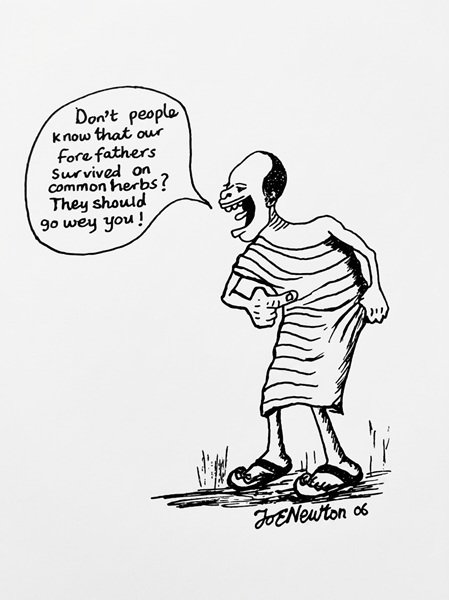
THE typical itinerant salesman in Sikaman is a herbalist. He is normally a slim macho with the capacity to perambulate the expanse of area covering the triangle of Accra-Tema-Ashiaman. In short, he can walk a total of 60 miles a day, marketing a product that cures every disease, including poverty. 
The door-to-door herbal pharmacist advertises his product by word of mouth. He has nothing to do with the Food and Drugs Board (FDB). After all, his concoctions do not feature on FM stations.
Those herbalists who cannot walk to propagate the herbal gospel, liaise with drivers of mass transportation and their mates. They are, therefore, given the chance to sell their products on Benz buses that ply the routes.
Normally, the herbalist starts his sales message with a prayer and Bible study. He asks the passengers to bow down their heads in supplication to God the father, the son, the Holy Spirit.
When a herbalist asks the passengers to close their eyes and bow their heads, Moslems on board naturally feel offended. They feel that the herbalist has no right to assume that every passenger is a Christian. They think such an assumption is an affront to Islam.
So a Moslem on board will raise the hand for a point of order. He’ll remind the herbalist that it would be in his own interest to mind his language.
“Be careful the way you address people in a public place. Not every person here is a Christian,” he’d state assertively.
Of course, the herbalist will promptly ignore him, but would all the same “watch” his tongue. Who knows whether or not the Moslem brother is inspired by Quoranic zeal to defend the tenets of Islam to the hilt?
When he starts saying, “Wallahi!” and “Inshallah!” it could be the beginning of proclaiming Islam as supreme, a point which must be driven home with talibanic precision.
So the herbalist must tread carefully lest he steps on fire.
The herbalist could even add a measure of mirth to it all, by announcing that Christians on board today have very interesting company on the journey, but that should not detract from the business of the day.
The Moslem brother will weigh the words carefully and offer a wry smile.
He must be careful the occasion does not degenerate into the use of semantics and proverbial oration to deride his conviction that public utterances must be mindful of religious sensibilities. He has made his point very clear and expects that it is taken in good faith in the interest of a peaceful journey.
The herbalist will now open the New Testament and preach salvation, stating clearly that salvation can come only through Jesus Christ and NOBODY else.
The Moslem brother will now start twitching his moustache. The visible and almost revolutionary reflexes of his upper lip can be an indication that sentiments have begun superseding reason, and the outcome could well be tragic now shift uneasily in his seat.
The time has come for him to also express his right to the religion of his fore-bears. He’ll put his hand into his pocket and rise to his feet. The time has indeed come!
This article was first published on Saturday, September 9, 2006
When the cause of a particular problem like sickness, disease, sudden illness, a social issue etc. are not known, it stands to reason that resolving it becomes a huge challenge.
Citizens would understand the government when public announcements are made to the effect that government is trying to find a solution to the issue, even though it is taking a while for it to be resolved because citizens are rational beings.
On the other hand, if the solution to a particular issue is known to everybody but the government for whatever reason, is dragging its feet in resolving it, citizens become frustrated and begin to lose trust in their leaders.
One such issue is the heavy traffic along a section of the Kasoa – Odokor road. A short stretch of bad road between the traffic light at the Weija Government Hospital and the entrance to the entrance of the overhead that leads to the N1, is the cause of the problem but nothing is being done about it, day after day, week after week, month after month. Thus is clearly unacceptable.
Another issue that requires urgent attention is the lack of pavements along a lot of streets in parts of the various Municipal Assemblies. Exercise is a prerequisite for long life and healthy living and for those of us who it has become a way of life, this issue of people putting up structures right to the edge of the drains beside the roads, are making life difficult for us.
We are compelled to walk along the roads, putting our lives at serious risk. Pedestrians should never be compelled to compete with vehicles on our streets and roads. Roads and streets are made for vehicles and pavements are made for pedestrians. That is the norm. Any attempt to normalise a situation where pedestrians are mingling with vehicles is insanity.
It is the road regulations that makes it so and therefore district or municipal assemblies are to take responsibility and ensure that spaces for pavements are not encroached upon. Citizens have rights that must be protected by their leaders and making pavements available to pedestrians, is one of them.
When we hear of teachers having sex with students, it appears it is something recent. It is not a new phenomenon. It has been there since Adam. Perhaps this issue is getting much attention due to the proliferation of social media. It was an open secret in times past when Teachers were in relationships with female students and some married them immediately after completion of school.
Some teachers were also known to be having unholy interactions with female pupils but due to the times that these acts occurred, human rights issues and the awareness around it, allowed such unscrupulous teachers to get away with their crimes.
Now we are in a different era and so a Headmaster is now in hot waters. He is alleged to have raped about 19 female students and as usual, some officials tried to cover it up and are also in hot waters and their actions or inactions in the matter are under investigation.
Why the man has been allowed to roam freely without being arrested is simply mind boggling. It appears that the law applies differently, depending on who you are. This issue came to public attention sometime in August this year, yet the police had not arrested or invited this man for question regarding the rape allegation.
It has come out that he is a Constituency Secretary of the ruling party and the question in the public domain is that, is it because he is a political figure that is why he is still walking around without questioning? I believe in the rule of law so let us hold our breadth and let the proper thing be done.
The police must however be seen to be active in this matter. God bless.
SKIP THE QUEUE, TAP THE NEWS
You can now read the Ghanaian Times and The Spectator newspapers from the comfort of your device via TimesNewsPlus.
Join our WhatsApp Channel: https://whatsapp.com/channel/0029VbBElzjInlqHhl1aTU27