Features
Environmental stewardship is an act of worship: The Islamic response to climate change, environmental degradation (Part 5)

Waste management and public cleanliness
Closely connected to water conservation is the Islamic emphasis on cleanliness. The Prophet Muhammad (peace be upon him) taught that “Purity is half of faith” (Sahih Muslim, Hadith 223). Although this Hadith primarily refers to personal and spiritual cleanliness, its broader implications extend to the cleanliness of homes, neighbourhoods, markets, roads, and public spaces. A clean environment reflects both personal discipline and collective responsibility.
Unfortunately, indiscriminate disposal of refuse remains a significant challenge in many communities. Plastic waste clogs drainage systems, contributes to flooding during the rainy season, pollutes rivers and beaches, and threatens marine ecosystems. Open burning of waste further degrades air quality and poses serious health risks, particularly for children and the elderly (UNEP, 2024).
Islam calls believers to eliminate harm wherever it exists. The Prophet Muhammad (peace be upon him) said, “Removing harmful things from the road is an act of charity” (Sahih al-Bukhari, Hadith 2989; Sahih Muslim, Hadith 1009). This teaching encourages Muslims to view environmental cleanliness as an act of service to society. Proper waste disposal, recycling, community clean-up campaigns, and responsible sanitation practices are therefore practical expressions of Islamic charity and civic responsibility. Mosques can play an exemplary role by maintaining clean premises, minimising plastic waste during religious programmes, promoting reusable materials where practical, and educating congregants on environmental sanitation. Such initiatives demonstrate that environmental ethics are inseparable from Islamic values.
Sustainable development and the ethics of moderation
The modern concept of sustainable development seeks to meet present needs without compromising the ability of future generations to meet their own needs (World Commission on Environment and Development, 1987). Although this terminology is contemporary, its underlying principles have long been embedded in Islamic teachings.
The Qur’an consistently promotes moderation and warns against excess. Allah commands, “Eat and drink, but be not excessive. Indeed, He likes not those who commit excess” (Qur’an 7:31, Sahih International). Extravagance, wastefulness, and irresponsible consumption contribute significantly to environmental degradation by accelerating resource depletion, increasing pollution, and generating unnecessary waste. Islam, therefore, encourages a lifestyle characterised
by moderation (wasatiyyah), gratitude, and responsible consumption.
Similarly, the Qur’an describes the universe as having been created in perfect balance and instructs humanity not to disturb that balance (Qur’an 55:7–9). Sustainable development, viewed through an Islamic lens, is not solely about economic growth; it is about ensuring that economic progress, social wellbeing, and environmental protection advance together in harmony. Development that
enriches one generation while impoverishing the next contradicts the ethical principles of justice and stewardship emphasised throughout the Qur’an.
For Ghana, sustainable development requires integrating environmental protection into national planning, mining, agriculture, infrastructure development, and industrialisation. It also demands greater investment in renewable energy, climate-resilient agriculture, responsible land management, afforestation, and environmental education. These initiatives are consistent not only with international commitments such as the United Nations Sustainable Development Goals (particularly Goals 6, 12, 13, and 15) but also with the Islamic principles of stewardship, justice, moderation, and public welfare.
Ultimately, water conservation, responsible waste management, and sustainable development are not separate environmental agendas; they are practical manifestations of humanity’s role as Khalifah. Every drop of water conserved, every piece of waste properly managed, every tree planted, and every effort to promote sustainable living reflects obedience to Allah and contributes to the preservation of His creation. In this way, ordinary environmental actions become
extraordinary acts of worship, demonstrating that faith is expressed not only through ritual devotion but also through responsible care for the world that Allah has entrusted to humankind.
Aligning Islamic environmental ethics with the sustainable development goals
The environmental values espoused by Islam closely align with the United Nations Sustainable Development Goals (SDGs), demonstrating that Islamic principles continue to provide practical guidance for addressing contemporary global challenges. While the SDGs were adopted in 2015 as an international framework for sustainable development, many of their underlying values have been embedded in Islamic teachings for over 14 centuries.
For example, the Islamic emphasis on protecting water resources directly supports Sustainable Development Goal 6 (Clean Water and Sanitation), which seeks to ensure the availability and sustainable management of water for all. Likewise, the Qur’anic prohibition against wastefulness and extravagance complements SDG 12 (Responsible Consumption and Production) by encouraging moderation, efficient resource use, and environmental responsibility.
Islam’s call to preserve ecological balance and prevent corruption on earth resonates strongly with SDG 13 (Climate Action), which urges coordinated efforts to combat climate change and build resilience against its impacts. Similarly, the obligation to protect forests, wildlife and biodiversity reflects the aspirations of SDG 15 (Life on Land), which promotes the conservation, restoration and sustainable use of terrestrial ecosystems.
This convergence illustrates that environmental stewardship is both a religious obligation and a global development priority. Muslims therefore have an opportunity to contribute meaningfully to national and international sustainability efforts while remaining faithful to the ethical teachings of the Qur’an and the Sunnah. Protecting Allah’s creation simultaneously fulfils the objectives of
Islamic law and advances the broader pursuit of sustainable and inclusive development.
The author is Chief Imam of Katamanso Municipal and Certified Counsellor and Governnace Expert.
SKIP THE QUEUE, TAP THE NEWS
You can now read the Ghanaian Times and The Spectator newspapers from the comfort of your device via TimesNewsPlus.
Join our WhatsApp Channel: https://whatsapp.com/channel/0029VbBElzjInlqHhl1aTU27

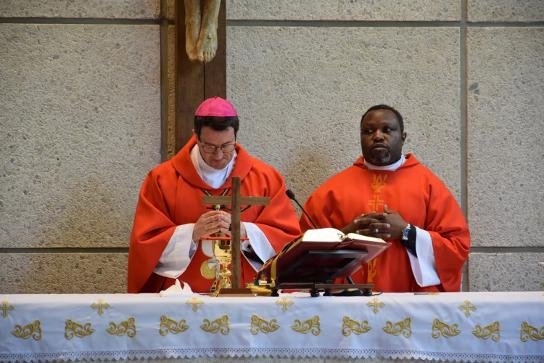
On Sunday, October 11, 2026, it was the turn of Ghanaian Catholics in Finland to lead the singing in the church service of the African Catholic Chaplaincy in Finland (ACCF).
It was indeed a spirit-filled feeling for worshippers present. And for the Ghanaian migrants, the occasion also brought back to them memories of church services in their home country, Ghana.
The ACCF has a roster for each country/community to sing from time to time. Next Sunday will be the turn of the Nigerian community. Other communities that usually sing are the Kenyan/Tanzanian community, the Cameroonian, the Ugandan, group, etc.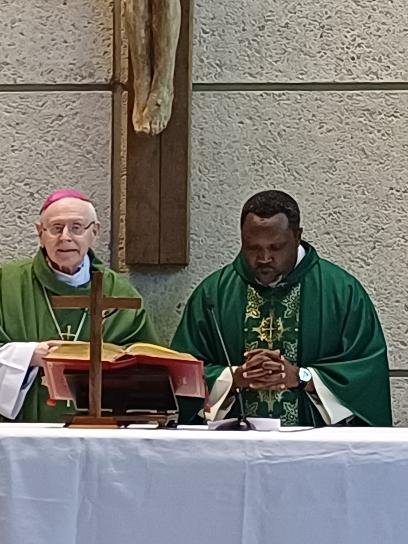
A powerful religious experience
The mass services of the Chaplaincy usually give a powerful religious experience and a display of cultural diversity, especially in occasions such as when the Bishop of Helsinki, Bishop Raimo Goyarrola, celebrated mass with the Chaplaincy on Pentecost Day, May 24, 2026.
There was a similar time of spiritual joy last month (September 27, 2026) when Emeritus Bishop Teemu Sippo, former Bishop of Helsinki, visited the Chaplaincy. Bishop Teemu was the main celebrant, assisted by the Chaplain, Reverend Father Thomas Otieno.
Last Sunday, Reverend Father Bernard Sor, a Ghanaian Catholic priest based in Austria, was the main celebrant in the mass service where he performed a rite of baptism. Fr Bernard had celebrated mass a few months ago when he visited his sister and her husband in Helsinki. 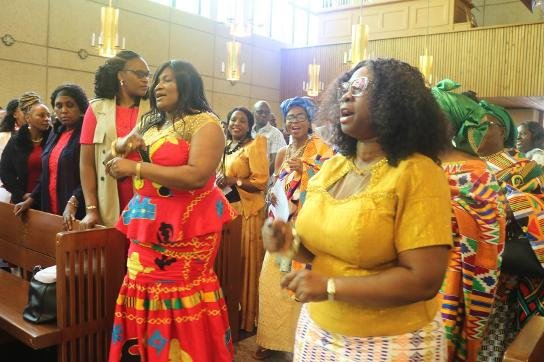
All these well-attended religious occasions indeed leave lasting memories. The homilies (peaching) by the priests usually emphasize religious tenets such as the importance of loving and serving God in truth, existing in peace with our fellow humans to promote unity in diversity, etc.
Unity in diversity and a colourful display of cultures
The African Chaplaincy church services usually produce impressive displays of diverse cultures from different parts of Africa and elsewhere. The events are often spiced by rich cultural displays of dances and colourful attires which are a delight to watch.
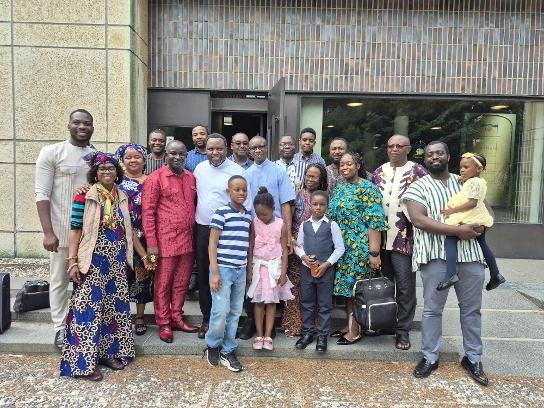
On special occasions, members of the Ghanaian Catholic community, in their gay and colourful kente attire and with adowa dance and music, usually lead the procession into the church. Other communities such as the Cameroonian, Nigerian, Kenyan and Tanzanian as well as Sudanese/South Sudanese groups also put up well-choreographed performances from their cultures.
The African Catholic Chaplaincy in Finland
The African Chaplaincy was founded on June 4, 2017, which was a Pentecost Sunday, in a Pontifical High Mass celebrated by Monsignor Emeritus Sippo S.C.I., the then Bishop of Helsinki, at the St. Mary’s Catholic Parish Church in Helsinki.
The Chaplaincy was created by Bishop Teemu in collaboration with the Diocesan body when they detected a great flocking of African immigrants to Finland, the majority of whom were Catholics. This was to give the immigrants a possibility to integrate into the Finnish society by worshiping as Catholics and in their African cultural identity.
The responsibility of the Chaplaincy was given by Bishop Teemu to Father Dr Leonard Wobilla Shwei, who is thus the first Chaplain and ably led the Chaplaincy. He was succeeded a few years ago by Father Thomas Otieno, who continues to move the Chaplaincy forward. Thank you!
GHANA MATTERS column appears fortnightly. Written in simple, layman’s terms, it concentrates on matters about Ghana and beyond. It focuses on everyday life issues relating to the social, cultural, economic, religious, political, health, sports, youth, gender, etc. It strives to remind us all that Ghana comes first. The column also takes a candid look at the meanings and repercussions of our actions, especially those things we take for granted or even ignore. There are key Ghanaian values we should uphold rather than disregard with impunity. We should not overlook the obvious. We need to search for the hidden or deeply embedded values and try to project them.
With Dr Perpetual Crentsil
SKIP THE QUEUE, TAP THE NEWS
You can now read the Ghanaian Times and The Spectator newspapers from the comfort of your device via TimesNewsPlus.
Join our WhatsApp Channel: https://whatsapp.com/channel/0029VbBElzjInlqHhl1aTU27
She did not find out he was cheating. She found out he was drowning.
It was two weeks after their beautiful wedding. The jollof was still in the fridge. A loan officer called her number-not his-and politely asked, “Madam, please tell your husband to pay his overdue loan. We have been calling him.”
That was how she discovered her new husband had entered their marriage with a hidden debt of over GH¢ 40,000. No cheating. No other woman. Just a financial secret.
And that is how many Ghanaian marriages begin to die. Not with a shout, but with a secret alert on a phone.
We prepare for the wedding. We do not prepare for the wallet.
What is money honesty?
Let me define it simply. Money honesty is not that you both earn the same. It is that you both know the same. It is the ability to sit down and say without fear:
“This is how much I earn.”
“This is how much I owe.”
“This is how I was raised to see money.”
“This is what scares me about money.”
Financial transparency is not about control. It is about clarity. You cannot build trust on top of secrets.
Many couples tell me, “Counsellor, we love each other, love will handle money.” I always answer, “Love is the car, but money honesty is the fuel. Love without honesty cannot move.”
How To Buy Your Marriage Insurance Today – My 5-Step Protocol
If you are engaged, newly married, or even 20 years in marriage, you can still fix this. At Counsellor Prince & Associates Consult—CPAC, this is what I give couples:
Step 1: The 90-Minute Money Naked Session.
No phones, no blame. Each partner writes down on paper: Monthly income, monthly debts, monthly family obligations, savings, and your biggest money fear. Then you exchange papers. Read it. Don’t react for 24 hours. Just absorb.
Step 2: Create OUR Money, YOUR Money, My Money.
You need three pots. OUR money for rent, food, school fees, utilities, properties, and the like— joint contribution. YOUR money and MY money—a small agreed allowance no one questions. This stops the feeling of being controlled.
Step 3: The No-Secret Debt Rule.
Agree from today: No new loan, no new hire purchase, no new family financial commitment above GHS 500 without telling each other first. Not permission, but information.
Step 4: Talk About Your Money Personality.
Are you a Spender or a Saver? Are you Risky or Safe? Most Ghanaian marriages are a Spender married to a Saver. Neither is wrong. But if you don’t understand your partner’s personality, you will call his saving “stinginess” and her spending “wastefulness.”
Step 5: Do a Monthly 30-Minute Money Date
Not an argument date. Light, with tea. “How did we do this month? What worried you? What should we plan for next month?” Couples who do this divorce far less.
My Final Word
Before you say “I Do” at the altar, have pre-marital counselling and also have the money talk on the sofa.
Ask your partner:
“If I lost my job today, how long can we survive?”
“What debt are you bringing into this marriage?”
“How much do you send to your family monthly and will that continue?”
If he or she gets angry that you asked, don’t get married yet. A person who is angry about accountability will be abusive about money.
Marriage insurance is not bought at Star Assurance or Enterprise. It is bought in honest conversations when no one is watching.
The wedding costs one day. The marriage costs a lifetime. Don’t enter a lifetime contract and covenant with hidden costs.
You can still insure your marriage today.
Source:
Counselor Prince Offei, CPAC’s founder, is a leading Mental Health Professional, Marriage Counsellor, Author, ADR Expert/Arbitrator, and Spectator Newspaper Columnist. He writes on relationships, marriage, parenting, special needs support, and their connection to mental health. For therapy, counselling, or enquiries, contact Counselor Prince & Associates Consult (CPAC) in Accra on 0559850604 / 0551428486.
SKIP THE QUEUE, TAP THE NEWS
You can now read the Ghanaian Times and The Spectator newspapers from the comfort of your device via TimesNewsPlus.
Join our WhatsApp Channel: https://whatsapp.com/channel/0029VbBElzjInlqHhl1aTU27