Drama in court … accused blames victim’s father for indecent assault

A 42-year-oldcar washer, Mr. Francis Agyei popularly called Shaba who is standing trial for alleged indecent assault of an 11-year-old school girl gave the people in the Accra Circuit Court ‘5’ good doses of laughter on Tuesday when he told the Court that it was rather the victim who attempted to kiss him.
He said that when he refused to accede to the victim’s advances, she told him (accused) that he was not a guy.
Hear him: “I did not touch her. She rather wanted to Kiss me and when I refused, she told me that I was not a guy,” thus drawing laughter from those in the courtroom.
But the victim (name withheld) vehemently denied Mr. Agyei’s assertion when she was cross-examined during a video conference.
She said that it was the accused who covered her mouth with a piece of cloth, dragged her to his room after she had finished easing herself in a toilet closed to his room, undressed her and inserted his finger into her vagina.
The accused had early on told the Court presided by Mrs. Christiana Cann in his cross-examination that, it was the father of the victim, Detective Sergeant Lawrence who inserted his finger into the vagina of his biological daughter when he traced and found her with Mr. Agyei, to ascertain whether the accused had slept with her.
“It is the man who “finger-printed” his daughter not me” he said, throwing the entire Courtroom into a “pool” of laughter.
Shaba is currently on a GH¢50,000.00 bail with three sureties, two to be justified.
He has, however, pleaded not guilty to the charge of indecent assault.
The prosecutor, Sergeant Opoku Aniagyei said that at about 12:30pm on July 20, 2021, at the Central Police Barracks in Accra, the accused removed the underwear and blouse of the victim and inserted his finger into her vagina.
He said that the victim, a class six pupil, was the biological daughter of the complainant, D/Sgt Lawrence Tettey, while the accused Mr. Francis Agyei, a car washer also lived in the same house with him.
He said that the victim on that fateful day went to their washroom to attend to call of nature when the accused who was within the facility, and in his boxer shorts held and dragged her to one of the rooms, removed her underwear and blouse, and inserted his finger into her vagina.
The prosecutor said that the complainant who was waiting for her daughter (victim) around the washroom made a follow up to the toilet to call her because she was keeping long.
Sgt. Aniagyei said that on reaching the washroom, the complainant saw only the skirt of the victim and decided to turn back but heard some voices in one of the rooms and knocked to find out those inside.
He said the accused responded and the complainant requested to know who was inside the room which he (accused) answered that he was alone.
Not satisfied with the answer, the complainant opened the door and saw the victim naked in the room. He arrested the accused to the Accra Central Police Station and lodged a complaint where a medical form was issued to him (complainant) to take the victim to the hospital for treatment.
By Castro Zangina-Tong


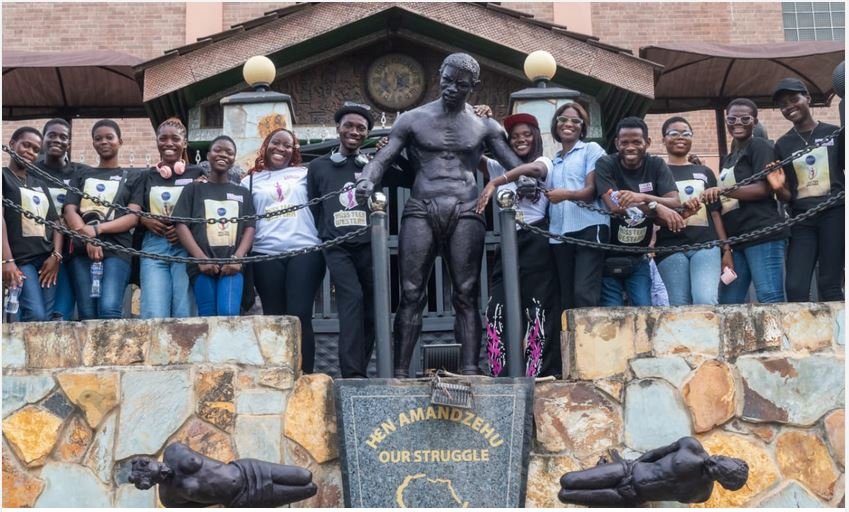
MTN Ghana has hosted more than 200 students from various educational institutions in Accra for an engaging, hands-on technology immersion at MTN House, bringing classroom theory to life and fueling interest in STEM and digital innovation.
Students from Ashesi University, Ghana International School, Cradle Star Academy, and Kinderland School explored MTN Ghana’s rich history, core values, customer-focused innovations, and digital transformation agenda.
They were introduced to the company’s sustainability and social impact initiatives, spanning education, youth empowerment and community development. A key highlight of the visits was a tour of MTN Ghana’s Network Operations Centre (NOC) and data centres.
The students gained first-hand exposure to the advanced technology, systems, and expertise powering seamless connectivity for millions daily – offering a rare look into how MTN ensures network performance, security, and resilience.
Speaking on the initiative, the Chief Corporate Services and Sustainability Officer at MTN Ghana, Adwoa Wiafe, noted, “Hosting students at MTN House reflects our commitment to shaping Ghana’s digital future. As we deliver our Ambition 2030 strategy, we are deepening investments in youth development through programmes like the Bright Scholarship, the MTN Digital Skills Academy, and collaborations on the One Million Coders Programme and the Girls in ICT initiative led by the Ministry of Communications, Digital Technology and Innovation.”
Paschal Paaga, Manager for IT Projects Implementation, emphasised the importance of experiential learning.
‘’By opening our doors, we are helping to bridge the gap between academia and industry. We want young people to see the real-world impact of technology and be inspired to pursue careers in STEM.”
For many participants, the experience was transformative. Maame Sapomaa, a Level 300 Information Systems student from Ashesi University, shared, “The visit was incredibly inspiring. Everything we have learned in the classroom came to life, and we were exposed to new concepts beyond our studies. It has motivated me even more to pursue a career in technology.”
As MTN Ghana advances its Ambition 2030 vision, the company remains committed to driving digital inclusion, platform-led innovation, and building strategic partnerships that support Ghana’s long-term socio-economic development.
Conflict at work is more common than you might think. According to 2022 research by The Myers-Briggs Company, more than a third of the workforce reports dealing with conflict often, very often, or all the time in the workplace.
Addressing a dispute might feel tense or awkward, but resolving the conflict is typically well worth it in the long run. Whether you are trying to mediate conflict between colleagues or are directly involved. Last week we looked at three and this week is the remaining four steps you can take to manage workplace conflict.
4. Find common ground
The best way to handle workplace conflict is to start with what you can agree on. Find common ground between the people engaging in conflict. If you are directly involved in the conflict, slow down and focus on results instead of who’s right.
If you are the mediator for conflict resolution between coworkers, observe the discussion and help point out the common ground others may not see.
5. Collectively brainstorm solutions
When deciding how to handle workplace conflict, it can be tempting to problem-solve on your own. Sometimes, it feels easier to work independently rather than collaboratively. However, if you want to achieve a lasting resolution, you will need to motivate your team to get involved.
Brainstorm possible solutions together, and solicit input from everyone involved on the pros and cons of each option until you settle on a solution that feels comfortable to everyone. This will help all team members feel a sense of ownership that can help prevent future conflicts.
6. Create an action plan
Once you have created an open dialogue around workplace conflicts, it is time to resolve them. Just like any other work goal, this requires creating a concrete plan and following through.
Create an action plan and then act on it. It does not matter what the plan is, as long as you commit to it and resolve the conflict as a result.
7. Reflect on what you learned
All conflicts offer an opportunity to grow and become a better communicator. Identify what went well and what did not.
Work with your whole team to gather learnings from the conflict so you can avoid similar situations in the future.