Hot!
Don’t leave Ghana; stay and help the people – Gov’t appeals to nurses

- /home/u249204778/domains/spectator.com.gh/public_html/wp-content/plugins/mvp-social-buttons/mvp-social-buttons.php on line 27
https://spectator.com.gh/wp-content/uploads/2022/05/Nurses-in-Ghana-696x392-1.webp&description=Don’t leave Ghana; stay and help the people – Gov’t appeals to nurses', 'pinterestShare', 'width=750,height=350'); return false;" title="Pin This Post">
- Share
- Tweet /home/u249204778/domains/spectator.com.gh/public_html/wp-content/plugins/mvp-social-buttons/mvp-social-buttons.php on line 72
https://spectator.com.gh/wp-content/uploads/2022/05/Nurses-in-Ghana-696x392-1.webp&description=Don’t leave Ghana; stay and help the people – Gov’t appeals to nurses', 'pinterestShare', 'width=750,height=350'); return false;" title="Pin This Post">
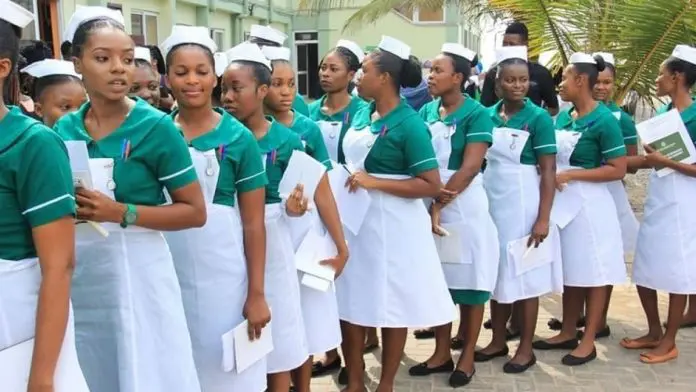
The Government of Ghana has appealed to nurses and other health professionals not to leave Ghana to other countries to seek greener pastures.
Presidential Advisor on Health, Dr Anthony Nsiah-Asare has told the nurses that Ghanaians are looking up to them to meet their health needs in the country hence they should stay.
His comments come at a time the General Secretary of the Ghana Medical Association (GMA), Dr Titus Beyuo earlier revealed that medical doctors and nurses are leaving the country in droves.
Dr Beyuo said brain drain has returned to the medical profession in Ghana.
Speaking on the New Day show on TV3 Wednesday May 11, Dr Beyuo said “…as we speak, doctors, nurses are leaving this country in droves, brain drain has returned in full swing.
“I know that because I am the General Secretary of the GMA, I wont give you figures immediately,” he said when asked by host Roland Walker to mention how many have so far left the country.
He added “But I can give you some examples, I will give you a unit in one hospital I won’t name, a big hospital in Accra, from January till now, five doctors have left that unit
“We need to do something about it deliberate in this country.”
Addressing nurses and other health professionals during the International Nurses Day, in Accra on Thursday May 12, Dr Nsia Asare said “I think the unethical way that the developed countries are trying to take our scarce health resources of this country is not the right thing to do. Ghana, like other developing counties, is seeing an increase in migration of our professional nurses to high income countries like United States, United Kingdom, Australia, Canada and other countries as a result of the global shortage of nurses, caused partly by the impact of the coronavirus.
“This trend is quite worrying and it amounts to massive public subsidy to the wealthier nations, so we are subsidizing their health care system, given the fact that nursing education in Ghana is is mainly publicly financed , it also threatens to worsen the nurse-patient ratio and for that matter our ability to accelerate our progress towards universal health coverage which is a top priority of this government .
“I know many of our professional nurses continue to yearn for greener pastures beyond the shores of Ghana. I wish to take this opportunity to encourage all of you to stay like us and to contained to the development of our country health sector. Bear in mind that Ghanaians are looking up to you in their quest to maintain their health.”
By Laud Nartey|3news.com|Ghana


A 24-year-old tricycle (Pragyia) rider, has been jailed three months by the Nkawie Circuit Court in the Atwima Nwabiagya South Municipality of the Ashanti Region for biting a Community Police Assistant (CPA) at Nkawie.
Abdul Aziz pleaded guilty to the charge of negligently causing harm and was convicted on his own plea.
Police Inspector Kwaku Frimpong, prosecuting told the court presided by Mr Robert Addo that, complainants in the case were officers from the Nkawie Divisional Motor Traffic and Transport Department (MTTD) of the Ghana Police Service.
He said on September 3, at about 8:40am, the complainants led by Chief Inspector Abedi Larbi, were on their official patrol duty to ensure safety at Nkawie township and met the convict, who was in-charge of a Pragya tricycle with registration number M-25-A-3722.
He explained that, after a careful inspection, it was detected that the convict was without licence and other required documents, so Alhassan Seidu, the CPA, was instructed to lead him to the office for the next action.
On their way to the office, the convict took a different direction, so the CPA directed him to take the right route to the police station, but he disobeyed and attacked the CPA, resulting in a struggle between them.
In the process the convict bit the CPA on the chest, so he shouted for help and some nearby youth rushed to the scene and helped him to arrest the convict.
In his caution statement, he admitted the offence and after further investigations he was charged and brought before the court. –GNA
SKIP THE QUEUE, TAP THE NEWS
You can now read the Ghanaian Times and The Spectator newspapers from the comfort of your device via TimesNewsPlus.
Join our WhatsApp Channel: https://whatsapp.com/channel/0029VbBElzjInlqHhl1aTU27

The New Patriotic Party (NPP) has urged the government to place all 54,985 candidates affected by the 2026 Basic Education Certificate Examination (BECE) placement exercise in schools and publish the final outcome.
The party says the government must ensure that the affected candidates secure actual school places rather than merely being allowed to access the self-placement portal.
In a statement signed by the Chairman of the NPP Policy Co-ordination Committee, Kojo Oppong Nkrumah, the party expressed concern about the situation facing the candidates.
The NPP said the government had announced that 53,887 of the affected candidates could use the self-placement system after initially being told that they had not qualified for secondary school.
It, however, argued that access to the portal did not guarantee that candidates would secure their preferred schools or programmes.
“Ghanaian parents and candidates will judge the resolution of the challenge by one thing only: how many of the original 54,985 are sitting in a classroom, not how many were allowed to open a website,” the statement noted.
The party said the government’s own figures showed that the country had 859,828 declared vacancies for 623,072 BECE candidates.
It explained that the main challenge was the concentration of demand in a small number of highly subscribed schools.
The NPP noted that 313,283 candidates selected Category A schools as their first choice, while those schools had 76,417 declared vacancies.
It therefore called on the government to explore ways to improve schools with available spaces, including providing teachers, laboratories and better programmes.
The party urged the government to use the 85 private schools participating in the Free SHS programme to absorb candidates who remained without placements.
The NPP further called for clarification of the rule and pass mark used for this year’s placement exercise, saying parents were entitled to know the standard before their children sat the examination.
It urged the government to take urgent action to ensure that the affected candidates were not left behind in the transition to secondary education.
By: Jacob Aggrey