Hot!
CEMLAWS organises workshop on transparency and accountability

- /home/u249204778/domains/spectator.com.gh/public_html/wp-content/plugins/mvp-social-buttons/mvp-social-buttons.php on line 27
https://spectator.com.gh/wp-content/uploads/2023/12/IMG-20231212-WA0102.jpg&description=CEMLAWS organises workshop on transparency and accountability', 'pinterestShare', 'width=750,height=350'); return false;" title="Pin This Post">
- Share
- Tweet /home/u249204778/domains/spectator.com.gh/public_html/wp-content/plugins/mvp-social-buttons/mvp-social-buttons.php on line 72
https://spectator.com.gh/wp-content/uploads/2023/12/IMG-20231212-WA0102.jpg&description=CEMLAWS organises workshop on transparency and accountability', 'pinterestShare', 'width=750,height=350'); return false;" title="Pin This Post">
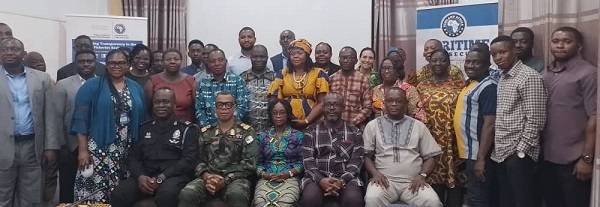
A day’s workshop aimed at disseminating the findings on transparency and accountability in Ghana’s fisheries sector project has been held in Accra.
Organised by the Centre for Maritime Law and Security (CEMLAWS) Africa yesterday, the transparency and accountability in Ghana’s fisheries sector project was funded through the Bloomberg Philanthropies Vibrant Oceans project titled: Enhancing Transparency in the Fisheries Sector of Ghana.
The project which was carried out in four African countries including Ghana sought to evaluate transparency and accountability gaps within the fisheries sector, with a focus on governance and policy framework.
According to the Programmes Manager at (CEMLAWS) Africa, Dr Rebecca K. Essamuah, although there had been transparency by the government in the fisheries sector, more could be done to improve it.
She explained that transparency mechanisms in the fisheries sector could be improved by making information more available, and including stakeholders in decision-making for their voice to be heard.
Dr Essamuah further underscored the need to have a concerted effort that was geared towards achieving a sustainable fisheries sector as efforts to meet transparency goals were scattered.
In addition, she noted that the project had three main objectives which were to assess the transparency and accountability, to assess the functional information-sharing mechanisms and to find out how transparency was being held across the regions in terms of governance and enforcement in the fisheries sector.
The Board Chairman of the Fisheries Commission (FC), Professor Francis Nunoo noted that his outfit was collecting data on fisheries to help improve the inland fisheries sector.
This, he said, was important due to limited data in the inland fisheries sector compared to the marine fisheries sector.
.
Prof Nunoo further bemoaned how information or data obtained from the FC by stakeholders in the fisheries sector and individuals were often misinterpreted and therefore recommended a formal engagement with stakeholders in the fisheries sector to better explain the data obtained to them as the sector was the least understood in West Africa.
He asserted that although the government had supported the FC over the past years, the FC still faced challenges in terms of data collection which affected its operations.
The Board Chairman therefore urged the government to assist the FC by providing it with adequate resources to help in data collection to help the FC manage the fisheries sector effectively.
The Minister of Fisheries and Aquaculture Development (MoFAD), in a keynote address read on her behalf by a representative from the MoFAD noted that good governance, transparency, and accountability were essential for the sustainable management of natural resources in Ghana, including fisheries and aquaculture.
The Minister emphasised government’s commitment to improve transparency and accountability in the fisheries sector by collaborating with stakeholders in the implementation of fisheries policies, plans and management measures.


General Secretary of the New Patriotic Party (NPP), Justin Kodua Frimpong, has filed his nomination to contest the position of General Secretary again as the party begins its rebuilding efforts ahead of the 2028 general elections.
He was accompanied by party stalwarts and supporters who were in high spirits, expressing confidence that he is the right person to hold the position.
Speaking after filing his nomination, Mr Kodua Frimpong assured the rank and file of the party that he would not disappoint them.
“I can assure you that the faith the rank and file of the party have had in me, I will never disappoint them,” he said.
He also pledged to run a clean campaign devoid of personal attacks.
“I can assure you that our internal campaign will be devoid of personal attacks,” he told his fellow contestants and the rank and file of the party as he seeks to retain his position.
His tenure has seen the party through the 2024 general elections, where the NPP lost power to the National Democratic Congress (NDC) after eight years in government.
The party is currently in a rebuilding phase, with internal elections scheduled to elect new national executives to lead its reorganization towards the 2028 polls.
The General Secretary position is considered one of the most influential in the party’s administrative structure, responsible for the day-to-day running of the party secretariat and implementation of party decisions.
By Edem Mensah-Tsotorme

The University of Ghana Medical Centre (UGMC) has disputed claims made on social media by comedian Michael Blackson concerning the treatment given to his late mother, saying a review found that the allegations did not accurately reflect what happened during her stay at the hospital.
In a statement issued in Accra on August 5, 2026, the management of UGMC expressed condolences to Mr. Blackson and his family over the death of his 83-year-old mother, who died at the facility on July 16, 2026.
The hospital said it had taken the concerns raised by Mr. Blackson seriously and conducted a thorough review in line with its clinical and administrative procedures.
According to the statement, the facts presented by Mr. Blackson on social media contained “numerous inaccuracies” and did not accurately reflect the medical care provided to his mother.
UGMC explained that she was referred to the facility from another hospital and received treatment there from May 27 to July 16, 2026, a period of about eight weeks.
The hospital stated that it would not release details of her diagnosis, treatment, medical records or other aspects of her care because it had a duty to protect patient confidentiality, even after death.
It said the decision was intended to respect the dignity of the deceased and the privacy of her family.
UGMC further stated that all clinical decisions at the facility are made by qualified healthcare professionals based on medical judgment, established standards of care and the best interests of the patient.
The statement added that such decisions are made in consultation with authorised family representatives where necessary and that billing and financial procedures are governed by institutional policies and are separate from clinical decision-making.
The hospital noted that it values feedback from patients and their families and considers both positive and negative comments important for improving the quality of care.
Mr. Blackson had earlier used social media to criticise the care his mother received at UGMC, prompting the hospital’s response.
By: Jacob Aggrey