Features
Black Stars’ early kayo and unfolding dramas

It was Friday, December 2, 2022, the venue was the Al Janoub Stadium in Qatar and the event was a crucial match to determine who qualifies to the Group of 16 stage of the 2022 World Cup tournament, between Ghana and Uruguay, both of whom are in Group H, considered a group of death in the on-going world soccer fiesta. Ghana, with three points ahead of Uruguay and South Korea, and lying second on the league table, needed a win or a draw to advance to the knockout stage of the competition. Portugal, with six points to its credit, topped the group and, therefore, firmly secured to advance to the group of 16 stage of the competition.
GHANAIANS HOPEFUL FOR TEAM’S ADVANCEMENT
Considering the drama that unfolded in the 2010 World Cup tournament in South Africa, in which certain Luis Suarez of Uruguay made it impossible for Ghana to advance to the semi- final stage of the competition, using his hands to clear the ball from the goal post of which the resultant penalty was wasted by Ghana’s captain and prolific goal poacher, Asamoah Gyan, Ghanaians were hopeful that, this was the time for a possible revenge and that victory would be ours at all cost. Connoisseurs of football, have tipped Ghana to win that match and advanced to the next stage of the competition, in view of their three points advantage over Uruguay and South Korea, who had a point each.
Days before that match and after the match itself on Friday, December 2, 2022, there had been a series of drama from certain personalities including former Black Stars player during studios’ discussions, thus, hyping tension among Ghanaians in that particular encounter.That game itself, looked as if Ghana had reached the finals of this tournament and that Ghana was heading for the golden trophy. The whole country was quiet like a catacomb, as Ghanaians were glued to their television sets to watch that crucial encounter, waiting for victory to come so that the country could explode in joy and ecstasy. But that was not to be, as Ghanaians were given the shock of their lives by conceding two goals to Uruguay. It was a painful defeat and I am sure that many households lost appetite for supper and slept early.
EMERGING DRAMAS THAT UNFOLDED
The emerging dramas that unfolded after the defeat, were unimaginable and difficult to comprehend. People shed tears uncontrollably, some husbands refused to talk to their wives due to intense anger, while others shaved their hairs and beards to register their protests and anger. Perhaps, what could console Ghanaians a little, was the inability of Uruguay to use their score line to advance to the knockout stage of the competition because South Korea was able to beat Portugal 2-1 and advanced on basis of head-to head to the knockout stage of the competition.
It was painful and emotional spectacle, when veteran Sports journalist, writer and commentator Mr. KwabenaYeboah, was spotted in tears on a national television studio. That sad moment occurred during a GTV studio discussion, leading to the match between Ghana and Uruguay in Qatar’s ongoing World Cup tournament. Kwabena Yeboah and other studio panellists including John Painstil, former Black Star player, were all emotional, when a video of Suarez handling the ball out their goal post in the 2010 World Cup tournament in South Africa, and that of Asamoah Gyan, missing his penalty was shown on the television screen.
Another worrying drama, involved a former Black Stars midfielder, Emmanuel Agyeman-Badu, who had his hair shaved on national television, following Ghana’s loss to Uruguay. The former Udinese player, had to fulfil his promise of getting his hair shaved, should Ghana fail to qualify to the knockout stage of the competition. When the game finally ended with Ghana losing 2-0 to Uruguay, Agyemang-Badu had to eat his humble pie by honouring his promise. A barber was invited into the TV 3 Studio, who immediately cleared all the hair off the head of Agyeman-Badu, who currently plays for Accra Great Olympics in the national premier league.
It is recalled that a few weeks ago, Agyemang-Badu made a bold declaration in the studio of TV 3 that, Ghana was going to qualify to the group of 16 stage of the competition at all cost. Hear him, “With set pieces, we are progressing well over time. We are not yet in the air. We now have a sturdy bench. I am not certain that this will lose their chance to advance from the group. If they don’t, I will shave off all my hair on live TV”.
OTTO ADDO’S RESIGNATION
What is most astonishing and shocking to Ghanaians was the sharp announcement by Coach Otto Addo about his resignation in a post-match interview by the press. According to him, he had already indicated before the start of the World Cup that he would step down from his job after the competition, regardless of Ghana’s performance. As he put it, “Me and my family are happy in Germany. I said I would step down after the World Cup, even if we are world champions after the tournament. I have resigned my role as Ghana’s coach”.
Even though Coach Otto Addo has explained the reason for his resignation, the announcement was quite in a haste, as many Ghanaians will view it. You took your army to a battle front, and soon after you have been defeated, you have decided to leave them in the midstream by denouncing your leadership role. Why didn’t you wait for the team to return to Ghana before announcing your resignation as a coach? The cheek of it was to say that your family are better off in Germany. What do you take this country or Ghanaians for?
GFA TO TAKE THE BLAME OF HIS RESIGNATION
The blame should be placed at the doorsteps of the government and the football governing body, Ghana Football Association (GFA) who contracted this coach to lead the technical bench of the Black Stars. When he told the whole nation during the time of his recruitment that he was going to combine the Dortmund job with the Black Stars coaching job, many were those who thought that the handling of the team should be a full time job and, therefore, he should be allowed to choose between the two jobs, the one that was dear to his heart. That advice from Ghanaians was flatly ignored and the contract was awarded. At a point, he was operating from Germany and directing affairs of the team in Ghana and the GFA accepted that. Yes, he was able to help Ghana to qualify for the World Cup in Qatar at the expense of Nigeria, but that did not give him the impunity to do what he liked. Sometimes, the way he reacted to media interviews, showed some sort of arrogance in his utterances.
KUDUS DESERVES COMMENDATION
Coming to the game itself with Uruguay, the matured manner in which Mohammed Kudus, AFC Ajax Amsterdam player and Ghana’s standout performer in the Black Stars team, spoke to sports journalists in a post-match interview was so commendable. When quizzed about his general impression about the match as well as the penalty missed by Captain Andre Dede Ayew, this was what he had to say, “First I want to really thank Ghanaians. I know they are very disappointed right now, but I really want to thank them for their support from the start to today, even some flew all the way from Ghana to Qatar to support us. It has been incredible and we want to thank them for their prayers and support and we will keep improving as human beings and then we will do better next time”.
On Dede’s missed penalty, he said that was not the ultimate reason for Ghana’s defeat. He, however, said that missed chances including those from him could have changed the outcome of the game and aided Ghana to progress to the Round of 16. These were the intelligent remarks from a young and skillful player who had earlier on won the Budweiser Man-of-the Match award in a game in which Ghana beat South Korea by 3-2. In that hectic encounter, Kudus scored two important goals to earn Ghana the maximum three points, thus placing it initially, above Uruguay and South Korea. He later told the media that, the award had been dedicated to all his players, both on the field and on the bench. That was a matured statement from a youngster.
NURTURING THE YOUNG TALENTS
We have been exited from the ongoing World Cup tournament in Qatar, but we have not been disgraced. We have to put our acts together with these youthful, skillful and talented players and victory will be ours in future tournaments. We have to encourage and nurture these young players to bring honours to our country and to encourage more jubilations from Ghanaians including the Speaker of Parliament, Hon Alban Kingsford Sumana Bagbin.
Contact email/WhatsApp of author:
ataani2000@yahoo.com
0277753946/0248933366
By Charles Neequaye

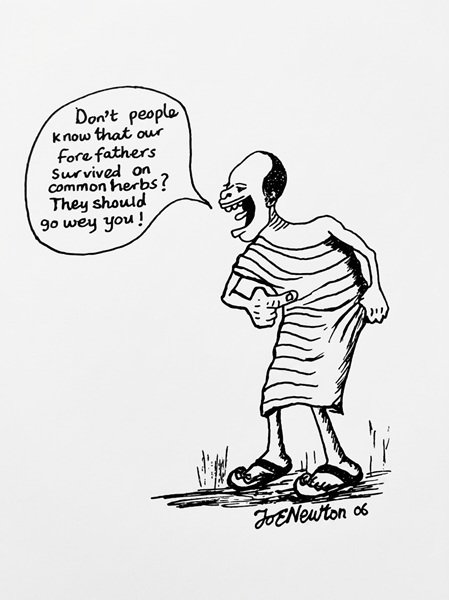
THE typical itinerant salesman in Sikaman is a herbalist. He is normally a slim macho with the capacity to perambulate the expanse of area covering the triangle of Accra-Tema-Ashiaman. In short, he can walk a total of 60 miles a day, marketing a product that cures every disease, including poverty. 
The door-to-door herbal pharmacist advertises his product by word of mouth. He has nothing to do with the Food and Drugs Board (FDB). After all, his concoctions do not feature on FM stations.
Those herbalists who cannot walk to propagate the herbal gospel, liaise with drivers of mass transportation and their mates. They are, therefore, given the chance to sell their products on Benz buses that ply the routes.
Normally, the herbalist starts his sales message with a prayer and Bible study. He asks the passengers to bow down their heads in supplication to God the father, the son, the Holy Spirit.
When a herbalist asks the passengers to close their eyes and bow their heads, Moslems on board naturally feel offended. They feel that the herbalist has no right to assume that every passenger is a Christian. They think such an assumption is an affront to Islam.
So a Moslem on board will raise the hand for a point of order. He’ll remind the herbalist that it would be in his own interest to mind his language.
“Be careful the way you address people in a public place. Not every person here is a Christian,” he’d state assertively.
Of course, the herbalist will promptly ignore him, but would all the same “watch” his tongue. Who knows whether or not the Moslem brother is inspired by Quoranic zeal to defend the tenets of Islam to the hilt?
When he starts saying, “Wallahi!” and “Inshallah!” it could be the beginning of proclaiming Islam as supreme, a point which must be driven home with talibanic precision.
So the herbalist must tread carefully lest he steps on fire.
The herbalist could even add a measure of mirth to it all, by announcing that Christians on board today have very interesting company on the journey, but that should not detract from the business of the day.
The Moslem brother will weigh the words carefully and offer a wry smile.
He must be careful the occasion does not degenerate into the use of semantics and proverbial oration to deride his conviction that public utterances must be mindful of religious sensibilities. He has made his point very clear and expects that it is taken in good faith in the interest of a peaceful journey.
The herbalist will now open the New Testament and preach salvation, stating clearly that salvation can come only through Jesus Christ and NOBODY else.
The Moslem brother will now start twitching his moustache. The visible and almost revolutionary reflexes of his upper lip can be an indication that sentiments have begun superseding reason, and the outcome could well be tragic now shift uneasily in his seat.
The time has come for him to also express his right to the religion of his fore-bears. He’ll put his hand into his pocket and rise to his feet. The time has indeed come!
This article was first published on Saturday, September 9, 2006
When the cause of a particular problem like sickness, disease, sudden illness, a social issue etc. are not known, it stands to reason that resolving it becomes a huge challenge.
Citizens would understand the government when public announcements are made to the effect that government is trying to find a solution to the issue, even though it is taking a while for it to be resolved because citizens are rational beings.
On the other hand, if the solution to a particular issue is known to everybody but the government for whatever reason, is dragging its feet in resolving it, citizens become frustrated and begin to lose trust in their leaders.
One such issue is the heavy traffic along a section of the Kasoa – Odokor road. A short stretch of bad road between the traffic light at the Weija Government Hospital and the entrance to the entrance of the overhead that leads to the N1, is the cause of the problem but nothing is being done about it, day after day, week after week, month after month. Thus is clearly unacceptable.
Another issue that requires urgent attention is the lack of pavements along a lot of streets in parts of the various Municipal Assemblies. Exercise is a prerequisite for long life and healthy living and for those of us who it has become a way of life, this issue of people putting up structures right to the edge of the drains beside the roads, are making life difficult for us.
We are compelled to walk along the roads, putting our lives at serious risk. Pedestrians should never be compelled to compete with vehicles on our streets and roads. Roads and streets are made for vehicles and pavements are made for pedestrians. That is the norm. Any attempt to normalise a situation where pedestrians are mingling with vehicles is insanity.
It is the road regulations that makes it so and therefore district or municipal assemblies are to take responsibility and ensure that spaces for pavements are not encroached upon. Citizens have rights that must be protected by their leaders and making pavements available to pedestrians, is one of them.
When we hear of teachers having sex with students, it appears it is something recent. It is not a new phenomenon. It has been there since Adam. Perhaps this issue is getting much attention due to the proliferation of social media. It was an open secret in times past when Teachers were in relationships with female students and some married them immediately after completion of school.
Some teachers were also known to be having unholy interactions with female pupils but due to the times that these acts occurred, human rights issues and the awareness around it, allowed such unscrupulous teachers to get away with their crimes.
Now we are in a different era and so a Headmaster is now in hot waters. He is alleged to have raped about 19 female students and as usual, some officials tried to cover it up and are also in hot waters and their actions or inactions in the matter are under investigation.
Why the man has been allowed to roam freely without being arrested is simply mind boggling. It appears that the law applies differently, depending on who you are. This issue came to public attention sometime in August this year, yet the police had not arrested or invited this man for question regarding the rape allegation.
It has come out that he is a Constituency Secretary of the ruling party and the question in the public domain is that, is it because he is a political figure that is why he is still walking around without questioning? I believe in the rule of law so let us hold our breadth and let the proper thing be done.
The police must however be seen to be active in this matter. God bless.
SKIP THE QUEUE, TAP THE NEWS
You can now read the Ghanaian Times and The Spectator newspapers from the comfort of your device via TimesNewsPlus.
Join our WhatsApp Channel: https://whatsapp.com/channel/0029VbBElzjInlqHhl1aTU27