Sports
Beyond the FIFA badges

- /home/u249204778/domains/spectator.com.gh/public_html/wp-content/plugins/mvp-social-buttons/mvp-social-buttons.php on line 27
https://spectator.com.gh/wp-content/uploads/2025/01/Ref-Serlom-Yao-Bless-left-receiving-his-badge-from-FA-President-Kurt-Okraku.jpg&description=Beyond the FIFA badges', 'pinterestShare', 'width=750,height=350'); return false;" title="Pin This Post">
- Share
- Tweet /home/u249204778/domains/spectator.com.gh/public_html/wp-content/plugins/mvp-social-buttons/mvp-social-buttons.php on line 72
https://spectator.com.gh/wp-content/uploads/2025/01/Ref-Serlom-Yao-Bless-left-receiving-his-badge-from-FA-President-Kurt-Okraku.jpg&description=Beyond the FIFA badges', 'pinterestShare', 'width=750,height=350'); return false;" title="Pin This Post">
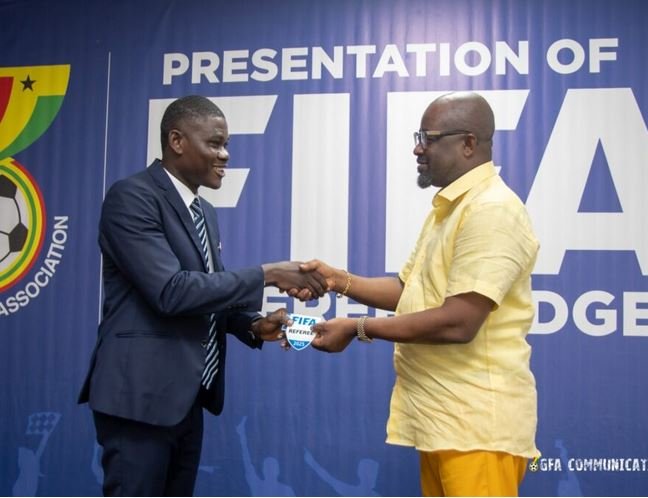
Twenty-two FIFA badges were presented to Ghanaian referees and assistants based on their performance from the previous year.
Historically, FIFA gives these Referees’ badges for the calendar year to the top ranked referees from the previous year who excel in both local and international matches.
And, owing to the importance of referees not only in sports but other spheres of life, it is important to congratulate them instead of attempting to denigrate the feat.
It is a major feat in every sense of the word. Selecting 22 from a field of hundreds of match officials across the country should tell us that these group of officials have done something good.
The recipients comprised 10 Centre Referees, 10 Assistant Referees, a Futsal Referee, Beach Soccer Referee, and Video Assistant Referee (VAR).
Officiating has been one of the most challenging areas in sports in Ghana, especially football and it is a global phenomenon.
In fact, the recent rift between the International Olympic Committee (IOC) and the International Boxing Association (IBA) leading to the latter’s split is as a result of ills committed by referees.
Football has not been spared of the controversies associated with officiating with announcement of referees’ sanctions flying around most of the time.
In the Ghana Premier League (GPL), it is a major worry for clubs, especially when they are faced with away matches where some of their calls beats one’s imagination.
A lot of the incidents that have clouded the game’s integrity in controversy have come from referee’s decisions with the unfortunate May 9 Accra Sports Stadium incident.
At the presentation ceremony, the Ghana Football Association (GFA) President, Kurt Edwin Simeon-Okraku, and General Secretary, Prosper Harrison Addo, congratulated the officials and made statement I found very profound.
“This is not to say that there have not been challenges. Refereeing is an art that has to grow continuously. On that journey of growth, there will be mistakes. On that journey of growth, there will be challenges.
“But when you are very motivated and your eyes are fixed on excellence, you continue to invest in yourself and to challenge yourself towards being much better at every given opportunity. That’s why I’m so happy about the performances you guys have put up on the African continent, especially. We will continue to push and to ask for more opportunities for you. And I hope that when such opportunities come, you will not disappoint us.”
The duo were right in their statements but what they failed to add were the roles expected of them to play in order to ensure that the performances of these referees are improved and make those investment in themselves.
Referees themselves have complained about treatment meted out to them on several platforms. They go for months without being paid their allowances.
In a funny and jovial manner, some shared how they take loans from their wives/partners to enable them travel to match destinations and return on that same money source.
If such a debt hangs around the neck of the referee, how can he get the concentration to interpret the laws of the game on the field of play?
The only way out for such a referee would be to officiate to the gallery of the home team who as host would make every pleasantry available to the referee – accommodation, feeding, money and others.
This is the reason why the FA must put in place the needed measures to ensure that the referees gets the needed support to improve their standards.
In cases when they are found culpable of some of the incidents that mars a game, they must be quickly sanctioned to serve as a deterrent to others.
By Andrew Nortey

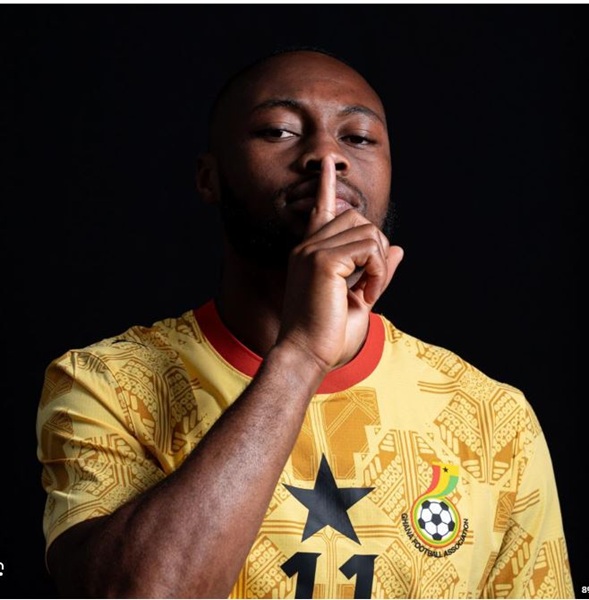
There couldn’t have been a more challenging moment for Black Stars coach, Carlos Queiroz than the situation he faced ahead of the commencement of the 2027 African Cup of Nations (AFCON) Group C qualifiers.
Apart from opening the qualifying campaign with two high-profile encounters against The Elephants of La Cote d’Ivoire, and following up with The Gambia, Queiroz has been hit hard by several player withdrawals.
As of press time, seven top players of the team had announced their withdrawals with just about two days to the Bouake ‘clasico’ where the Ivorians engaged Ghana in a tough clash that reminded fans of their historic meeting in the finals of the 1992 edition of the championship that was decided after a marathon penalty shoot-out.
Queiroz was forced to make late changes to his side as Mohammed Kudus, Thomas Partey, Antoine Semenyo, Captain Jordan Ayew, Prince Adu Kwabena, Alidu Seidu indicated their unreadiness to serve.
This group of players can be considered as the spine of the team, and without them, the team is weak, timid, putting their ability to face the Elephants in their own habitat in doubt.
From the players, several excuses –mostly on injuries and fitness, have been given for the decision and they expect Ghanaians to just accept that and move forward.
Before the withdrawals, Atletic Bilbao’s Inaki Williams also announced his retirement from international football. Fact is, what he actually wanted to tell Ghanaians is that he would not play for the Black Stars again.
Others like Kevin Prince Boateng have walked on this path with the Black Stars before, turning his back on Ghana after enjoying his World Cup experience.
For the two, there would have been no World Cup experience without the opportunities presented by the Black Stars.
All of these are pointing to a particular trajectory which the Ghana Football Association (GFA) must be seen to be finding solutions to.
Clearly, it is showing a pattern where either players are becoming selective with the games they play or beginning to see the AFCON as an inferior championship.
Maybe what every Black Stars player must be reminded about is the fact that Ghana’s credentials at senior level were achieved through efforts at the AFCONs and not the World Cup which Ghana’s maiden qualification came in 2006.
At the AFCON, Ghana boasts of four trophies and considered heavyweights although recent history shows otherwise. For the World Cup, all the Black Stars have to show for is the quadrennial $100,000 appearance fee bonanza.
And if they don’t know, they must be told that those paydays don’t affect Ghana’s position on the FIFA rankings.
Maybe, the recent withdrawals should spark the conversation to let the Black Stars understand that just as they strive to make a name for themselves at the World Cup, fans back home equally demand same for the AFCON that presents a better chance for silverware than the World.
The FA must not entertain these excuses on the face value. They must verify some of the claims and excuses to ensure future withdrawals can be controlled. What is needed for the team to thrive is commitment and dedication at all platforms. Anything less will spell doom for the Black Stars.
By Andrew Nortey
The driver stopped the vehicle at the gate of the big fenced property along the Nsawam Highway, and Kakraba stepped out to meet the several workers who had gathered to wait for him. He greeted them and went to straight to the point. ‘Gentlemen, I am glad to see that you have almost completed the clearing of the land. I’m happy to report that we have concluded all arrangements with Nana Serebour, and construction of the palace will start in a few days.
I will need you to go and level the ground, and come back to start this project. Some workers from a construction company will come and join us to start the project. My plan is to build twenty houses in four months, then we will do twenty more until we reach two hundred.
I am relying on you to help me deliver good quality work to satisfy our clients, and as I have already indicated to you, I will reward you for your work’. After an hour’s discussion, he closed the meeting and moved to drive away. Wofa Yaw drew closer.
‘Director, can you please spare me five minutes? I would like to discuss a small issue’. ‘Why Wofa Yaw, your wife has threatened to leave you?’ ‘No, Director’. My wife will never leave me. This concerns a young niece of mine’.
‘I hope it’s something I can help with. Please sit in the car and let me hear you’. ‘Boss, my niece Beesiwa is a polytechnic graduate, very beautiful and with very good character.
Unfortunately, her parents virtually forced her into a relationship with an idiot based in the US, which impacted her badly. She has now recovered from that experience, and boss, I am respectfully asking if you would find a job for her.
I promise you that you will never regret it’. ‘Well, Wofa Yaw, let me meet her and speak with her. I may be able to help, maybe not in the way you will expect, but let me meet her. I will not be back here till after a week, but I will be at the office the whole of next week. You can come with her’.
‘On Monday morning, Wofa Yaw and Beesiwa were seated at the office by nine. Three young ladies welcomed them warmly, offered them soft drinks, and assured them that Kakraba would be there shortly, and got seated behind computers with large screens showing various building designs. Kakraba walked in and greeted them warmly, and after chatting with the three ladies, he ushered Wofa Yaw to his office’. ‘Director, this is my niece, Beesiwa. I mentioned her to you when you came to Nsawam’. ‘Yes indeed. Madam Beesiwa, you are very beautiful, as your uncle said. Wofa Yaw is my colleague.
We have just started a building project that will take about three to four years. He mentioned that you have a very small problem, so I said I would like to meet you, and see how I can help. So Beesiwa, please tell me a little about yourself’.
Beesiwa described her childhood, her school experience, her brief work at the bank, and the nasty episode with Sammy Abrokwa which shattered her peaceful life, and how she had been recovering’.
‘I am really sorry to hear this. Now, here is what we are going to do. We are a small but very busy company. The three ladies over there spend most of the day on site, and come back to report on their work in the morning.
I have three main projects. The big one is an estate project in Nsawam, where your uncle is one of my main colleagues. I need a personal assistant who can take care of my activities, especially when I am not in town.
Now, we will have to start with trust. Based on what I know about Wofa Yaw, and based on what you yourself have told me, I think we can start on a sound basis. So, Wofa Yaw will take you to my home. You can move into one of the four guest rooms. I will give you a good phone and a laptop. I will arrange computer lessons for you’. ‘Sir, I have taken some computer lessons, and I have even done graphics and web design’. ‘Fantastic! Now, Wofa Yaw, take her home. My sister Kuukuwa will meet you and show you round, and you can return to Koforidua. When would you like to start work?’ ‘Sir, I would like to start today, but I would need to go and bring my things’. ‘No problem. Take a taxi to my house, meet my sister, and let me know what you decide’.
Kakraba and the three ladies met with some bank officials to conclude on the sale of the three buildings at Adabraka.
They closed at five-thirty, and after rewarding the ladies for their hard work, he got home just after dark. He was surprised to find Kuukuwa and Beesiwa sitting at table enjoying supper. ‘What’s happening here?’ her said. ‘Beesiwa, I thought you would return to Koforidua?’ ‘She changed her mind’, Kuukuwa said. ‘We went to the Mall and bought a few things for her, and we came back to cook. She has made some nice changes to your bedroom. And she cooked a couple of interesting things. Sit down, we will serve you’.
‘Well, I certainly can’t refuse that. It’s been a busy day. So what’s the plan now? Will Beesiwa go to Koforidua tomorrow, gather her stuff together and come down? ‘No, I will stay here for a while. Kuukuwa bought me things that I need, so I may go back next week. I’m ready to start work. What would you like me to start with?’
‘Well, you can come to the office tomorrow morning, meet the three girls and get a feel of what we do. Since you are living here, at least for now, we can discuss the plans for the next few weeks. Sometimes there are gaps when I travel up north. You can take care of things from now. I think the girls would like having someone like you around’.
SKIP THE QUEUE, TAP THE NEWS
You can now read the Ghanaian Times and The Spectator newspapers from the comfort of your device via TimesNewsPlus.
Join our WhatsApp Channel: https://whatsapp.com/channel/0029VbBElzjInlqHhl1aTU27