News
Anna Gertrude Yankah clocks 105…still counting

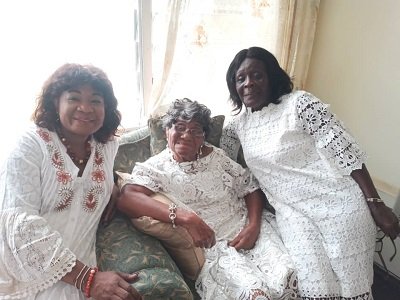
With life expectancy at 65 years for female in Ghana, it is just divine providence that Madam Anna Gertrude Yankah, the former Headteacher of Korle Gonno Catholic Boys School, clocked 105 years on Tuesday, November 2.
Born November 2, 1916, at Atuabo in the Western Region, as twince, Anna Yankah outlived her sibling who passed in to eternity at the age of 90years.
Although the COVID-19 restriction on social gathering has limited the pomp and pageantry that would have gone with her birthday celebration, close family relations rallied around to celebrate her and to give glory to God for her longevity.
When The Spectator touched her home at Nungua on her birthday on Tuesday, Anna Yankah looked hale and hearty and was able to tell her birthday and names of her children.
Her last daughter Ms Baaba Yankah-Oduah, who is 68 years old praised God for the life of her mother.She made a passionate appeal to the government to honour people like her mother for their service to the country, since they could easily be identified on the pension payroll.
“The government can say thank you,” Mrs Yankah-Oduah said.
A Ghanaian world renowned Senior Consultant Cardiothoracic and Vascular Surgeon, whose uncle was Anna Yankah’s husband sent a congratulatory message to her from his base in German by phone told The Spectator that “it is a great day and great achievement in Ghana and in Africa for one to live up to105 years” and commended her for keeping her life fit.
Gertrude was born a twin at Atuabo in the Western Region to Mr Alfred Bimpeh-Sequ, a Customs Officer in the Gold Coast and Madam Elizabeth Bimpeh-Sequ (Nee Otu). In 1922, the family moved to Accra where she and her twin sister, Mary attended the Government Girls’ School.
After attaining her Standard Seven (7) certificate, her father vetoed that she train at the Midwifery School at the Korle Bu Hospital which she did but for only a semester.
She sat for the end of semester exams and excelled and when a friend of her father read the results on the hospital board, he quickly communicated the results to her father and it was at the time of her father congratulating her that she expressed the desire to quit the midwifery course and take up sewing as a profession.
She learnt to sew and was particularly busy during the Empire Day activities, sewing dresses for a great number of teachers for the march-pasts. In 1936, she incidentally sewed a shirt for Rev Fr Bronk at the Sacred Heart Parish at Derby Avenue.
Satisfied with her sewing prowess, he recommended her to teach Needle Work at the St. Joseph Catholic School at Adabraka.
In the course of her teaching, she sat for the Teachers Examination in 1938 and became a full-fledged teacher teaching other subjects besides needlework. In 1943 she was transferred back to the Sacred Heart School, Derby Avenue where she taught till 1948.
It was during that period that she married and became Mrs Anna Gertrude Yankah but popularly called Teacher Akweley. In 1948 she joined her husband also a Teacher (but in Anglican Schools) on transfer to Saltpond.
At Saltpond she taught with two lady teachers, Teacher Mary Mensah-Brown (later became Mrs. Hindson) and Teacher Emelia Attah-Fynn who had just started a newly founded Catholic Girls School. In 1950 her husband left the teaching field to join a newly formed Social Welfare and Mass Education Department recruiting trained teachers for Adult Education and Community Development at Winneba.
She, therefore, left Saltpond at the end of 1949 back for Accra to take up teaching again at the St. Joseph Catholic School Adabraka. In 1951 while her husband was engaged in Mass Education and Community Development programmes in the Central Region, she had to transfer to Cape Coast with the children and taught for six months at the Catholic Jubilee Boys School.
At Saltpond and Cape Coast she was affectionately known as Teacher Anna.
At the end of 1952 she decided to leave the teaching field and join her husband at Mass Education doing more of adult education at Winneba until 1955 and later at Akim Oda until 1957.
Between 1958 and 1960 she took a break from the Mass Education work and in 1961 went back to the teaching field this time as a Head Teacher in a government school (The Sarkodie Primary School) because there was no vacancy in the Catholic Schools at Koforidua for a head teacher.
So for the first time in her life she taught for seven years in a non-Catholic school.
Her husband left Social Welfare in 1967 to co-start the Commercial Department of the Ghana Broadcasting Corporation.
So in 1968, she was back in Accra and as a Head Teacher of the Korle Gonno Catholic Boys School.
A position she held until her retirement in 1974.
By Salifu Abdul-Rahaman

News
GES directs Ashanti Regional, Obuasi Municipal Education Directors to step aside over Obuasi SHTS scandal
The Management of the Ghana Education Service (GES) has directed the Ashanti Regional Director of Education, Dr. William Amankrah Appiah, and the Obuasi Municipal Director of Education, Mr. Kwamena Owusu-Nketiah, to step aside with immediate effect.
The directive forms part of ongoing investigations into allegations of sexual misconduct involving the headmaster of Obuasi Senior High Technical School (SHTS), Mr. Zakaria Abdulai.
According to GES, the decision is intended to ensure that the investigations proceed without potential interference, nor the perception of it.
The two directors are to hand over their offices and all state property in their possession to the Deputy Ashanti Regional Director of Education, Mr. Thomas Kwame Boateng.
Management added that the headmaster, Mr. Zakaria Abdulai, also remains interdicted and therefore urged the public to ignore any news circulating that he has been cleared.
Management is calling for calm, support and cooperation as thorough investigations into the matter continue.
By Edem Mensah-Tsotorme
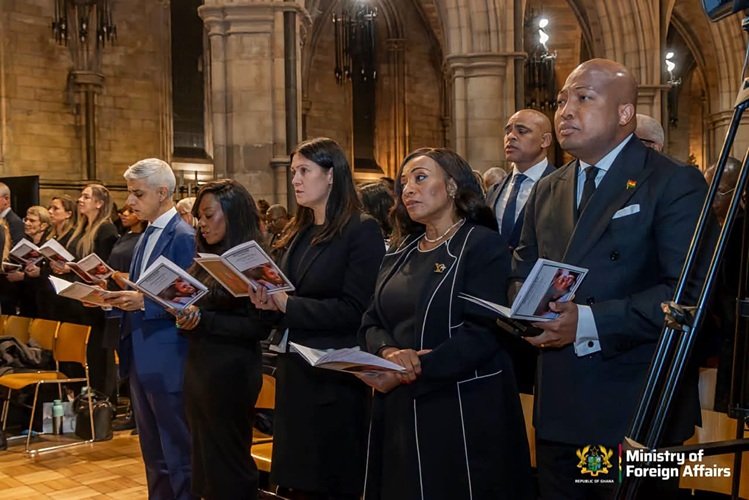
The Minister for Foreign Affairs, Samuel Okudzeto Ablakwa, has joined the family of the late Professor Jason Atta Kwei Arday, the Ghanaian community in the UK, and other dignitaries for a memorial service in Southwark, UK.
In a post, Mr. Ablakwa described the service as deeply moving and unforgettable, held in honour of the late professor’s memory.
According to him, in keeping with the government’s pledge, he joined the family, Ghana’s High Commissioner to London, British MPs, Ministers, the Mayor of London, Cambridge scholars, Prof. Arday’s students and loved ones to pay respects and honour his inspiring legacy.
Mr. Ablakwa noted that Prof. Arday’s accomplishments as the youngest Black professor appointed at the University of Cambridge and his widely appreciated charitable contributions will continue to inspire generations.
“The Government and People of Ghana will continue to stand by our compatriots everywhere they are in the world. As we do so, we profess our commitment to justice, equality and the creation of a new world,” he said.
He prayed for fortitude for the family in what he described as an extraordinarily difficult time.
“We shall always remember Prof. Arday for his response when asked what he will wish to do to change the world: ‘I would take a thread and a needle, and I’d interweave love into our society’,” Mr. Ablakwa added.
By Edem Mensah-Tsotorme